🦴 PREHISTORIC
🦴 Smilodon fatalis • Machairodontinae
VA Science SOL 2.5, 3.4, 3.5, 5.8 (Fossils, Adaptations & Earth History)
Smilodon (Saber-Toothed Cat)
Ice Age Ambush Hunter With Curved Sabers
Grade 5 • Advanced • 328 words
🌋 Geologic Period & RegionPleistocene Epoch (2.5 MYA–10,000 YA) • North & South America
📏 Size & Weight3.3 ft (1 m) tall at shoulder • 350–620 lbs (160–280 kg)
🦴 Diet & FossilsApex Carnivore • Rancho La Brea Tar Pits fossils
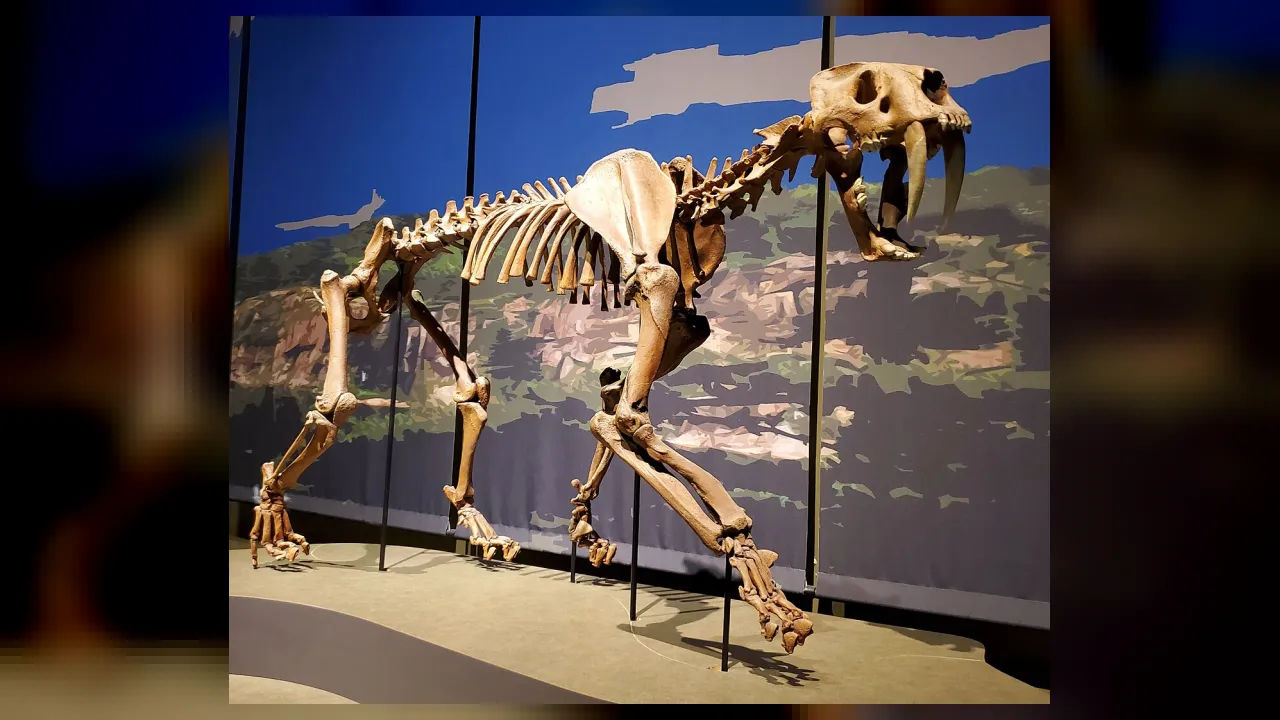
⚡ Survival SuperpowerSeven-inch serrated canine teeth paired with bear-strong front legs
🤯 Mind-Blowing Fact • Grade 1
Smilodon could open its mouth wider than a modern lion—almost like a wide yawn of 120 degrees!
✨ Word Sparks (Grade 1 Glossary)
Tap 🔊 to hear
saber
a long, curved blade or tooth shape
ambush
hiding quietly and jumping out by surprise
fossil
ancient bone or print saved in earth
🪝
What cat had teeth as long as bananas?
1
Two Giant Teeth
Hush! Tall dry grass shakes in the wind. Out steps a big Ice Age cat called Smilodon. Two long curved teeth peek past its chin. Each tooth is as long as a banana!
2
Built Like a Bear
This cat did not run far like a cheetah. It had thick, heavy legs like a strong bear. Its tail was short like a bobcat tail.
3
Hiding in Brush
Smilodon hid behind bushes and tall grass. It waited quietly and leaped fast. bones in sticky tar pits tell us its story today.
California made Smilodon its official state fossil because more than two thousand individuals were found in Los Angeles!
✨ Word Sparks (Grade 2 Glossary)
Tap 🔊 to hear
canine
a pointed front tooth used for gripping
asphalt
thick, sticky black tar from the ground
skeleton
all the bones that support a body
🪝
Is a saber-toothed cat really a tiger?
1
Not Really a Tiger
Picture an Ice Age meadow filled with giant bison and wild horses. Crouching low in the bushes is Smilodon! People sometimes call it a saber-toothed tiger, yet it was not closely related to modern tigers at all.
2
Super Strong Shoulders
Smilodon had muscles like a wrestler. Its front legs and shoulders were much thicker than a lion's legs. Because its famous seven-inch saber teeth were thin and flat, it used its strong paws to hold prey still first.
3
Saved in Sticky Tar
Thousands of Smilodon were found at the La Brea Tar Pits in California. Sticky natural trapped animals long ago and preserved their bones like a time capsule.
1. Why did Smilodon hold animals steady with its strong front legs?
2. Where were thousands of Smilodon bones discovered?
🤯 Mind-Blowing Fact • Grade 3
Baby Smilodon kittens kept their baby fangs alongside their growing adult sabers so they were never left toothless while hunting lessons began!
✨ Word Sparks (Grade 3 Glossary)
Tap 🔊 to hear
Pleistocene
the geologic epoch known for Ice Ages
predator
an animal that hunts others for food
cooperative
working together as a helpful team
🪝
How could a cat bite with seven-inch fangs in the way?
1
A Jaw Built to Stretch
Imagine trying to take a bite of an apple if your front teeth grew past your chin! To clear its seven-inch canine teeth, Smilodon evolved special jaw hinges. Its lower jaw could drop open to an amazing 120-degree angle, nearly twice as wide as a house cat's yawn.
2
Wrestler of the Ice Age
Unlike slender cheetahs built for long sprints across open plains, Smilodon was a muscular ambush . Its compact body, powerful neck muscles, and short bobtail worked best for explosive pounces from woodland edges and tall brush.
3
Three Species Across the Americas
Paleontologists recognize three species of Smilodon that roamed North and South America during the Epoch. The largest species, Smilodon populator of South America, weighed more than 800 pounds and stood taller than today's biggest lions.
4
Clues About Pack Life
Some fossil bones from Rancho La Brea show healed sprains and bone bumps. Because an injured hunter could not easily catch food alone, many scientists think Smilodon may have lived in family groups that shared meals.
2. What fossil clue suggests Smilodon might have lived in groups?
🤯 Mind-Blowing Fact • Grade 4
X-ray studies of juvenile fossils show that Smilodon's adult saber teeth grew at about six millimeters per month for nearly two years!
✨ Word Sparks (Grade 4 Glossary)
Tap 🔊 to hear
serrations
tiny saw-like ridges along a sharp edge
biomechanical
how living bones and muscles move mechanically
megafauna
very large animals of a particular region
🪝
Why were Smilodon's giant fangs shaped like flat blades instead of round cones?
1
Precision Blades, Not Bone Crushers
Run your finger carefully along the edge of a plastic butter knife and you will notice tiny ridges called . Smilodon's famous upper canines had microscopic serrations along both front and back edges! Rather than thick, cone-shaped teeth like a lion's—which clamp down and withstand twisting forces—Smilodon's fangs were flattened from side to side like curved daggers. This oval cross-section sliced cleanly, though it could fracture if jammed directly into heavy bone.
2
Neck Power Over Jaw Power
Computer models of Smilodon skulls reveal a surprising twist: its jaw-closing muscles alone were actually weaker than a modern lion's bite! Instead, Smilodon relied on massive neck-depressor muscles anchored to tall projections at the back of its skull. Once the cat pinned a bison or camel with its bear-like forelimbs and retractable claws, its neck muscles drove the entire upper skull downward in a controlled, powerful motion.
3
The Asphalt Trap Mystery
At California's Rancho La Brea Tar Pits, paleontologists have cataloged over 166,000 Smilodon bones—outnumbering herbivore fossils nearly nine to one! Shallow pools of water hid sticky asphalt seeps underneath. Whenever a single mammoth or horse became mired in the tar, its distress calls attracted whole groups of hungry saber-toothed cats and dire wolves, creating an extraordinary predator fossil record.
4
End of an Ice Age Icon
Around 10,000 years ago, as Earth's climate warmed at the close of the Pleistocene, vast herds of slow, heavy vanished across the Americas. Specialized to ambush huge Ice Age herbivores rather than chase swift deer or pronghorn, Smilodon disappeared alongside the giants it hunted.
1. Which muscles supplied most of the downward force for Smilodon's bite?
2. Why are predator fossils far more common than plant-eaters at Rancho La Brea?
🤯 Mind-Blowing Fact • Grade 5
The Greek name Smilodon literally translates to 'two-edged knife tooth,' coined by naturalist Peter Wilhelm Lund in 1842 after exploring caves in Brazil!
✨ Word Sparks (Grade 5 Glossary)
Tap 🔊 to hear
Machairodontinae
the extinct subfamily of saber-toothed cats
torsional
relating to twisting forces that bend objects
isotopes
chemical atoms revealing ancient diets in fossils
🪝
How did an extinct branch of cats evolve engineering completely different from every big cat alive today?
1
A Separate Branch of the Felid Family Tree
Step onto the Pleistocene grasslands of North America twelve thousand years ago, where herds of steppe bison, wild horses, and giant ground sloths graze beneath snow-capped peaks. Watching from willow thickets is Smilodon fatalis—not a prehistoric tiger, despite its nickname, but the culmination of , an extinct subfamily of felids that diverged from the ancestors of lions, tigers, and house cats roughly twenty million years ago. Danish naturalist Peter Wilhelm Lund first named the genus in 1842 after uncovering fossils in Brazilian limestone caves; Smilodon derives from Greek words meaning 'scalpel tooth.'
2
Cranial Engineering and Forelimb Stability
Every feature of Smilodon's skeleton solved an engineering trade-off between lethality and fragility. Its maxillary canines reached 18 centimeters (7 inches) in Smilodon fatalis and up to 28 centimeters (11 inches) including the root in South America's giant Smilodon populator. CT scans of its humerus—the upper arm bone—demonstrate cortical bone walls far thicker than those of any living pantherine cat. By immobilizing large prey with grappling forelimbs before biting, Smilodon protected its laterally compressed, finely serrated canines from snapping.
3
The Great American Biotic Interchange
For millions of years, North and South America were separate island continents. When volcanic activity raised the Isthmus of Panama roughly 2.7 million years ago, Smilodon ancestors trekked southward across the land bridge during the Great American Biotic Interchange. In South America, encountering towering toxodonts and elephant-sized ground sloths, Smilodon populator evolved into one of the heaviest felids in Earth's history, reaching up to 400 kilograms (880 pounds).
4
Isotope Forensics in Fossil Enamel
Modern geochemists analyze stable carbon and nitrogen locked inside Smilodon tooth enamel to reconstruct ancient food webs. Results from Rancho La Brea show that while dire wolves hunted open-plains horses, Smilodon fatalis favored forest-browsing camels and bison, reducing head-to-head competition between rival apex carnivores.
5
Vulnerability of Hyper-Specialization
Hyper-specialization gave Smilodon unmatched mastery over slow, heavy Pleistocene megafauna, yet left it vulnerable when rapid climate shifts and human arrival reshaped late Ice Age ecosystems around 10,000 years ago. As smaller, agile fleet-footed herbivores replaced giant browsers, cougars and jaguars thrived while the last machairodonts vanished forever.