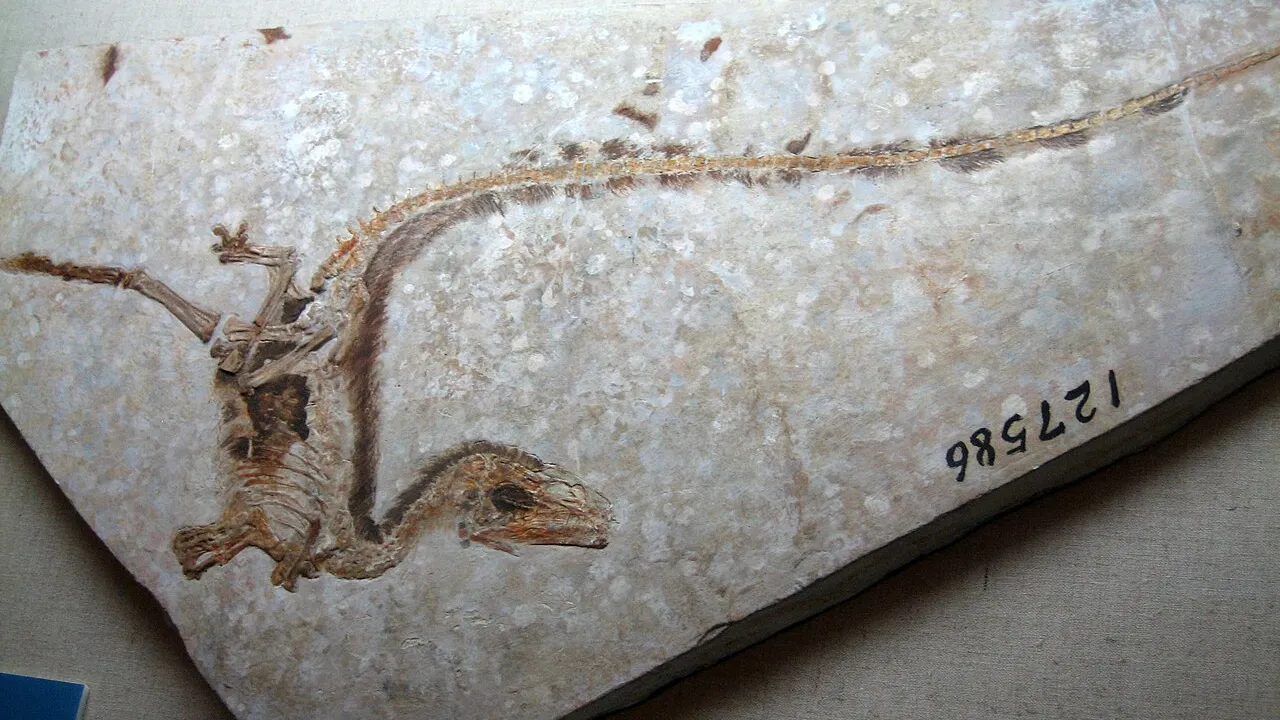
⚡ Survival SuperpowerBandit face mask, orange-and-white raccoon tail, and record 64-bone tail
🤯 Mind-Blowing Fact • Grade 1
Sinosauropteryx had 64 bones in its tail—more tail bones than any other meat-eating dinosaur ever discovered!
✨ Word Sparks (Grade 1 Glossary)
Tap 🔊 to hear
stripe
A neat band of color across fur or feathers
mask
A dark band of color around the eyes
scamper
To run with quick, light little steps
🪝
Why did this speedy little dinosaur wear a bandit mask and a striped raccoon tail?
1
First Fuzzy Dinosaur!
Zip, ! Across sunny fern leaves darts a turkey-sized runner. Look at its super long tail! Sinosauropteryx wore a dark eye and orange-and-white tail like a cute raccoon!
2
Soft Fuzzy Fuzz
In 1996, farmers in China found its fossil. It was the VERY FIRST land dinosaur ever found with soft, fuzzy feathers!
3
Super Long Tail
More than half of its whole body was tail, helping it turn on a dime while chasing quick lizards!
1. Why did Sinosauropteryx make big news around the world in 1996?
2. What modern animal's markings looked a lot like Sinosauropteryx?
🤯 Mind-Blowing Fact • Grade 2
One fossil of Sinosauropteryx still held two oval eggs inside its body alongside the skeleton of a fast-running lizard from its very last meal!
✨ Word Sparks (Grade 2 Glossary)
Tap 🔊 to hear
camouflage
Colors and patterns helping an animal blend into surroundings
ginger
Warm reddish-orange or chestnut-brown color
slab
A flat, smooth piece of split stone
🪝
How did one Chinese farmer's rock slab shock dinosaur scientists all over the world?
1
The Fossil That Changed Everything
Imagine walking into a paleontology meeting in 1996 holding photos of a meter-long dinosaur ringed with soft, downy fuzz! Farmer Li Yumin had split a stone in Liaoning, China, into two matching halves and found Sinosauropteryx prima, meaning 'first Chinese dragon feather.' It proved non-flying dinosaurs grew feathers!
2
Ginger Stripes and Bandit Mask
Microscope studies of its fossil fuzz revealed reddish-orange pigment packets! Sinosauropteryx had a -brown back, a pale belly, a dark bandit mask across its eyes, and bold orange-and-white stripes down its super-long tail.
3
Fast Lizard Chaser
Inside one fossil skeleton, scientists spotted tiny mammal jaws and a whole lizard—plus two unlaid dinosaur eggs!
1. What amazing clues were preserved inside one Sinosauropteryx skeleton's body?
2. What does 'Sinosauropteryx prima' translate to in English?
🤯 Mind-Blowing Fact • Grade 3
Scientists tested 3D dinosaur models outdoors in sunny meadows versus shady woods to prove Sinosauropteryx's sharp belly shading matched open, sunlit habitats!
✨ Word Sparks (Grade 3 Glossary)
Tap 🔊 to hear
countershading
Dark back and light belly hiding body shadows outdoors
savanna
Sunny, open plain with scattered shrubs and trees
glare
Harsh, dazzling brightness reflected from sunlight
🪝
What can a dinosaur's camouflage pattern tell us about whether it lived in dark forests or sunny meadows?
1
Dawn of the Feathered Dinosaur Era
Bright sunlight sparkles across open lakeside in Liaoning, China, 125 million years ago. Sprinting past low shrubs comes Sinosauropteryx prima, a lightweight compsognathid dinosaur barely four feet long—and over half that length is its whip-like, sixty-four-bone tail! When unveiled in October 1996, its fuzzy halo launched a golden age of feathered dinosaur discoveries.
2
First Dinosaur Pigment Discovery
In January 2010, paleontologist Mike Benton and colleagues found spherical pheomelanin packets inside Sinosauropteryx's short, downy protofeathers—identifying the very first dinosaur colors ever discovered! Chestnut-orange bands alternated with white rings all along its tail.
3
Countershading and Bandit Glare Shield
In 2017, researcher Fiann Smithwick mapped its whole-body camouflage. Like modern pronghorn antelopes that live under bright open skies, Sinosauropteryx had sharp high-up —a dark ginger back meeting a bright white belly—to flatten shadows, while a dark raccoon mask reduced bright sun around its eyes!
4
Nimble Ground Hunter
Short, strong three-fingered hands and quick legs helped it pounce on swift lizards and tiny venomous mammals.
1. How did countershading (a dark back and bright white belly) help Sinosauropteryx?
2. How did the dark 'bandit mask' around Sinosauropteryx's eyes help it hunt?
🤯 Mind-Blowing Fact • Grade 4
One Sinosauropteryx specimen preserved the jaws of Sinobaatar and Zhangheotherium—proving this little feathered dinosaur hunted ancient venomous spur-bearing mammals!
✨ Word Sparks (Grade 4 Glossary)
Tap 🔊 to hear
collagen
Structural protein fiber strengthening internal skin and tendons
dorsum
The upper back surface of an animal's body
oviduct
Internal tube through which shelled eggs pass before laying
🪝
Why did Sinosauropteryx cause a thrilling scientific debate in 1996 before changing textbooks forever?
1
Splitting Slab and Counterslab
Picture August 1996 in Sihetun village, Liaoning Province, when farmer-collector Li Yumin split a fine-grained Early Cretaceous lake slab (~125 MYA) into matching part and counterpart halves, selling one to Beijing's National Geological Museum and the other to the Nanjing Institute. Named Sinosauropteryx prima by Qiang Ji and Shu'an Ji, this 1.1-meter compsognathid sported a continuous halo of five-to-forty-millimeter filaments along its neck, back, hips, and record-setting sixty-four-vertebrae tail.
2
Protofeathers Defeat Skepticism
At first, a handful of skeptics argued the dark fibers were merely frayed skin fibers rather than true protofeathers. That doubt vanished in January 2010 when Fucheng Zhang, Mike Benton, and colleagues imaged the filaments under scanning electron microscopes, discovering densely packed spherical pheomelanosomes—structures formed exclusively inside pigment cells of feathers and hair, never inside internal collagen fibers! Furthermore, white tail bands completely lacked melanosomes, proving living striped plumage.
3
Physics of Open-Habitat Camouflage
In 2017, Fiann Smithwick and Jakob Vinther measured the high-contrast transition line between Sinosauropteryx's dark rufous and unpigmented white ventrum. Under direct, cloudless sunlight—unlike diffuse forest shade—sharp, high-flank countershading cancels three-dimensional self-shadowing, proving Sinosauropteryx hunted across open, sunlit Jehol lakeshores.
4
Reproductive and Dietary Snapshot
Gut fossils containing whole Dalinghosaurus lizards and three different Early Cretaceous mammal jaws, plus paired eggs, make Sinosauropteryx an unparalleled window into dinosaur biology.
1. How did scanning electron microscopy in 2010 prove Sinosauropteryx's fuzzy halo was feathers rather than frayed skin collagen?
2. What did Sinosauropteryx's high, sharp countershading line tell scientists about its habitat?
🤯 Mind-Blowing Fact • Grade 5
Sinosauropteryx holds TWO historic science 'firsts': the first non-avian dinosaur ever discovered with feathers (1996) AND the first dinosaur ever tested for fossilized melanosome colors (January 2010)!
✨ Word Sparks (Grade 5 Glossary)
Tap 🔊 to hear
coelurosaur
Major theropod clade uniting compsognathids, tyrannosaurs, ornithomimosaurs, and birds
periocular
Situated directly around the region of the eye
basal
Branching off early near the base of an evolutionary tree
🪝
How did Sinosauropteryx prima ignite both the feathered-dinosaur revolution and quantitative paleo-ecology?
1
Catalyst of the 1996 Jehol Revolution
In October 1996, photographs carried to the Society of Vertebrate Paleontology meeting in New York electrified modern science: an articulated Barremian-stage (~125 MYA) from Liaoning's Yixian Formation preserved a distinct, filamentous integumentary halo. Described by Qiang Ji and Shu'an Ji as Sinosauropteryx prima ('first Chinese dragon feather'), this 1.07-to-1.2-meter, 2.5-kilogram compsognathid sat well to Avialae and Maniraptora—confirming that simple, hollow protofeathers originated early among coelurosaurian theropods for thermoregulation and visual signaling long before flight.
2
Refuting the Collagen Hypothesis via Melanosomes
For over a decade, critics contended that Sinosauropteryx's short, unbranched Stage-1/Stage-2 filaments represented degraded subcutaneous collagen fibers. In January 2010, Fucheng Zhang, Michael Benton, and colleagues settled the controversy in Nature—simultaneously inaugurating dinosaur paleocolor science—by identifying dense 0.4-micrometer spheroidal pheomelanosomes restricted exclusively to dark tail rings and dorsal filaments while absent from intervening unpigmented bands.
3
Radiative Optics of Countershading and Facial Masks
In 2017, Fiann Smithwick, Jakob Vinther, and Innes Cuthill mapped melanosome distribution across three specimens against biophysical light-environment models. A sharp, dorsally positioned countershading gradient paired with a rufous-darkened 'bandit mask' and striped tail optimized three-dimensional background matching and glare reduction under direct, open-sky illumination—demonstrating that open lakeshore scrublands bordered Yixian forests.
4
Extreme Caudal Elongation and Cursorial Agility
Composed of sixty-four caudal vertebrae—the highest tail count known in Theropoda—its whip-like tail served as a high-moment dynamic counterbalance during rapid directional pivots while pursuing agile lizards like Dalinghosaurus and symmetrodont/eutriconodont mammals preserved inside its gut.
5
Dual Oviduct Reproductive Anatomy
Specimen NIGP 127587 preserves two symmetrical, rough-shelled thirty-six-millimeter eggs side by side inside the pelvic canal, demonstrating that retained paired functional oviducts prior to modern birds losing the right oviduct.