1. Which common underground rock slowly dissolves in rainwater to make caves and sinkholes?
2. What happens when a sinkhole fills up with clean underground water?
🤯 Mind-Blowing Fact • Grade 2
Mammoth Cave in Kentucky—carved in karst limestone—is the longest cave system on Earth, with over 420 miles of mapped passages!
✨ Word Sparks (Grade 2 Glossary)
Tap 🔊 to hear
karst
Landscape of caves and sinkholes in dissolved rock.
stalactite
Icicle-shaped cave rock hanging from the ceiling.
stalagmite
Mound-shaped cave rock growing upward from floor.
🪝
Where do 'disappearing streams' go when they vanish right into a rocky meadow?
1
Nature's Fizzy Rainwater
Plain water cannot dissolve hard granite, yet rainwater has a secret helper! As raindrops fall through the sky and soak through rich garden soil, they pick up carbon dioxide gas. That turns rainwater into super-weak fizzy acid—harmless to touch, yet able to dissolve limestone!
2
Welcome to Karst Country
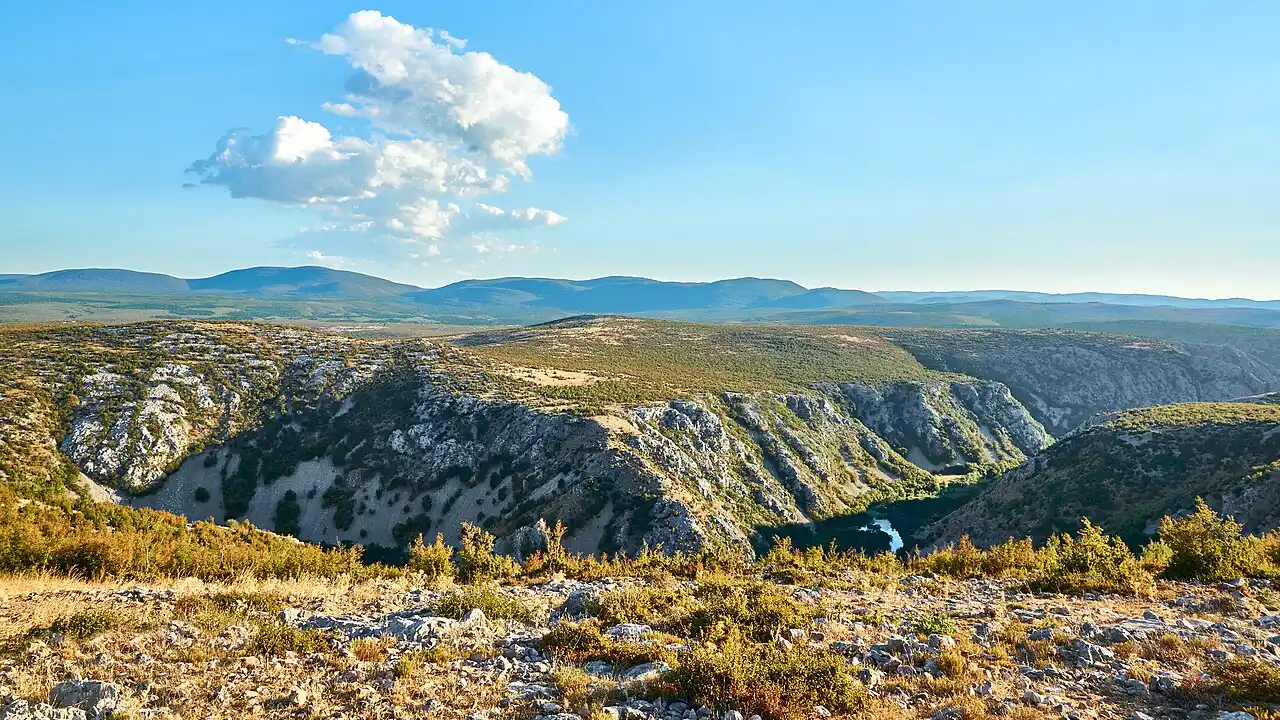
Landscapes shaped by dissolving rock are called topography. In karst regions like Kentucky, Florida, and western Virginia, surface creeks suddenly dive down holes to become underground rivers, and rolling hills dimple with bowl-shaped sinkholes!
3
Stalactites and Stalagmites
Inside caves, mineral-rich drops leave behind tiny rings of stone. hold 'tight' to the ceiling, while 'might' reach up from the floor!
1. Easy memory trick: which cave formation hangs 'tight' from the ceiling?
2. What gas does rainwater pick up from air and soil to become weakly acidic?
🤯 Mind-Blowing Fact • Grade 3
Inside Virginia's Luray Caverns, an inventor hooked soft rubber mallets to tuned cave stalactites to build the 'Great Stalacpipe Organ'—Earth's largest musical instrument!
✨ Word Sparks (Grade 3 Glossary)
Tap 🔊 to hear
carbonic acid
Weak natural acid formed from water and `CO2`.
chemical weathering
Breaking down rock through natural chemical reactions.
aquifer
Underground rock layer storing and carrying fresh water.
🪝
How did a collapsed karst cave leave behind Virginia's famous 215-foot-tall Natural Bridge?
1
Chemical Weathering at Work
Most erosion scrapes rock physically with wind, ice, or river pebbles. Karst topography is special because it forms by ! Rainwater absorbs carbon dioxide from decaying leaves in topsoil to form weak , which seeps along cracks in limestone, dolomite, or gypsum.
2
Two Ways Sinkholes Form
Not all sinkholes form at the same speed. 'Dissolution sinkholes' lower the ground slowly over centuries into gentle grassy bowls. 'Cover-collapse sinkholes' happen faster when groundwater drops and stops supporting an underground soil arch!
3
Virginia's Karst Wonders
Every valley west of Virginia's Blue Ridge—including the Shenandoah Valley—sits on ancient ocean limestone! Dissolving rock sculpted dazzling Luray Caverns and left one sturdy arch of an old collapsed cave standing as Natural Bridge.
4
Protecting Karst Groundwater
Because sinkholes connect directly to underground cave streams without thick sand to filter water, keeping karst meadows clean protects everyone's well water!
1. How did Virginia's towering Natural Bridge form?
2. Why is groundwater in karst topography extra sensitive to surface pollution?
🤯 Mind-Blowing Fact • Grade 4
China's Heavenly Pit (Xiaozhai Tiankeng)—the world's deepest karst sinkhole—plunges 662 meters deep and hosts its own misty underground forest with clouded leopards!
✨ Word Sparks (Grade 4 Glossary)
Tap 🔊 to hear
speleothem
Cave mineral formation like stalactites and stalagmites.
calcite
Calcium carbonate mineral making up limestone and cave formations.
hachure marks
Short inward ticks on map contours showing depressions.
🪝
Why do Florida, Kentucky, Virginia's Valley and Ridge province, and Southern China share the exact same ancient ocean secret?
1
Ancient Seas Beneath Karst Landscapes
Named after the Kras limestone plateau along the border of Slovenia and Italy, karst topography covers roughly 15 to 20 percent of Earth's ice-free land! What connects Virginia's Valley and Ridge province, central Florida, Kentucky's Mammoth Cave, and China's towering Guilin peaks? Hundreds of millions of years ago, warm shallow seas covered all of those regions, piling up thick beds of calcium carbonate (`CaCO3`) shells and coral reefs that hardened into limestone and dolostone.
2
The Reversible Carbonic Acid Equation
Karst sculpture runs on one elegant, reversible chemical reaction! Rainwater soaking through root-rich soil absorbs `CO2` to become carbonic acid (`H2O + CO2 -> H2CO3`), which dissolves solid in limestone into soluble calcium and bicarbonate ions. Below the water table, groundwater enlarges vertical joints and horizontal bedding planes into cavernous conduits. Later, when rivers cut deeper and drain the cave into air, dripping water loses `CO2` gas back into cave air—reversing the reaction and precipitating calcite like stalactites, stalagmites, columns, and drapery!
3
Why Lowering the Water Table Triggers Sinkholes
Water filling an underground cavity actually helps buoy up the ceiling soil and rock! During severe droughts or heavy agricultural pumping—such as in Florida during winter freeze protection for citrus groves—dropping groundwater removes buoyant support, triggering cover-collapse sinkholes.
4
Reading Topographic Maps for Karst
On Virginia SOL topographic maps, you can spot karst terrain instantly by closed circular contour lines ticked with short inward 'hachure' marks indicating sinkhole depressions—plus streams that abruptly end!
1. Which geologic province of Virginia is famous for karst topography, sinkholes, Luray Caverns, and Natural Bridge?
2. How are circular sinkholes shown on a standard topographic map?
🤯 Mind-Blowing Fact • Grade 5
New Mexico's gigantic Carlsbad Caverns were carved from the bottom UP by sulfuric acid rising from deep ancient oil fields rather than rainwater trickling down!
✨ Word Sparks (Grade 5 Glossary)
Tap 🔊 to hear
hypogenic cave
Cave dissolved from below by rising acidic fluids.
vadose zone
Unsaturated rock layer located above the water table.
tower karst
Steep isolated limestone peaks left after intense dissolution.
🪝
How can caves be carved by sulfuric acid rising from BELOW instead of rain from above—and how do cave stalagmites record 500,000 years of monsoons?
1
Carbonate Equilibrium and Epigenic Speleogenesis
About a quarter of humanity relies on freshwater drawn from karst aquifers! Classic ('epigenic') karst develops where meteoric rainwater equilibrates with soil-zone `CO2`—where microbial respiration elevates carbon dioxide partial pressures 10 to 100 times higher than open atmosphere—producing carbonic acid: `H2O + CO2 <-> H2CO3`. Percolating along tectonic joints into limestone (`CaCO3`) or dolostone (`CaMg(CO3)2`), this acid dissolves bedrock via `CaCO3 + H2CO3 <-> Ca2+ + 2HCO3-`. Dissolution peaks right near the fluctuating water table, excavating horizontal phreatic tubes that later drain into air-filled vadose canyons as regional rivers incise downward.
2
Hypogenic Caves: Carlsbad Caverns and Lechuguilla
In the 1980s, geochemists stunned the caving world by proving New Mexico's Carlsbad Caverns and neighboring Lechuguilla Cave were NOT carved by rainwater trickling down! Instead, hydrogen sulfide (`H2S`) gas migrating upward from deep Permian Basin petroleum reservoirs met oxygenated groundwater and oxidized into potent sulfuric acid (`H2SO4`). This 'hypogenic' acid aggressively dissolved massive cathedral chambers from the bottom up, leaving telltale snowy gypsum (`CaSO4·2H2O`) chandeliers!
3
Subsidence Mechanics and Tower Karst
Geomorphologists classify dolines (sinkholes) into solution, caprock-collapse, cover-subsidence (sandy overburden trickling steadily into rock fissures like sand in an hourglass), and rapid cover-collapse (cohesive clay arches failing once drought or pumping removes buoyant pore pressure). Given millions of years in humid tropics like South China or Vietnam's Ha Long Bay, coalescing sinkholes leave isolated vertical limestone pinnacles called '' (fenglin) and cone karst (fengcong).
4
Speleothems as High-Resolution Paleoclimate Archives
Because stalagmites grow in sheltered, constant-temperature caves layer by microscopic layer, paleoclimatologists date their trace uranium-thorium (`U-Th`) isotopes precisely and measure oxygen-18 (`δ18O`) ratios—reconstructing ancient rainfall, ice ages, and monsoons over 500,000 years!
5
Ground-Penetrating Radar and Dye Tracing
Civil engineers survey karst building sites using microgravity meters, electrical resistivity tomography, and non-toxic fluorescent dye tracing to map hidden voids and safeguard subterranean rivers.