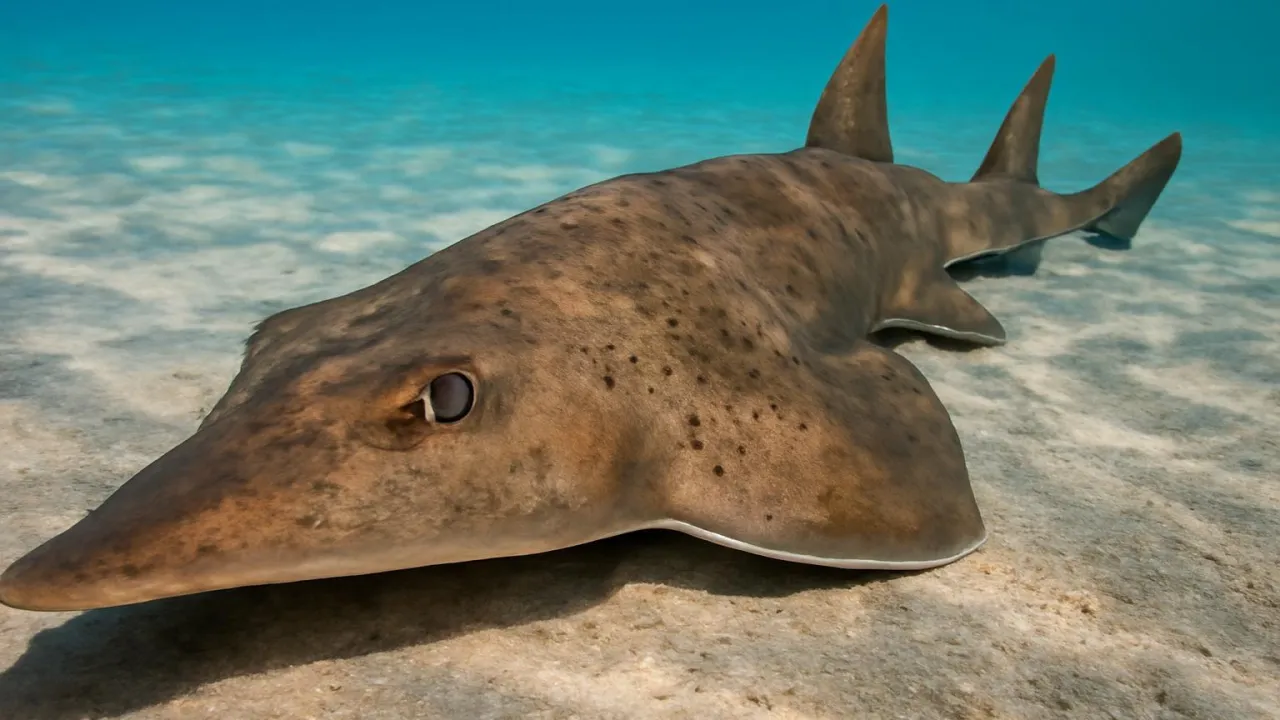
The shovelnose guitarfish can grow as long as a tall child is tall!
✨ Word Sparks (Grade 2 Glossary)
Tap 🔊 to hear
camouflage
Colors that help animals hide
predator
An animal that hunts other animals
habitat
The place where an animal lives
🪝
Have you ever seen a fish that looks like a guitar?
1
A Fish with a Unique Shape
The shovelnose guitarfish has a flat, wide body that looks like a guitar. It is gray and brown, which helps it blend with the sandy ocean floor. Its body shape helps it swim close to the bottom easily.
2
Where It Lives and Grows
This fish lives in the eastern Pacific Ocean near sandy shores. It grows up to five feet long as it gets older. The sandy bottom is perfect for hiding from and hunting for food.
3
What Makes It Special
The guitarfish eats small fish, crabs, and shrimp found on the ocean floor. Its flat body helps it hide by lying still on the sand. This keeps it safe from bigger fish that want to eat it.
1. Why does the guitarfish have gray and brown colors?
2. What does the guitarfish eat?
🤯 Mind-Blowing Fact • Grade 3
The shovelnose guitarfish can bury itself in sand to hide from predators quickly!
✨ Word Sparks (Grade 3 Glossary)
Tap 🔊 to hear
adaptation
A body change that helps survival
nutrients
Food parts that help animals grow
camouflage
Colors or shapes that help hide
🪝
Did you know the shovelnose guitarfish uses its shape to survive underwater?
1
A Body Built for Hiding
The shovelnose guitarfish has a flat body that helps it on sandy ocean floors. This keeps it safe from predators that hunt nearby. Its wide, guitar-shaped body blends with the ocean bottom’s colors. This camouflage is a clever survival trick.
2
Living in the Eastern Pacific
This fish lives along the coasts of California and Mexico in shallow waters. It prefers sandy or muddy bottoms where it can easily hide. The habitat provides plenty of food and shelter from larger predators. The ocean floor is its perfect home.
3
Eating and Hunting
The guitarfish hunts small fish, crabs, and shrimp by lying still and waiting. It uses its mouth to suck up prey from the sand. This feeding method helps it get without chasing fast animals. It is an effective hunter on the ocean floor.
4
Camouflage and Defense
Besides hiding, the guitarfish’s flat body helps it escape predators by quickly burying itself in sand. This behavior is a key for survival. Its shape also allows it to swim close to the ocean floor quietly. These traits make it a master of disguise.
Shovelnose guitarfish help keep ocean food webs balanced by eating small animals.
✨ Word Sparks (Grade 4 Glossary)
Tap 🔊 to hear
ecosystem
All living things and their homes together
food web
How animals eat each other in nature
camouflage
Colors or shapes that help hide
🪝
How does the shovelnose guitarfish’s shape help it survive in the ocean?
1
Shape and Survival
The shovelnose guitarfish’s flat, guitar-shaped body allows it to lie close to the ocean floor, making it hard for predators to spot. This shape causes it to blend perfectly with sandy habitats, providing excellent . Because it can hide so well, it avoids becoming food for larger fish. Its body design is a key cause of its survival success.
2
Role in the Ecosystem
This fish plays an important role by controlling populations of small fish, crabs, and shrimp in its habitat. It helps keep the ocean floor’s balanced by eating these animals. In turn, the guitarfish is prey for larger predators, showing its place in the food chain. Its presence supports ocean health and biodiversity.
3
Where It Lives
The shovelnose guitarfish is found along the Pacific coasts of the United States and Mexico, especially in shallow sandy bays. These regions provide the right mix of food and shelter needed for its growth and reproduction. Human activities like fishing and habitat changes can affect its populations. Conservation efforts focus on protecting its coastal habitats.
4
How It Protects Itself
Besides , the guitarfish uses quick burying in sand as a defense against predators. This behavior allows it to disappear almost instantly when threatened. Its flat body also helps it swim quietly near the ocean floor to avoid detection. These adaptations work together to keep it safe in a dangerous environment.
2. Why is the guitarfish important to the ocean ecosystem?
🤯 Mind-Blowing Fact • Grade 5
Shovelnose guitarfish use special electroreceptors to sense prey hidden under the sand!
✨ Word Sparks (Grade 5 Glossary)
Tap 🔊 to hear
cartilaginous
Animals with skeletons made of cartilage, not bone
electroreceptors
Body parts that sense electric signals in water
bycatch
Animals caught by mistake during fishing
🪝
Did you know the shovelnose guitarfish is part of a unique group of cartilaginous fishes with fascinating adaptations?
1
Taxonomy and Scientific Context
The shovelnose guitarfish, scientifically named Pseudobatos productus, belongs to the Rhinobatidae family within the class Chondrichthyes, which includes sharks and rays. This species represents an evolutionary link between sharks and rays due to its flattened body and elongated snout. Its taxonomic classification highlights its unique adaptations among fishes.
2
Physiological Mechanics and Adaptations
Its flattened, guitar-shaped body allows the shovelnose guitarfish to glide effortlessly along sandy ocean floors while remaining nearly invisible to predators. The fish uses called ampullae of Lorenzini to detect prey buried in sediment. Its muscular pectoral fins enable sudden bursts of speed up to 10 miles per hour to capture prey or escape threats.
3
Conservation and Human Impact
Though not currently endangered, shovelnose guitarfish populations face threats from habitat destruction and in commercial fisheries. Coastal development and pollution reduce the quality of their sandy habitats. Conservation efforts focus on habitat protection and sustainable fishing practices to maintain healthy populations.
4
Ecological Role and Geographic Distribution
Found along the eastern Pacific coast from California to Baja California, Mexico, this species occupies shallow coastal waters with sandy or muddy substrates. It plays a vital role as a mid-level predator, regulating populations of benthic invertebrates and small fish. Its presence supports the balance of coastal marine ecosystems.
5
Quantitative Comparisons and Interesting Facts
The shovelnose guitarfish can reach lengths up to 5 feet and weigh around 40 pounds. It can swim at speeds near 10 miles per hour when hunting or escaping predators. Its detect electrical signals as low as 0.01 microvolts, enabling precise prey location. These impressive traits demonstrate its specialized adaptations.