1. About how tall could a huge Short-Faced Bear stand on its back legs?
2. How did the Short-Faced Bear get its name?
🤯 Mind-Blowing Fact • Grade 2
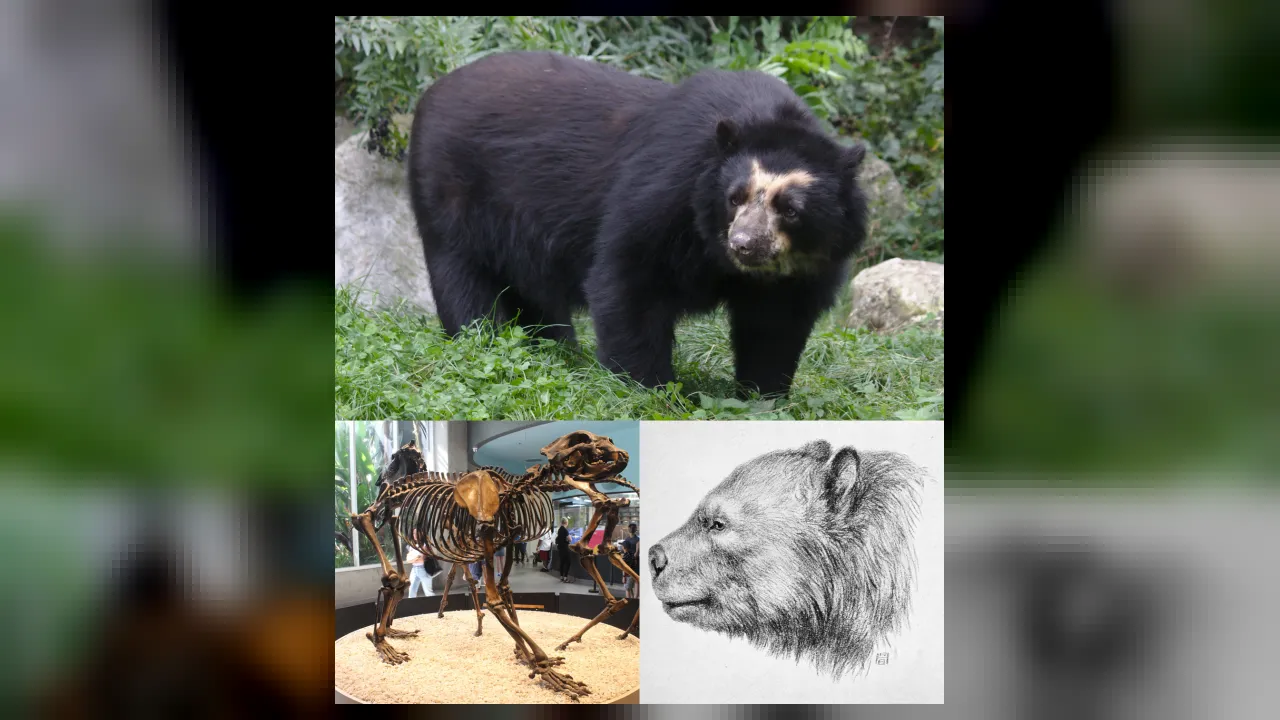
The giant Short-Faced Bear's only living close relative is the shy, tree-climbing Spectacled Bear of South America!
✨ Word Sparks (Grade 2 Glossary)
Tap 🔊 to hear
amble
walk at a slow, relaxed pace
sensitive
quick to notice tiny smells or sounds
subfamily
a smaller cousin branch inside a family
🪝
What bear walked with its toes pointed straight ahead instead of pigeon-toed?
1
Built for Long Journeys
Watch a modern grizzly bear along a trail and you will see its paws turn slightly inward. Now picture the giant Ice Age Short-Faced Bear! Its toes pointed straight forward, letting it cover dozens of miles each day without getting tired.
2
A Super Sniffer
Why was its snout so wide? Inside that broad nose sat extra-wide nasal passages! Riding on Ice Age winds, scents from distant plants or food reached its nose from miles away across open grasslands.
3
One Living Cousin Left
Today, only one bear on Earth belongs to the same short-faced bear : the gentle, fruit-loving Spectacled Bear of South America's Andes Mountains!
1. How were the Short-Faced Bear's feet positioned for long walks?
2. Which modern bear is the closest living relative of the Short-Faced Bear?
🤯 Mind-Blowing Fact • Grade 3
Scratch marks left by Short-Faced Bear claws on cave walls in Missouri sit fifteen feet above the cave floor!
✨ Word Sparks (Grade 3 Glossary)
Tap 🔊 to hear
gait
the pattern of steps an animal uses
omnivores
animals that eat both plants and meat
optical
relating to how eyes see shapes
🪝
How did this giant bear travel across huge plains without burning up all its energy?
1
The Camel Pacer Gait
Imagine a one-ton bear gliding effortlessly across Alaska's treeless tundra! Scientists studying Arctodus simus leg joints discovered it likely used a 'pacing' like a camel—moving both right legs forward together, then both left legs together. That smooth swinging motion saved tremendous energy over vast distances.
2
An Optical Illusion Snout
Surprise—Arctodus simus did not actually have a tiny nose! Measurements show its snout was nearly as long as a grizzly's, yet its skull was so deep and wide from cheek to cheek that its face looked snub-nosed by comparison.
3
Intimidating Rival Predators
When its giant nose picked up a distant scent, Arctodus could stride right over to a meal found by wolves or saber-toothed cats. Simply rearing twelve feet into the air was enough to persuade smaller predators to step politely aside!
4
Omnivore Menu Flexibility
While northern bears in icy Alaska and Yukon ate mostly meat, fossils from warmer regions show Short-Faced Bears were flexible that enjoyed plants, berries, roots, and meat alike.
1. What walking style helped Arctodus simus save energy across wide plains?
2. Why did the Short-Faced Bear's snout look so short?
🤯 Mind-Blowing Fact • Grade 4
Inside Missouri's Riverbluff Cave, paleontologists discovered untouched 50,000-year-old sleeping beds and claw marks made by Short-Faced Bears!
✨ Word Sparks (Grade 4 Glossary)
Tap 🔊 to hear
endurance
ability to keep going for a long time
turbinates
scrolled nose bones that boost smelling power
territories
large home areas an animal travels across
🪝
Was the Short-Faced Bear really a high-speed cheetah-bear—or an unstoppable long-distance cruiser?
1
Rethinking the 'Cheetah Bear' Idea
Watch old documentaries and you might hear claims that Arctodus simus sprinted 40 miles per hour to chase down wild horses! However, when biomechanics researchers examined its thigh and shin bones closely in 2010, they realized thin leg walls on an 1,800-pound bear would snap during sharp high-speed turns. Rather than a sprinter, those long, straight limbs made Arctodus an unmatched walker capable of patrolling huge Ice Age !
2
Kleptoparasitism: Nature's Polite Takeover
Ecologists have a special word for animals that claim food caught by other hunters: kleptoparasitism! Equipped with cavernous nasal —delicate scrolled bones inside the nose coated with Millions of scent receptors—Arctodus detected carcasses miles downwind across windy steppes, where no solitary cougar or small wolf pack dared challenge a one-ton giant.
3
South American Giant Cousins
Even larger short-faced bears lived in South America! In Argentina, paleontologists unearthed an arm bone from Arctotherium angustidens suggesting huge males may have exceeded 3,000 pounds—the heaviest bear ever discovered!
4
Sharing Caves and Landscapes
Fossils in Riverbluff Cave, Missouri, preserve deep claw marks, footprints, and hollow sleeping beds called bear wallows pressed into ancient clay more than 50,000 years ago.
1. Why did biomechanics scientists reject the old idea that Arctodus simus made sharp high-speed chases?
2. How did scrolled turbinate bones inside its broad nose help Arctodus survive?
🤯 Mind-Blowing Fact • Grade 5
Male Short-Faced Bears exhibited extreme sexual dimorphism—weighing nearly twice as much as females of the exact same species!
✨ Word Sparks (Grade 5 Glossary)
Tap 🔊 to hear
opportunistic
eating whatever nutritious food is locally available
plantigrade
walking flat on the whole foot sole
dimorphism
size or shape differences between males and females
🪝
What do chemical isotopes and microscopic tooth marks reveal about what North America's largest bear REALLY ate?
1
Tremarctinae Across Two Continents
Stand face-to-face with a mounted skeleton of Arctodus simus from Alaska's Yukon Flats and its proportions defy every modern brown or polar bear: towering 1.5 meters (5 feet) at the shoulder on all fours and exceeding 3.4 meters (11.5 feet) upright, large males reached 800 to 950 kilograms (1,760 to 2,100 pounds), nearly double the mass of female bears! First described by paleontologist Edward Drinker Cope in 1879 from Shasta County, California, Arctodus belonged to Tremarctinae—an endemic Western Hemisphere bear lineage recognizable by a distinctive premasseteric fossa (muscle pocket) on the lower jaw.
2
Resolving the Hypercarnivore Debate
For decades, bone nitrogen-15 isotope readings from cold Beringian fossils in Yukon and Alaska pointed toward a heavily meat-based diet, inspiring hypotheses that Arctodus simus was a pure flesh-specialist. However, broader dental microwear, tooth-cavity studies, and isotope surveys from Rancho La Brea and mid-latitude caves overturned that one-size-fits-all portrait! Like oversized brown bears, Short-Faced Bears were omnivores whose menus shifted by latitude: Arctic individuals relied heavily on caribou and steppe bison when tundra plants were scarce, whereas southern bears consumed tubers, coarse vegetation, berries, and carrion.
3
Skeletal Mechanics of a Pacing Cruiser
Comparative osteology comparing Arctodus femora and tibiae against grizzly bears, lions, and felids confirms that its limbs lacked the reinforced cross-sectional bending strength required for high-speed pursuit turns. Instead, high shoulder posture, forward-oriented feet, and elongated strides minimized metabolic cost while traversing vast Pleistocene landscapes.
4
Arrival of Modern Grizzly Competitors
Around 50,000 years ago, Eurasian brown bears (Ursus arctos) crossed Beringia into Alaska, briefly retreating when ice sheets merged before expanding southward again as corridors opened after 14,000 years ago.
5
Vanishing at the Pleistocene Boundary
Radiocarbon Accelerator Mass Spectrometry dates place the last Arctodus simus fossils around 11,000 calendar years ago. As megafaunal carrion vanished across open steppes and adaptable smaller-bodied brown and black bears thrived in expanding Holocene forests, the towering giant of Tremarctinae disappeared.