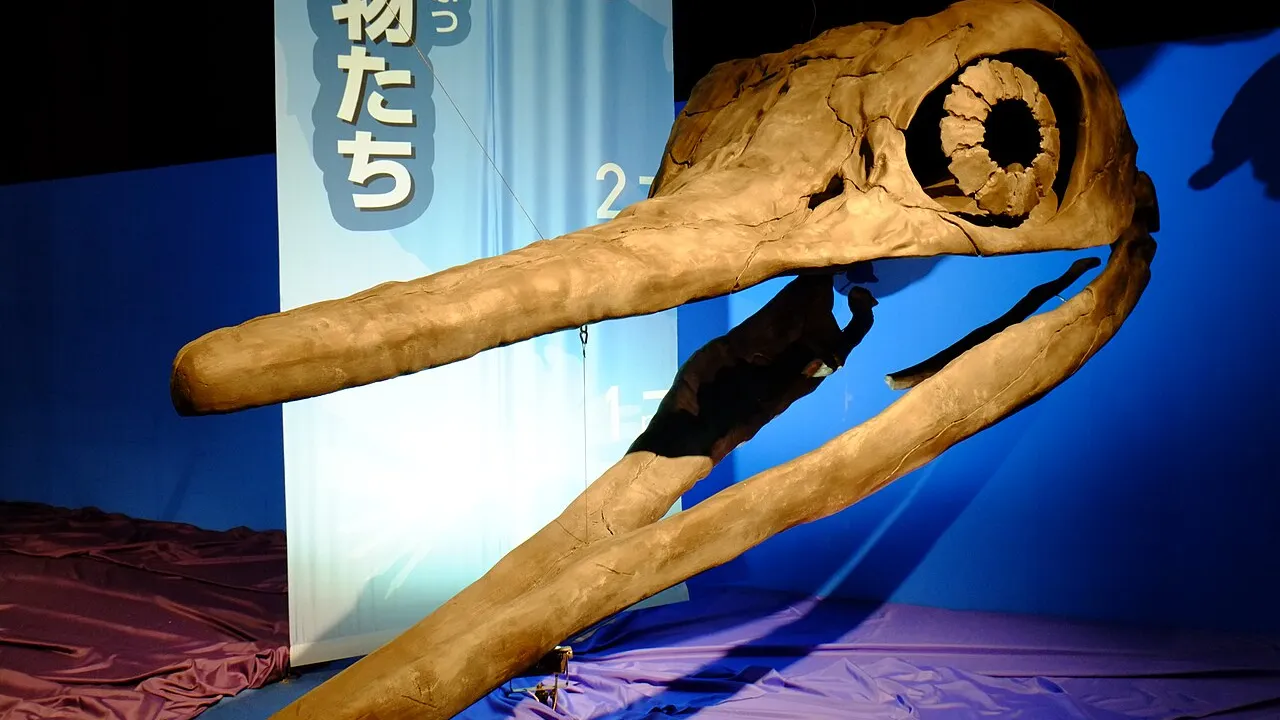
1. How were the four flippers of Shonisaurus unusual?
2. Why were Shonisaurus fossils found in the dry mountains of Nevada?
🤯 Mind-Blowing Fact • Grade 2
Shonisaurus is the official State Fossil of Nevada, where thirty-seven giant skeletons lie preserved together at Berlin-Ichthyosaur State Park!
✨ Word Sparks (Grade 2 Glossary)
Tap 🔊 to hear
Triassic
The first time period of the dinosaur age
snout
The long front jaws of an animal
state fossil
A special ancient fossil chosen to honor a state
🪝
What ocean giant grew to thirty tons while early land dinosaurs were still small?
1
First Giants of the Sea
Picture the Late world 230 million years ago! On land, the earliest dinosaurs were mostly no bigger than dogs or horses. Out in the open ocean, however, Shonisaurus had already grown into a forty-nine-foot, thirty-ton giant!
2
A Deep-Bellied Cruiser
Named after Nevada's Shoshone Mountains, Shonisaurus was the largest kind of ichthyosaur of its time. It had a long, narrow , a deep barrel-shaped chest, and four slender flippers that each measured five feet long.
3
Toothless Grown-Ups?
Scientists first thought adult Shonisaurus only had teeth at the tip of its . Newer bone checks show teeth actually lined its jaws, helping it snatch deep-sea squid and shelled ammonoids!
1. How did Shonisaurus compare in size to early Triassic land dinosaurs?
2. Where does the name Shonisaurus come from?
🤯 Mind-Blowing Fact • Grade 3
Tiny embryo bones discovered near adult skeletons in Nevada suggest giant Shonisaurus mothers gathered there as a prehistoric ocean nursery!
✨ Word Sparks (Grade 3 Glossary)
Tap 🔊 to hear
limestone
Rock formed mostly from ancient ocean shells and mud
stabilizers
Fins or wings that keep movement steady
nursery
A safe gathering spot where babies are born
🪝
Why are thirty-seven whale-sized sea reptiles buried side by side in the Nevada desert?
1
Mystery at Berlin-Ichthyosaur
High in the sagebrush hills of central Nevada sits one of paleontology's greatest mysteries. Preserved inside grey lie at least thirty-seven giant Shonisaurus popularis skeletons! Around 230 million years ago, this dry mountain ridge formed the floor of a warm ocean bordering North America's western coast.
2
Solving a Prehistoric Puzzle
For years, visitors wondered if a whole pod got stranded on a shallow mudflat like modern pilot whales, or even if a mythical giant kraken arranged their bones! Careful rock chemistry studies solved the case: the skeletons settled in deep water during different events, likely where Shonisaurus gathered to give birth safely away from coastal predators.
3
Anatomy of an Ocean Cruiser
Measuring nearly fifty feet long, Shonisaurus differed from sleek, fast-darting Jurassic ichthyosaurs. It lacked a tall dorsal fin on its back, and its rear flippers stayed just as long as its front pair, acting as steady for deep ocean dives.
4
Even Bigger Northern Cousins
In British Columbia, Canada, paleontologists unearthed a close relative named Shonisaurus sikanniensis stretching an astonishing sixty-nine feet long—rivaling modern fin whales as one of the largest marine reptiles ever!
1. What recent discovery explains why so many Shonisaurus fossils rested in Nevada?
2. How long did the giant Canadian species Shonisaurus sikanniensis grow?
🤯 Mind-Blowing Fact • Grade 4
A single vertebra from Shonisaurus popularis looks like an oversized hockey puck up to twelve inches across and weighs more than a bowling ball!
✨ Word Sparks (Grade 4 Glossary)
Tap 🔊 to hear
Panthalassic Ocean
The giant global ocean surrounding supercontinent Pangaea
geochemical
Studying chemical clues locked inside natural rocks
micro-CT scan
Detailed 3D X-ray imaging of hidden fossils
🪝
How did scientists use rock chemistry and tiny embryo bones to solve Nevada's famous ichthyosaur graveyard?
1
Colossus of the Panthalassic Ocean
Long before gigantic sauropods shook the ground, marine reptiles achieved breathtaking scale in the vast . During the Late Triassic Period, Shonisaurus popularis reached fifteen meters in length and weighed nearly thirty tons. Unlike later dolphin-proportioned ichthyosaurs, this shastasaurid possessed an elongated, fusiform body lacking a dorsal fin, paired with four remarkably narrow, equal-sized flippers exceeding 1.5 meters each.
2
Rethinking Jaws and Feeding Habits
When Charles Camp excavated Nevada's skeletons in the 1950s, worn jaw tips led researchers to believe adult Shonisaurus lost its teeth and slurped soft squid like suction-feeding sperm whales. In 2022, paleontologists re-examined the skulls with modern imaging and discovered socketed, ridged teeth running along the entire jaw! Rather than suction-feeding alone, Shonisaurus actively seized large cephalopods and fish in the deep twilight zone.
3
Debunking Stranding Myths
At Berlin-Ichthyosaur State Park, dozens of massive skeletons lie aligned in the Luning Formation limestone. Early hypotheses suggested a shallow-water mass stranding or toxic algal bloom. tests of surrounding rock layers found zero volcanic mercury spikes and proved the seabed lay hundreds of feet deep—far too deep for beach strandings—while revealing multiple separate burial layers.
4
A 230-Million-Year-Old Birthing Ground
of surrounding rock blocks revealed tiny fossilized vertebrae and jaws belonging to newborn or unborn Shonisaurus calves, with almost no medium-sized juveniles nearby. Just as modern gray and humpback whales migrate to calm breeding lagoons, giant Triassic ichthyosaurs gathered generation after generation in these productive waters to give birth.
1. What did 2022 fossil scans reveal about adult Shonisaurus jaws?
2. Why did geochemical rock tests rule out a beach stranding in Nevada?
🤯 Mind-Blowing Fact • Grade 5
Plate tectonics lifted the ancient seafloor holding Shonisaurus fossils from hundreds of feet below the Pacific all the way to 7,000 feet high in Nevada's mountains!
✨ Word Sparks (Grade 5 Glossary)
Tap 🔊 to hear
taphonomy
How organisms decay, sink, and become fossils
pelagic
Relating to the open ocean far from shore
stratigraphic
Arranged in stacked layers of ancient rock
🪝
Why did marine reptiles evolve thirty-ton whale dimensions just fifteen million years after Earth's worst mass extinction?
1
Rapid Evolution into Pelagic Giants
Following the devastating End-Permian extinction 252 million years ago, ancestral reptiles invaded recovering oceans with astonishing evolutionary speed. Within fewer than twenty million years, the shastasaurid lineage produced Shonisaurus popularis—a fifteen-meter, thirty-metric-ton leviathan cruising the eastern Panthalassic Ocean—and its boreal relative Shonisaurus sikanniensis, excavated along British Columbia's Sikanni Chief River at an awe-inspiring twenty-one meters.
2
Morphology of a Deep-Ocean Diver
Anatomically, Shonisaurus occupied an intermediate evolutionary grade between basal eel-like ichthyopterygian swimmers and derived Jurassic thunniform sprinters. Its ribcage formed a deep torso, though modern 3D skeletal reconstructions show it was sleeker than pot-bellied mid-century drawings suggested. Lacking a stabilizing dorsal fin, Shonisaurus relied on four slender, symmetrical paddles exceeding 1.5 meters to regulate pitch and roll while its asymmetrical tail beat steadily across expanses.
3
Dentition Reassessed
For decades, textbooks portrayed adult Shonisaurus as nearly edentulous suction feeders that shed juvenile teeth upon maturity, hunting soft coleoids like modern beaked whales. In 2022, paleontologist Neil Kelley and colleagues re-examined historic Berlin-Ichthyosaur specimens and uncovered robust teeth sporting fluted enamel crowns set in continuous bony grooves across even the largest jaws, restoring Shonisaurus as an apex raptorial predator.
4
Forensic Taphonomy of the Luning Bonebed
Preserved at 2,100 meters elevation in Nevada's Shoshone Range—uplifted there by Mesozoic tectonic collisions—Quarry 2 houses seven aligned adult skeletons digitized with high-resolution laser scanning. Geochemical assays of mercury and organic carbon eliminated volcanic poisoning or anoxic suffocation, while sedimentary textures confirmed quiet deposition below storm-wave base.
5
Deep-Time Reproductive Migrations
Synchrotron and micro-CT imaging of Luning matrix blocks identified embryonic and neonatal Shonisaurus bones alongside mature adults across distinct horizons separated by thousands of years. This demographic signature—giant adults plus newborns, with scarce subadults—demonstrates that migratory reproductive aggregations seen in modern baleen whales already operated among marine reptiles 230 million years ago.