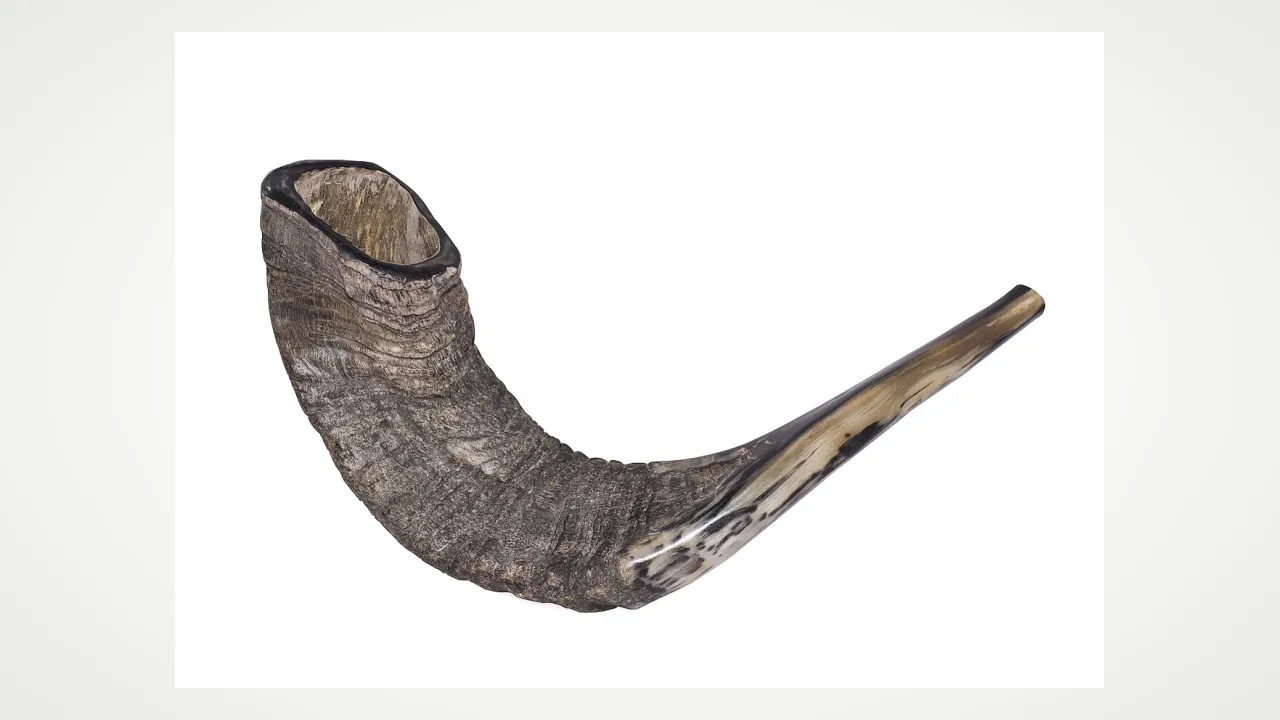
1. What natural object is a classic curved shofar made from?
2. How many metal keys or valves are attached to a traditional shofar?
🤯 Mind-Blowing Fact • Grade 2
Yemenite Jewish communities craft breathtaking spiral shofars from the horn of the greater kudu antelope that can measure up to four feet long!
✨ Word Sparks (Grade 2 Glossary)
Tap 🔊 to hear
keratin
Tough natural material forming horns and fingernails
kudu
African antelope with long corkscrew-shaped horns
ceremony
Special gathering honoring an important tradition
🪝
Why is a shofar actually made of the exact same stuff as your own fingernails?
1
Crafted From Natural Keratin!
Listen as a soaring, trumpet-like cry leaps across a crowded room and gives everyone goosebumps! Unlike bony deer antlers, a sheep or antelope horn is made of tough —the very same natural protein found in human fingernails!
2
Shaped With Heat, Never Metal
Because softens gently when warmed, skilled craftspeople steam the hollow horn, straighten its tip, and drill a narrow airway into its natural cavity. No separate metal mouthpiece is ever attached; the player buzzes directly against the smoothed horn rim!
3
Holiday Wake-Up Calls
During the Jewish High Holidays of Rosh Hashanah and Yom Kippur, a trained blower sounds ancient rhythmic calls that invite listeners to pause, reflect, and celebrate a fresh new year.
1. What natural material forms a ram's horn and lets makers soften it with steam?
2. Which animal horn is used to make extra-long, corkscrew-shaped Yemenite shofars?
🤯 Mind-Blowing Fact • Grade 3
On Rosh Hashanah morning, a synagogue shofar blower often performs a full sequence of one hundred distinct blasts during the service!
✨ Word Sparks (Grade 3 Glossary)
Tap 🔊 to hear
resonator
Hollow chamber that strengthens vibrating sound waves
staccato
Short, crisp notes separated cleanly apart
Tekiah
Single unbroken, ringing blast on the shofar
🪝
Why does every single shofar in the world have a one-of-a-kind musical voice?
1
No Two Horns Sound Alike!
Walk past a workbench of twenty finished shofars and blow each one—no two will match in pitch or tone color! Because every ram, ibex, or kudu grows its own curve, thickness, and inner width, nature builds a unique every single time.
2
Two or Three Powerful Partials
Inside that short, irregular keratin cone, buzzing lips usually unlock just two or three natural overtones spaced a musical fourth, fifth, or sixth apart. Tightening the corners of the mouth leaps dramatically from the earthy lower note up to a ringing high cry!
3
Language of Four Ancient Calls
Rather than playing modern songs, the ba'al (master blower) performs sacred rhythmic patterns: Tekiah (one long, steady blast), Shevarim (three medium sighing notes), Teruah (nine rapid bursts), and the breathless finale Tekiah Gedolah!
4
Strict Rules of Craftsmanship
Even a tiny crack that leaks air changes the standing wave, so no glue or metal patches may seal the bore.
1. Why does every shofar produce slightly different musical intervals from the next one?
2. Which traditional shofar call consists of nine rapid, staccato bursts like an urgent alarm?
🤯 Mind-Blowing Fact • Grade 4
Because the carved aperture of a ram's horn has no wide rim cushion like a brass mouthpiece, players must build tremendous embouchure strength at the corner muscles of their lips!
✨ Word Sparks (Grade 4 Glossary)
Tap 🔊 to hear
elliptical
Shaped like a flattened oval rather than circle
apex
Narrow pointed tip of a cone
jubilee
Ancient fiftieth-year celebration of freedom and renewal
🪝
How does an irregular twelve-inch horn produce intervals that break the neat rules of straight pipes?
1
Three Millennia from Mount Sinai to Modern Halls
Across ancient Near Eastern history, the shofar announced new moons, years, coronations, and watchtower alerts while silver trumpets (chatzotzrot) sounded alongside it in the Jerusalem Temple. After the Second Temple fell in 70 CE, orchestral instruments paused in mourning, yet the unadorned ram's horn endured unbroken—making it the world's oldest continuously performed wind tradition.
2
Bovid Biology: Why Horns Work and Antlers Do Not
True horns belong to the family Bovidae (sheep, goats, antelopes), growing as permanent keratin sheaths around a living bony core. Once removed from a kosher species—excluding cattle, which are avoided in remembrance of the biblical Golden Calf—the inner core leaves a natural conical hollow nearly to the tip, needing only a narrow 4-to-6-millimeter bore drilled through the solid to join tip to chamber.
3
Inharmonicity of an Asymmetric Bore
In an ideal mathematical cone, partials two and three always form a pure musical fifth (a 3:2 frequency ratio). Because a ram's horn flattens into an cross-section and curves sharply near the bell, its internal volume deviates from a uniform cone—stretching or compressing those resonant peaks into haunting fourths, fifths, or minor sixths rich in vocal edge.
4
Orchestral Echoes
Classical composers including Edward Elgar (The Apostles, 1903) and Ernest Bloch scored dramatic passages inspired by the shofar's unmistakable rising fifths.
1. Why can't a deer antler be hollowed out like a ram or kudu horn to make a traditional shofar?
2. Why do the two main pitches of a ram's-horn shofar vary between a fourth, fifth, or sixth?
🤯 Mind-Blowing Fact • Grade 5
To launch a crisp high note on a narrow-bored ram's horn, a shofar blower's lungs generate intra-oral air pressures around ten kilopascals—roughly double the pressure used in everyday mezzo-forte orchestral trumpet playing!
✨ Word Sparks (Grade 5 Glossary)
Tap 🔊 to hear
aperture
Small carved opening where air enters
kilopascal
Scientific unit measuring air pressure strength
inharmonicity
Slight shifting of overtones away from multiples
🪝
What aeroacoustic physics allow a thirty-centimeter keratin horn to generate piercing 105-decibel transients without a bell flare?
1
Organology and Halakhic Material Constraints
Classified under Hornbostel-Sachs 423.121 as an end-blown curved conical labrosone without an added mouthpiece, the shofar obeys centuries-old halakhic (rabbinic legal) specifications that double as fascinating acoustic constraints. Crafted from the keratin sheath of kosher Bovidae excluding Bos taurus (cattle), the horn may be heat-softened, scraped smooth, and carved externally, provided zero foreign material coats the interior bore or lip rim and no perforation compromises standing-wave containment.
2
Aeroacoustics of a Rimless Aperture
Whereas orchestral brasses use turned hemispherical or funnel mouthpieces whose internal cup volume lowers upper-mode impedance and stabilizes lip oscillation, a shofar terminates in a narrow oval slit or shallow hand-carved depression only 8 to 14 millimeters across leading into a 4-to-5-millimeter throat. Driving this high-impedance constriction requires high intra-oral air pressure (often exceeding 8 to 12 ), frequently placed against the firmer lateral corner of the player's embouchure rather than dead center.
3
Modal Frequencies: Ashkenazi Ram Versus Yemenite Kudu
Acoustic impedance measurements reveal stark contrasts between regional forms. A compact 30-to-40-centimeter Ashkenazi or Sephardi ram's horn supports two dominant playable resonances—typically near 350–440 Hz and 520–680 Hz—with non-uniform cross-sectional taper shifting the interval anywhere from 450 to 850 cents. Conversely, a 95-to-120-centimeter spiral Yemenite Tragelaphus strepsiceros (greater kudu) shofar functions like a compact natural horn, unlocking three to five warm, richly harmonic partials beginning near 180–230 Hz.
4
High-Frequency Spectral Projection
Despite lacking a wide exponential bell, steep pressure pulses inside the rigid keratin wall generate strong energy between 1,500 and 3,500 Hz—precisely where human auditory sensitivity peaks—allowing a small horn to reach 100+ decibels across large sanctuaries.
5
Enduring Cultural Resonance
Preserving articulated motifs (Tekiah, Shevarim, Teruah) documented in the 2nd-century Mishnah, the shofar links modern listeners directly to Bronze- and Iron-Age acoustic heritage.