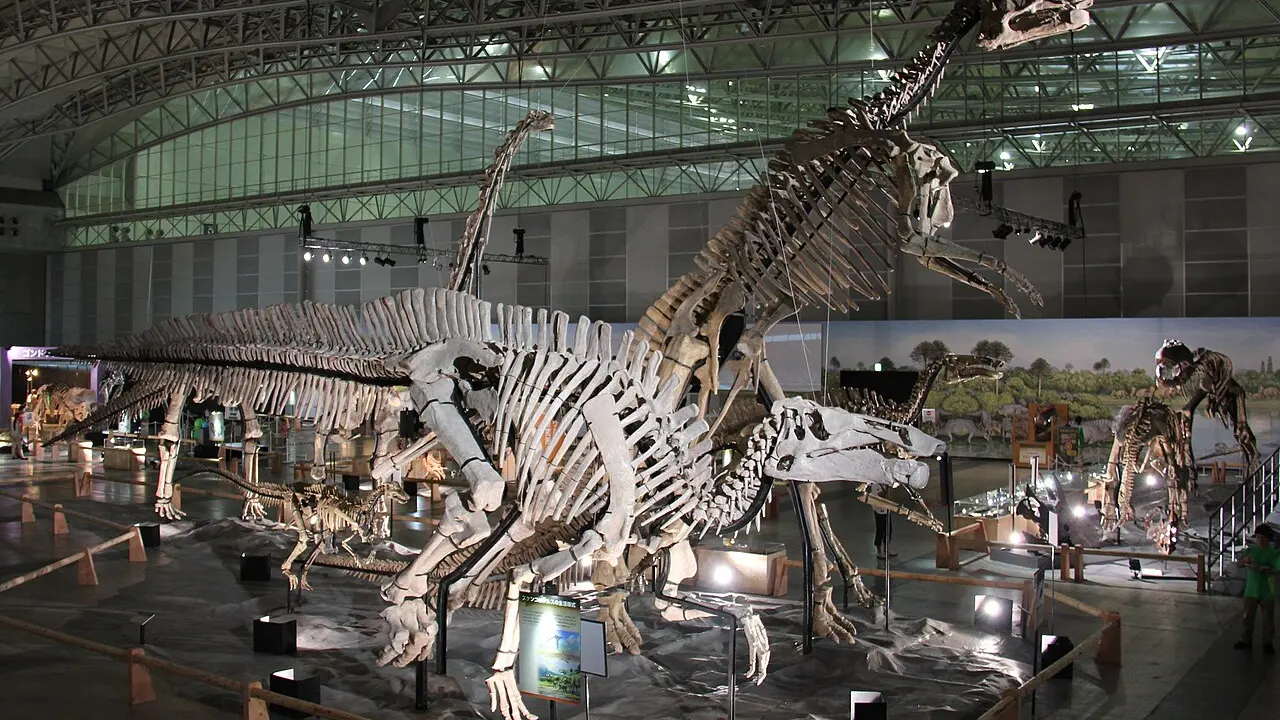
One single leg bone from Shantungosaurus is taller than most grown-up humans!
✨ Word Sparks (Grade 1 Glossary)
Tap 🔊 to hear
colossal
extraordinarily huge and heavy in size
bellow
to make a deep, loud roaring sound
twig
a thin woody shoot on a branch
🪝
Could a duck-billed dinosaur grow even bigger than Tyrannosaurus rex?
1
Bigger Than T. rex!
Thump, boom, thump! The ground shakes as a giant walks out of the trees. Shantungosaurus was the biggest duck-billed dinosaur ever found! It weighed as much as three elephants.
2
So Many Teeth
This huge plant-eater lived in ancient China. Inside its big jaws sat fifteen hundred tiny teeth to mash tough and leaves.
3
Loud Nose Honks
Loose skin over its big nose hole could puff up like a balloon. Honk! That loud call warned its herd of danger.
1. Where did Shantungosaurus live millions of years ago?
2. How might Shantungosaurus have made loud calls to its herd?
🤯 Mind-Blowing Fact • Grade 2
A mounted Shantungosaurus skeleton in Beijing measures nearly fifty feet long from its flat beak to the tip of its tail!
✨ Word Sparks (Grade 2 Glossary)
Tap 🔊 to hear
pillar
a thick, strong post supporting heavy weight
pulp
a soft, mashed-up wet mixture
skeleton
all the bones framing an animal body
🪝
What happens when a duck-billed dinosaur grows longer than a bowling alley lane?
1
King of the Duck-Bills
Look way up! Usually, only long-necked dinosaurs grew to giant sizes, yet Shantungosaurus broke that rule. Stretching over fifty feet long and weighing up to sixteen tons, it towered above every meat-eater in its neighborhood.
2
Built Like a Living Tank
Because it carried so much weight, Shantungosaurus walked mostly on four thick, -like legs. Still, its powerful back legs and stiff tail helped balance its massive body across muddy river plains in eastern China.
3
Nonstop Plant Muncher
Feeding a sixteen-ton body took serious chewing! Its wide, flat beak scooped up ferns, pine branches, and shrubs, while sixty rows of tightly packed cheek teeth ground every bite to .
1. How many teeth could fit inside the jaws of Shantungosaurus?
2. How did Shantungosaurus compare in size to Tyrannosaurus rex?
🤯 Mind-Blowing Fact • Grade 3
During the 1960s excavations in Shandong, workers hauled out more than thirty metric tons of fossilized dinosaur bones from a single gully!
✨ Word Sparks (Grade 3 Glossary)
Tap 🔊 to hear
excavate
to carefully dig fossils out of ground
ornithischian
a member of the bird-hipped dinosaur group
resonate
to echo and fill with deep sound
🪝
Why do people call a town in eastern China Dinosaur City, and which giant steals the spotlight there?
1
Treasures of Dinosaur Ravine
Imagine digging into a rocky hillside in Shandong Province, China, and uncovering thirty tons of fossilized bones! Starting in 1964 near the city of Zhucheng, Chinese scientists excavated thousands of bones belonging to an astonishing duck-billed giant. In 1973, paleontologist Hu Chengzhi named it Shantungosaurus giganteus.
2
Record-Breaking Ornithischian
Dinosaurs split into two big hip groups, and bird-hipped dinosaurs—called —included horned, armored, and duck-billed species. Shantungosaurus holds the crown as the largest bird-hipped dinosaur ever discovered, reaching lengths above fifty feet and weighing twice as much as Tyrannosaurus rex!
3
Flat Head, Booming Voice
Unlike crested cousins such as Parasaurolophus, Shantungosaurus had a long, flat skull without a bony tube. However, a deep pit surrounded its giant nostrils, likely anchoring an inflatable skin sac that resonated deep horn-like calls across wide floodplains.
4
Standing Tall Against Predators
Shantungosaurus shared its lush river valleys with Zhuchengtyrannus, a giant cousin of T. rex. Full-grown adults were so enormous that even fierce tyrannosaurs thought twice before challenging a healthy giant.
1. What record does Shantungosaurus hold among all known dinosaurs?
2. Which giant meat-eater lived alongside Shantungosaurus in ancient China?
🤯 Mind-Blowing Fact • Grade 4
A single femur bone from the largest Zhucheng hadrosaur specimen measures about 1.7 meters—roughly five feet seven inches long!
✨ Word Sparks (Grade 4 Glossary)
Tap 🔊 to hear
gigantism
evolution of unusually enormous body size
tendon
tough cord connecting muscle to solid bone
femur
the heavy upper bone of the leg
🪝
How did a duck-billed herbivore evolve sauropod-scale size without growing a long neck?
1
Giants of the Wangshi Floodplains
Picture a broad, sun-warmed river basin in Late Cretaceous eastern China about seventy-five million years ago. Towering conifers and ginkgoes line braided streams where herds of Shantungosaurus wade through shallow marshes. Reaching lengths up to fifty-four feet and masses approaching sixteen tons, this colossus from the Wangshi Group pushed the duck-billed body plan to its absolute physical limit.
2
Industrial-Strength Dental Batteries
Sauropods reached giant sizes by gulping unchewed leaves down long necks and letting huge guts ferment the meal. Shantungosaurus achieved the opposite way—by supercharging oral processing! Its massive jaws held over sixty vertical tooth columns packed with roughly 1,500 tiny diamond-shaped teeth, pulverizing coarse woody stems so nutrients absorbed rapidly.
3
Weight-Bearing Limbs and Stiffened Tails
Supporting sixteen tons required heavy engineering. Its stood nearly five feet seven inches tall, thicker than tree trunks, while crisscrossed bony stiffened its muscular tail like a suspension bridge. Although youngsters probably trotted on two legs, massive adults walked mostly on all fours and could not sprint—relying instead on sheer size and herd defense.
4
Mass Bonebeds of Zhucheng
Vast bonebeds near Zhucheng preserve hundreds of disarticulated hadrosaur bones swept together by ancient seasonal floods, giving scientists specimens from mid-sized subadults to record-shattering elders.
1. How did Shantungosaurus process food differently from giant long-necked sauropods?
2. What kept the heavy tail of Shantungosaurus held straight off the ground?
🤯 Mind-Blowing Fact • Grade 5
Scientists studying the giant Zhucheng fossils realized that specimens once given a separate name, Huaxiaosaurus, likely represent giant elder adults of Shantungosaurus measuring over fifty-four feet long!
✨ Word Sparks (Grade 5 Glossary)
Tap 🔊 to hear
diverticulum
a pouch or sac branching off a passage
quadrupedal
walking primarily on all four limbs
alluvial
formed by sand and mud left by rivers
🪝
What biomechanical adaptations allowed Shantungosaurus to become the heaviest ornithischian dinosaur in Earth's history?
1
Discovery in Shandong's Bone Gully
In 1964, geological survey crews exploring Longgujian—literally Dragon Bone Ravine—near Zhucheng on China's Shandong Peninsula exposed one of the richest Cretaceous fossil quarries on Earth. Over four field seasons, excavators recovered more than thirty metric tons of hadrosaurid skeletal elements from Campanian deposits of the Wangshi Group. Studying bones from at least five individuals, paleontologist Hu Chengzhi formally described Shantungosaurus giganteus in 1973, unveiling a duck-billed herbivore of unprecedented proportions.
2
Redefining Ornithischian Size Limits
Before Shantungosaurus, paleontologists assumed multi-ton megaherbivory above ten tons belonged exclusively to sauropodomorphs. Composite mounts in Beijing measure 14.7 meters long, while an even larger specimen later named Huaxiaosaurus—widely regarded by researchers as a mature growth stage of Shantungosaurus—reaches 16.6 meters (54 feet) and an estimated 13 to 16 metric tons, surpassing the largest known Tyrannosaurus skeletons by nearly double in body mass.
3
Cranial Anatomy and Acoustic Signaling
Classified within Saurolophinae, the flat-headed branch of hadrosaurids closely allied with North America's Edmontosaurus, Shantungosaurus lacked hollow bony crests. Instead, deep circumnarial excavations framed enormous external nostrils. Soft-tissue reconstructions indicate a loose of skin covered this basin, inflating when exhaled air rushed past to broadcast low-frequency infrasound across dense floodplain forests.
4
Quadrupedal Gravigrade Mechanics
Scaling up a bipedal ornithopod chassis to sixteen tons reshaped its locomotion. Massive pillar-like femora measuring 1.7 meters, robust forelimbs, and an ossified tendon trellis along the dorsal and caudal spine distributed immense gravitational loads. Biomechanical models show adults adopted habitual walking and could no longer achieve an aerial running phase.
5
Coexistence in a Giant-Dominated Ecosystem
Sharing plains with the giant tyrannosaurid Zhuchengtyrannus magnus and horned Sinoceratops, adult Shantungosaurus relied on sheer adult invulnerability and synchronized herd vigilance to dominate Late Cretaceous eastern Asia.