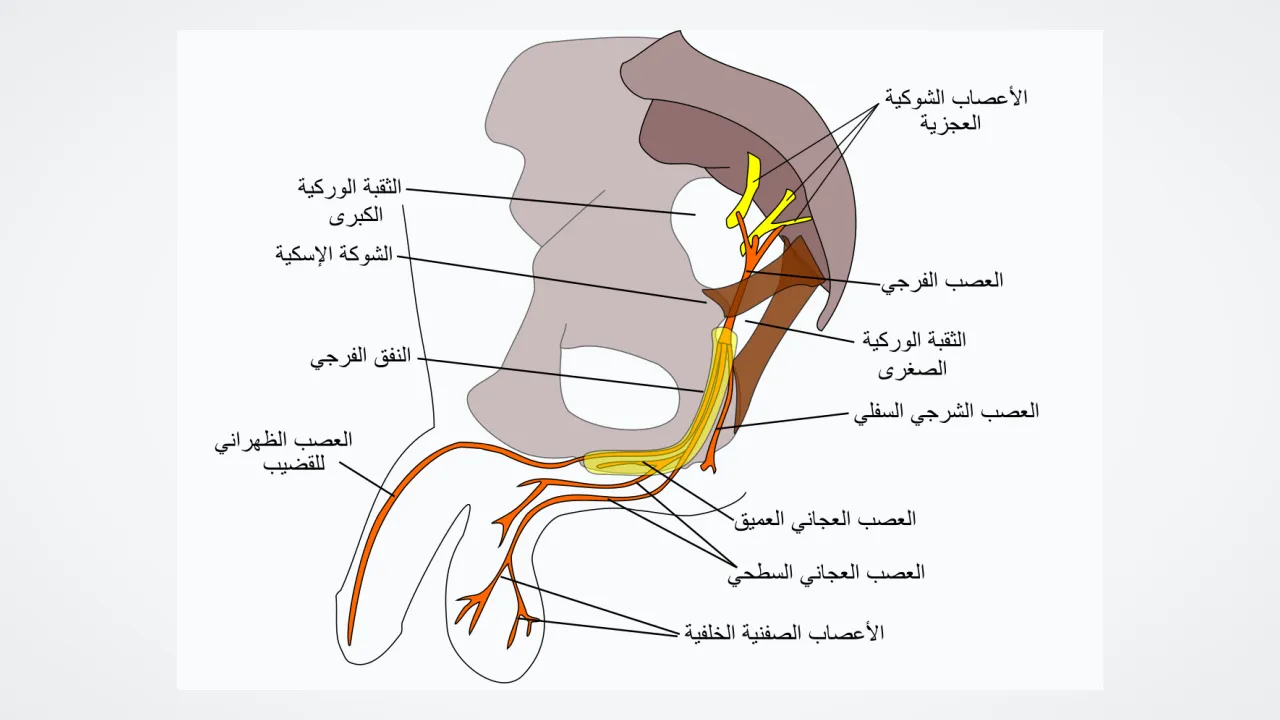
1. Where does the sciatic nerve travel inside your body?
2. About how wide is the sciatic nerve near your hip?
🤯 Mind-Blowing Fact • Grade 2
Inside one thumb-thick sciatic nerve cable, hundreds of thousands of microscopic nerve fibers travel side by side like tiny fiber-optic strands!
✨ Word Sparks (Grade 2 Glossary)
Tap 🔊 to hear
braid
To weave separate strands into one rope
thigh
The strong upper part of your leg
tingle
A fizzy tickly feeling on your skin
🪝
Why does sitting cross-legged too long sometimes make your foot feel fizzy with pins and needles?
1
Champion of All Nerves
Sprint across the playground, kick a soccer ball, and land on one foot! Powering those strong leg moves is the sciatic nerve, the longest and thickest nerve in your entire body.
2
Five Roots Braided Together
Near the bottom of your backbone, five smaller spinal nerves together like strands of a sturdy rope. That thick cable slips past your hip and travels down the back of your before splitting behind your knee.
3
Fizzy Pins and Needles
Have you ever sat awkwardly until your foot 'fell asleep'? Gently squishing part of this nerve path slows messages for a minute—until standing up lets signals sparkle back to normal!
1. How is each sciatic nerve formed near the bottom of your spine?
2. Where does the sciatic nerve split into two main branches?
🤯 Mind-Blowing Fact • Grade 3
Single motor axons inside a tall basketball player's sciatic nerve branches can measure well over three and a half feet long—making them the longest cells in the human body!
✨ Word Sparks (Grade 3 Glossary)
Tap 🔊 to hear
peripheral
Nerves branching outside brain and spinal cord
hamstring
Muscle group along the back of thigh
lumbar
Relating to the sturdy lower back curve
🪝
How does one braided nerve cable let you both flex your heel to climb stairs and point your toes like a dancer?
1
A Super-Cable Built for Upright Walking
Humans balance tall on two powerful legs—jumping, pedaling bikes, and climbing stairs every day. Coordinating all that strength takes a heavy-duty communication line! Measuring up to two centimeters wide at its start, the sciatic nerve is the undisputed giant of your nervous system.
2
From Spine Through Hip
Five nerve roots exiting your lower and sacral vertebrae merge into one ribbon-like trunk. Passing deep beneath your gluteal hip muscles, this protected cable runs straight down the back of your thigh, commanding your muscles whenever you bend your knee.
3
Splitting Behind the Knee
Just above the back of your knee, the sciatic trunk forks into two major branches: the tibial nerve down your calf to the sole of your foot, and the common fibular nerve wrapping forward to lift your toes so you never trip.
4
Mixed Two-Way Traffic
Because it is a 'mixed' nerve, motor commands zoom downward to muscles at the exact same moment sensory signals carry warm sand or cool puddle feelings upward!
1. Why do scientists call the sciatic nerve a 'mixed' nerve?
2. Which thigh muscles get their bending power directly from the sciatic nerve?
🤯 Mind-Blowing Fact • Grade 4
Your sciatic nerve is so tough and elastic that its connective-tissue wrappers let it stretch and slide several millimeters cleanly every time you kick high or touch your toes!
✨ Word Sparks (Grade 4 Glossary)
Tap 🔊 to hear
fascicle
A neat bundle of nerve or muscle fibers
plexus
A braided network of intersecting body nerves
plantarflexion
Pointing your foot downward to push off
🪝
How is a thumb-wide nerve organized inside like an armored transatlantic undersea cable?
1
Cable-Within-a-Cable Engineering
Slice open a model of an undersea internet cable and you will see dozens of smaller fiber bundles wrapped in tough protective jackets so ocean currents never snap the wires. Your sciatic nerve uses that exact engineering blueprint! Individual myelinated axons wear delicate wraps called endoneurium, group into neat bundles called inside sleeves of perineurium, and finally unite inside a stretchy outer jacket called epineurium—complete with its own tiny blood vessels!
2
Born in the Sacral Plexus
Deep inside the pelvis, anterior nerve roots from spinal segments L4, L5, S1, S2, and S3 weave together in a network called the sacral . Exiting through the greater sciatic foramen beneath the piriformis hip muscle, the newly united sciatic nerve descends safely behind the femur bone.
3
Tibial Push and Fibular Lift
At the diamond-shaped hollow behind the knee—the popliteal fossa—its two partner divisions separate. The tibial division powers (pushing off the ball of your foot to sprint or leap), while the common fibular division powers dorsiflexion (lifting your forefoot clear of each stair step).
4
Keeping Your Sciatic Highway Happy
Stretching tight hamstrings, sitting with good posture, and staying active keep muscles around the hip flexible so this busy cable glides smoothly with every stride.
1. Which five spinal nerve segments weave together to form the sciatic nerve?
2. Why are axons inside the sciatic nerve grouped into fascicles wrapped in stretchy connective tissue?
🤯 Mind-Blowing Fact • Grade 5
Tiny walking proteins called kinesins carry supplies down your sciatic nerve axons step-by-step, taking more than one hundred thousand molecular footsteps just to travel a single millimeter!
✨ Word Sparks (Grade 5 Glossary)
Tap 🔊 to hear
kinesin
A walking motor protein hauling cell cargo
paresthesia
Harmless pins-and-needles tingling when nerves wake
bipedal
Walking upright balanced on two legs
🪝
How does a single cell body smaller than a grain of dust maintain an axon stretching a full meter down your leg?
1
Two Nerves Sharing One Jacket
Anatomists have a favorite secret about the nervus ischiadicus, whose name traces back to the Greek 'ischion' for hip socket: although it looks like one solid two-centimeter trunk leaving the pelvis, it is actually two independent nerves—the tibial and common fibular nerves—bundled side by side inside a shared epineurial sheath! Their axons never trade signals inside the thigh, and in roughly twelve percent of people the two divisions split high in the hip right where they cross the piriformis muscle.
2
A Meter-Long Supply Chain
Consider the logistical marvel facing a single motor neuron in spinal segment L5 whose axon reaches an intrinsic muscle in your big toe. If its fifty-micrometer soma were scaled up to the size of a basketball, its axon would resemble a garden hose stretching nearly four miles! To keep that distant tip alive, molecular motor proteins called and dynein march tirelessly along microtubule tracks in fast axonal transport—hauling fresh mitochondria and vesicles downward at up to four hundred millimeters per day while returning worn parts upward for recycling.
3
Biomechanics of Bipedal Locomotion
Every human stride demands split-second coordination across sciatic branches: hamstring fibers decelerate the swinging leg, tibial branches fire the powerful gastrocnemius and soleus calf muscles to launch bodyweight forward, and fibular branches lift the toes during swing phase while cutaneous branches map pressure across the sole and outer ankle.
4
Vasa Nervorum and Temporary Compression
Because packed axons burn steady oxygen, tiny dedicated blood vessels called vasa nervorum thread right through the epineurium and perineurium. Crossing your legs tightly briefly pinches these micro-vessels and pauses fast myelinated signals—creating harmless temporary numbness followed by fizzy ('pins and needles') as circulation and firing resume.
5
Peripheral Regeneration Superpower
Unlike central spinal tracts, injured peripheral sciatic fibers can often regrow at roughly one millimeter per day—guided down surviving Schwann-cell tubes like seedlings following a trellis!