2. Who first spotted the giant Sauroposeidon bones sticking out of Oklahoma clay?
🤯 Mind-Blowing Fact • Grade 2
Each single neck bone of Sauroposeidon was over four and a half feet long, yet its outer bone wall was as thin as a chicken eggshell in places!
✨ Word Sparks (Grade 2 Glossary)
Tap 🔊 to hear
scanner
a machine using X-rays to see inside
honeycomb
many tiny six-sided rooms packed close together
footprint
a mark pressed into mud by a foot
🪝
Why did museum scientists think Sauroposeidon's neck bones were petrified tree trunks—until they put them inside a hospital scanner?
1
Too Big to Look Like Bone!
When diggers pulled four connected fossils over four feet long each out of Oklahoma clay in 1994, they looked so huge and papery-thin that people assumed they were fossilized tree trunks! For five years they sat quietly in storage.
2
A Trip to the Hospital Scanner
In 1999, a curious student slid those stone 'logs' through a hospital X-ray . Glowing on the screen was a of tiny air chambers—proving they were neck bones from the tallest dinosaur ever found!
3
Leaving Giant Tracks in Texas
Close-cousin sauropod pressed into ancient Texas river mud are big enough for a kid to sit in like a bathtub!
1. Why did museum staff think Sauroposeidon's neck fossils were fossilized tree trunks at first?
2. What machine revealed the honeycomb air cells hidden inside Sauroposeidon's neck bones?
🤯 Mind-Blowing Fact • Grade 3
To carry the giant Oklahoma neck fossils out of the mud, crews had to cut the specimen right through one vertebra because the whole block weighed three tons!
✨ Word Sparks (Grade 3 Glossary)
Tap 🔊 to hear
cylindrical
shaped like a long round tube or log
lagoon
shallow coastal water sheltered from open sea
trackway
a trail of fossil footprints left together
🪝
How did a graduate student and a hospital CT team uncover America's tallest dinosaur?
1
Hidden on Prison Ranch Land
In May 1994, canine trainer Bobby Cross noticed giant fossils eroding out of clay at a prison ranch in southeastern Oklahoma. Excavators sawed the four connected five-foot cylinders into three-ton plaster blocks—still puzzled over whether wood or bone lay inside!
2
Hospital X-Rays Crack the Case
Five years later, paleontologist Richard Cifelli asked student Matt Wedel to investigate. Teaming up with technicians at University Hospital in Oklahoma City, Wedel CT-scanned the blocks and gasped: up to eighty-nine percent of the interior was air-filled honeycomb bone!
3
Named After the Earthquake God
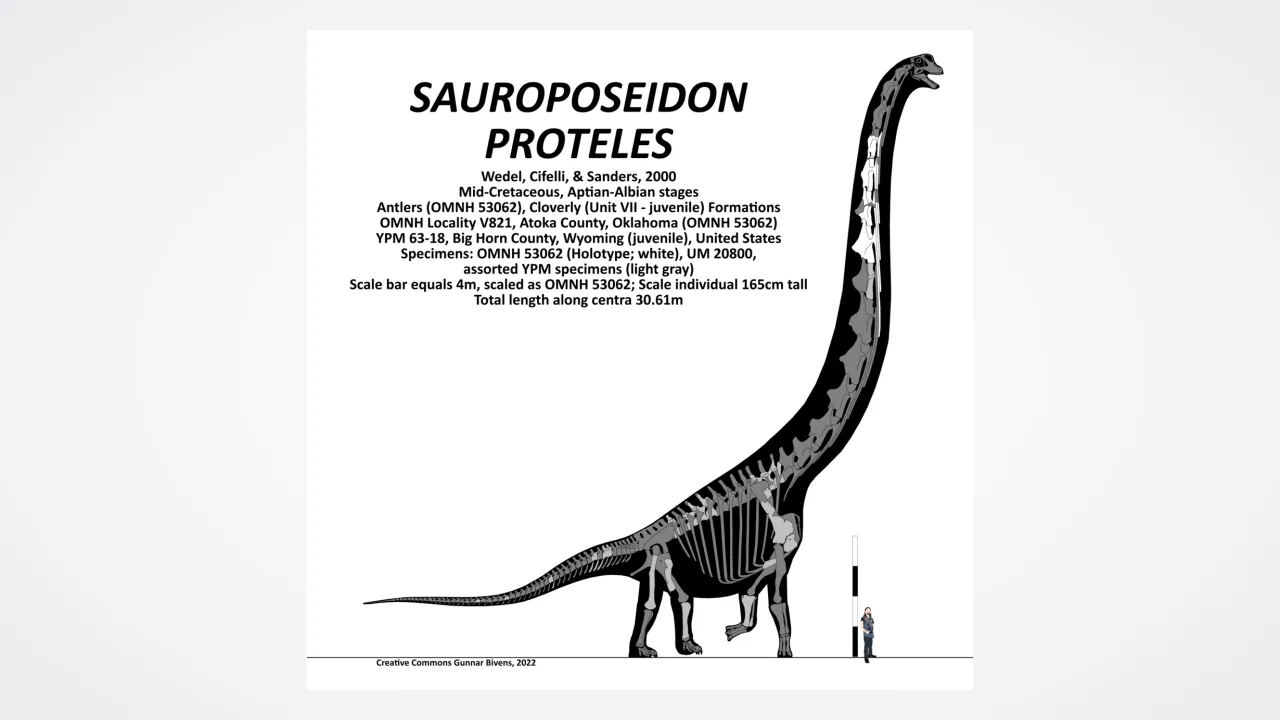
Announced in 2000 as Sauroposeidon proteles—'lizard earthquake god, perfected before the end'—its forty-foot neck lifted its head fifty-six to sixty feet high, about twelve feet higher than Giraffatitan!
4
Strolling Gulf Coast Lagoons
Around 112 million years ago, Oklahoma bordered the warm Gulf of Mexico. More complete Texas skeletons (originally named Paluxysaurus) show Sauroposeidon left famous Paluxy River alongside stalking Acrocanthosaurus!
1. Why does Sauroposeidon's species name proteles mean 'perfected before the end'?
2. How high did Sauroposeidon reach compared with Berlin's famous Giraffatitan?
🤯 Mind-Blowing Fact • Grade 4
Along the Paluxy River in Glen Rose, Texas, 112-million-year-old limestone preserves giant bathtub-sized Sauroposeidon footprints paralleled by the three-toed tracks of a stalking meat-eater!
✨ Word Sparks (Grade 4 Glossary)
Tap 🔊 to hear
cross-section
view seen when slicing straight across something
tidal flat
muddy coast covered and uncovered by tides
paralleled
followed right alongside in the same direction
🪝
How can four neck vertebrae from Oklahoma and a ranch bonebed in Texas unite to reveal the tracks and predator chases of a fifty-ton giant?
1
Engineering Extreme Lightness
Imagine holding a dinosaur vertebra measuring 1.4 meters (4.6 feet) long—a full third longer than Giraffatitan's longest neck bone—yet discovering its internal walls are thinner than cardboard! When Matt Wedel, Richard Cifelli, and R. Kent Sanders unveiled Sauroposeidon proteles in 2000, hospital CT scans proved camellate air cells occupied up to 89 percent of the bone , letting Sauroposeidon hoist an eleven-to-twelve-meter neck nearly eighteen meters into the Early Cretaceous sky.
2
Connecting the Paluxysaurus Puzzle
At first, critics wondered what the rest of Sauroposeidon's body looked like beyond those four Oklahoma neck vertebrae. Then in 2012, paleontologist Michael D'Emic re-examined dozens of sauropod limb, back, and skull bones from nearby Early Cretaceous rocks at Jones Ranch, Texas—previously named Paluxysaurus jonesi—and demonstrated they belonged to the exact same animal: Sauroposeidon!
3
Footprints Locked in Stone Drama
Uniting those fossils solved another famous Texas mystery: who pressed the yard-wide sauropod footprints along Glen Rose's Paluxy Riverbed? Sauroposeidon feet matched those Early Cretaceous tracks—including dramatic trackways shadowed step-for-step by the forty-foot spine-backed predator Acrocanthosaurus!
4
Canopy King of the Ancient Gulf Coast
Towering over cypress swamps, conifer groves, and 112 million years ago, adult Sauroposeidon weighed fifty tons and grazed sunlit treetops no rival herbivore could touch.
1. How did studying Texas fossils originally called Paluxysaurus help complete our picture of Sauroposeidon in 2012?
2. What dramatic scene is preserved in stone along the Paluxy River in Glen Rose, Texas?
🤯 Mind-Blowing Fact • Grade 5
Although Sauroposeidon's longest neck vertebra was a third longer than Giraffatitan's, its main bone cylinder was actually slightly slimmer—packed with up to 89% air like high-tech aerospace foam!
✨ Word Sparks (Grade 5 Glossary)
Tap 🔊 to hear
somphospondylan
sauropod clade with spongy honeycomb air vertebrae
ichnofossils
fossilized footprints, burrows, or tracks of behavior
septa
paper-thin dividing walls between internal air chambers
🪝
How did medical CT imaging of 'petrified logs' and taxonomic unification across Texas and Oklahoma reveal probably the tallest land animal in Earth's history?
1
Mistaken Wood in the Antlers Formation
Unearthed in 1994 on Howard McLeod Correctional Center ranchland in Atoka County, Oklahoma, holotype OMNH 53062 consisted of four articulated mid-cervical vertebrae (C5 through C8) so hyper-elongated and thin-walled that preparators initially filed them away as mineralized angiosperm trunks! In 1999, graduate researcher Mathew Wedel partnered with Oklahoma City radiologists to run helical CT scans through the plaster-jacketed blocks—revealing delicate camellate pneumatic chambers separated by 1-to-3-millimeter bony and launching the 2000 description of Sauroposeidon proteles.
2
Pushing Vertebral Pneumaticity to Its Limit
Eighth cervical vertebra C8 measured an astonishing 1,400 millimeters (4.6 feet) in length—roughly 25 to 33 percent longer than the longest homologous vertebra in Giraffatitan brancai—yet possessed a narrower centrum diameter! Internal air-space fractions reached up to 89 percent, representing the evolutionary pinnacle of ('spongy-vertebra') skeletal lightening and enabling an 11.5-to-12-meter neck capable of reaching 16.5 to 18 meters (54 to 59 feet) vertically.
3
Reclassification and Synonymy With Paluxysaurus
Initially classified as a giant brachiosaurid, Sauroposeidon gained whole-body clarity in 2012 when Michael D'Emic re-evaluated Early Cretaceous (Aptian–Albian, ~113–110 MYA) sauropod bonebeds from Texas's Twin Mountains and Glen Rose Formations—including material named Paluxysaurus jonesi. Overlapping cervical and dorsal apomorphies synonymized Paluxysaurus into Sauroposeidon and placed it within Somphospondyli, closer to titanosaurs than to Jurassic Brachiosaurus.
4
Trackmaker of the Glen Rose Ichnofossils
Linking Sauroposeidon to abundant Texas appendicular skeletons also identified the architect behind Roland T. Bird's iconic Paluxy River trackways (Brontopodus birdi), where meter-wide sauropod pes prints traverse carbonate tidal flats trailed closely by carcharodontosaurian theropod tracks attributed to Acrocanthosaurus atokensis.
5
Twilight of Native North American Sauropods
Weighing an estimated 40 to 60 metric tons, Sauroposeidon reigned over warm Gulf Coast estuaries just before mid-Cretaceous sea-level rise and floral turnover triggered North America's 35-million-year sauropod hiatus.