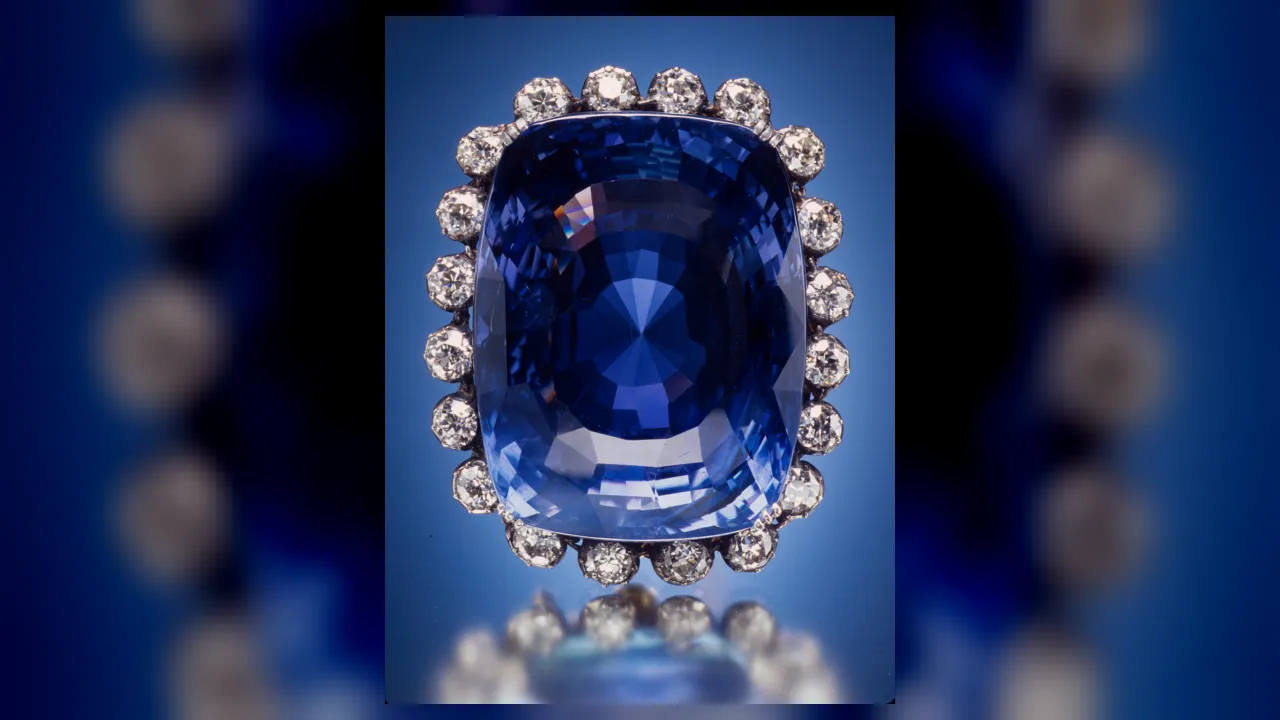
1. Which color of this mineral family is NOT called a sapphire?
2. Why is clear lab-grown sapphire used on nice watches and camera lenses?
🤯 Mind-Blowing Fact • Grade 2
The state of Montana is famous across North America for sparkling blue and pastel sapphires washed into gravel bars along the Missouri River!
✨ Word Sparks (Grade 2 Glossary)
Tap 🔊 to hear
titanium
A strong lightweight metal found in minerals
gravel
Loose rounded pebbles along rivers and streams
pastel
A soft pale shade of a color
🪝
What two metals team up inside Earth to paint a sapphire velvety blue?
1
Barrel-Shaped Treasure
Dig through mountain stream in Montana or Sri Lanka and you might spot a six-sided crystal shaped like a tiny barrel. Hold it up to the sun and velvety blue light shines right through!
2
Teamwork Makes It Blue
Like its sister gem ruby, sapphire is made of the super-hard mineral corundum. When tiny traces of iron and sit side by side inside the crystal, they trade tiny sparks of energy that absorb red light and leave vivid blue.
3
Fancy Colors in Nature
Geologists call non-blue gems fancy sapphires. Iron alone turns sapphire golden yellow, while a rare mix of pink and orange looks just like a tropical lotus flower!
1. Which two metals team up to turn a clear sapphire crystal deep blue?
2. Which U.S. state is famous for sapphire crystals found in river gravel?
🤯 Mind-Blowing Fact • Grade 3
Supermarket checkout barcode scanners often use synthetic sapphire windows so thousands of sliding cans and jars won't scratch the glass!
✨ Word Sparks (Grade 3 Glossary)
Tap 🔊 to hear
vanadium
A metal element that creates color-changing gems
padparadscha
A rare pink-orange lotus-colored sapphire gem
synthetic
Grown in a science lab with real chemistry
🪝
How can one sapphire look blue in sunlight and purple under a bedroom lamp?
1
Masters of Disguise
Step outside at noon holding a rare color-change sapphire and it gleams cornflower blue. Carry that exact same stone indoors under warm yellow lamplight and—presto—it shifts to rich violet-purple! Trace inside the crystal absorbs different light waves depending on the light source.
2
Hardness Nine Champions
Sapphire is every variety of aluminum oxide mineral corundum except red ruby. Ranking nine on the Mohs Hardness Scale, sapphire easily scratches quartz sand and steel keys, which helps crystals survive tumbling down rocky mountain rivers.
3
Rare Sunset Padparadscha
Collectors prize a rare pinkish-orange variety from Sri Lanka called , named after the Sinhalese word for aquatic lotus blossom. Tiny amounts of both chromium and iron blend sunset pink with warm apricot orange.
4
Armor for Grocery Scanners and Rockets
Next time groceries slide across a supermarket barcode scanner, look at the clear window. Engineers often make scanner plates and spacecraft sensor windows from lab-grown sapphire so sliding cans and flying dust cannot scratch them!
2. Why do supermarket barcode scanners use synthetic sapphire plates?
🤯 Mind-Blowing Fact • Grade 4
Large boules of ultra-pure synthetic sapphire weighing hundreds of pounds are grown in furnaces to build super-cooled mirrors for gravitational-wave observatories!
✨ Word Sparks (Grade 4 Glossary)
Tap 🔊 to hear
alluvial
Deposited by flowing rivers and mountain streams
density
How much mass is packed into a space
infrared
Invisible heat-sensing light beyond red wavelengths
🪝
Why does it take TWO different metal atoms sharing an electron to turn a sapphire blue?
1
An Atomic Game of Catch
In many minerals, a single impurity element creates color all by itself, yet blue sapphire relies on atomic teamwork. Inside its hexagonal aluminum oxide lattice, an iron ion sits right beside a titanium ion. When daylight enters the gem, an electron hops back and forth between iron and titanium! That tiny leap absorbs red and yellow wavelengths, letting deep velvety blue light shine back to your eyes.
2
Alluvial Placer Deposits
Earth science explorers study weathering and erosion to understand where gems gather. Because sapphire has high —about four times heavier than water—and extraordinary Mohs 9 hardness, crystals survive long after softer host rocks crumble away. Fast mountain streams sort heavy sapphires into rich gravel pockets called placer deposits in Sri Lanka, Madagascar, Kashmir, and Montana.
3
Heat Treatment in Nature and Workshops
Cloudy sapphires packed with microscopic titanium-oxide needles often look pale gray when mined. Heating the stone to around 1,500 degrees Celsius dissolves those needles into the lattice, deepening the blue color—a process that sometimes happens naturally near volcanic magma.
4
Extreme Engineering Crystal
Synthetic colorless sapphire melts only above 2,040 degrees Celsius, stays transparent from ultraviolet to wavelengths, and resists blistering acid. Engineers mount sapphire windows on deep-sea submersibles, high-speed infrared sensors, and planetary probes.
1. Why do sapphires collect in riverbeds as alluvial placer deposits?
2. What happens at the atomic level to produce blue color in sapphire?
🤯 Mind-Blowing Fact • Grade 5
Every bright white LED bulb in modern homes owes a debt to sapphire—thin synthetic sapphire wafers serve as the crystal foundation on which blue LED semiconductor layers are grown!
✨ Word Sparks (Grade 5 Glossary)
Tap 🔊 to hear
charge transfer
Electrons hopping between neighboring metal ions
cryogenic
Chilled to ultra-cold temperatures near absolute zero
substrate
A crystal base layer supporting electronics growth
🪝
How can giant synthetic sapphire mirrors chilled near absolute zero detect ripples in spacetime from colliding black holes?
1
Intervalence Charge Transfer
Pick up a transparent crystal of pure corundum (Al2O3) and light passes straight through unhindered. Introduce just 0.01 percent iron (Fe2+) alongside titanium (Ti4+) substituting for octahedral aluminum ions, however, and an extraordinary quantum effect called intervalence switches on. Incoming photons supply the exact energy needed for an electron to jump from Fe2+ to adjacent Ti4+, momentarily forming Fe3+ and Ti3+. That single electronic hop absorbs a broad band of yellow-red light, leaving intense royal blue transmission from trace impurities.
2
Kashmir Velvet and Montana Yogo
Geologists trace world-class sapphires to distinct tectonic settings. High in the Zanskar range of Kashmir, 19th-century landslides exposed pegmatite-like veins cutting metamorphic rocks, yielding sapphires prized for microscopic inclusions that scatter light like soft blue velvet. Meanwhile, at Yogo Gulch in central Montana, an ultramafic lamprophyre dike carried naturally vivid, inclusion-free cornflower-blue sapphires rapidly from the deep lithosphere.
3
Trace Chromophores Across the Spectrum
Because gemologists define ruby strictly as chromium-dominant red corundum, every other color variety belongs to sapphire. Ferric iron (Fe3+) alone yields sunny yellow and green sapphires; trace chromium produces vivid pink; vanadium drives alexandrite-like color shift; and paired iron-chromium chromophores create coveted salmon-pink padparadscha gems.
4
Optical Windows and LED Substrates
In materials science, synthetic monocrystalline sapphire grown via the Kyropoulos or Czochralski method serves as a cornerstone of modern photonics. Thin sapphire wafers match the hexagonal crystal geometry needed to grow gallium nitride semiconductors—the technology behind high-efficiency blue and white LED lightbulbs.
5
Listening to Spacetime in Japan's KAGRA Detector
Deep inside a mountain tunnel in Japan, the KAGRA gravitational-wave observatory suspends 23-kilogram optically polished sapphire test mirrors cooled to 20 kelvins. At temperatures, crystalline sapphire conducts heat rapidly while vibrating with near-zero thermal noise, letting lasers measure subatomic ripples from distant black-hole mergers.