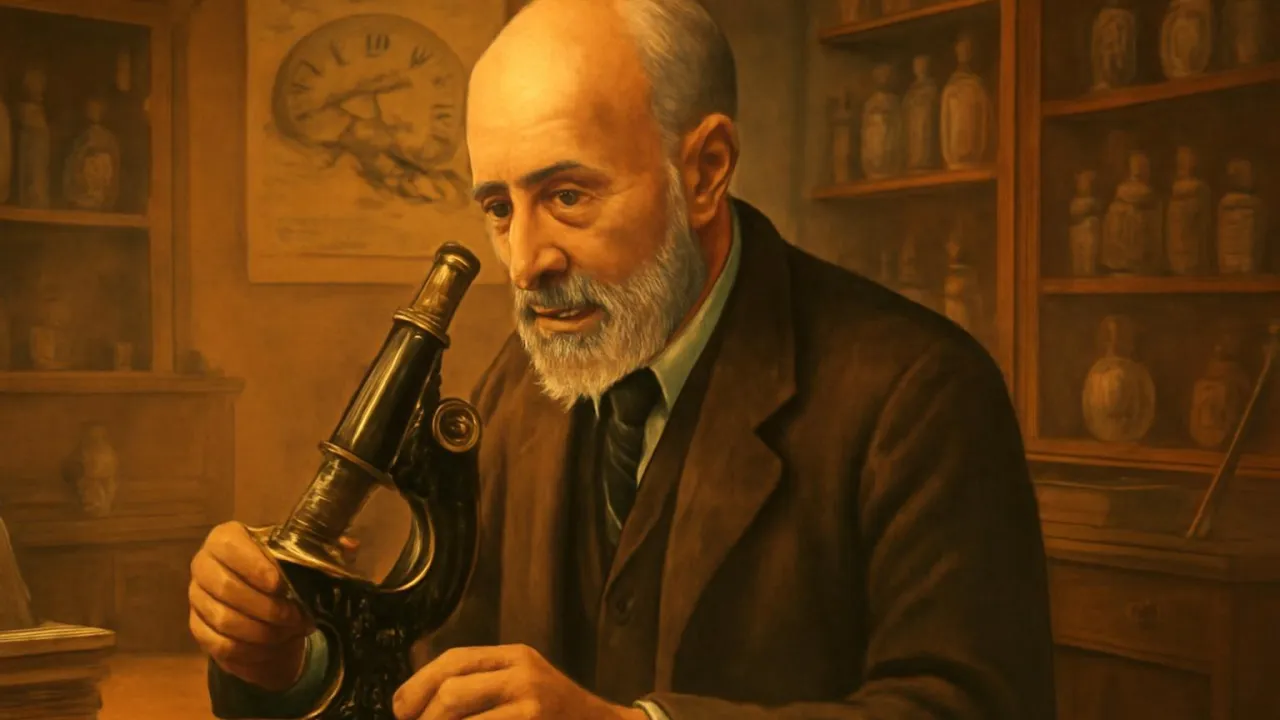
1. What did Santiago like to look at with his tool?
2. What did Santiago draw pictures of?
🤯 Mind-Blowing Fact • Grade 2
Santiago Ramón y Cajal won the Nobel Prize for his brain cell discoveries!
✨ Word Sparks (Grade 2 Glossary)
Tap 🔊 to hear
microscope
A tool that helps you see very tiny things
connect
To join or link things together
Nobel Prize
A special award for great discoveries or work
🪝
How can tiny brain cells help us learn and think every day?
1
A Boy Who Loved Tiny Things
Santiago was curious about the smallest things in the world. He used a to see tiny cells. He practiced drawing what he saw carefully every day.
2
Hard Work and Practice
He worked very hard to understand the brain’s secrets. Santiago studied how brain cells and send messages. His drawings helped scientists learn more about the brain.
3
A Big Discovery
Santiago showed that the brain is made of many separate cells. This idea changed how people thought about the brain. He won a big prize called the .
Santiago’s neuron drawings are still used by scientists to study the brain today!
✨ Word Sparks (Grade 3 Glossary)
Tap 🔊 to hear
neuron
A special brain cell that sends messages
synapse
A tiny gap where neurons send signals
perseverance
Trying hard and not giving up
🪝
What would happen if you could see the brain’s tiny parts like Santiago did?
1
Childhood Curiosity
Santiago Ramón y Cajal was fascinated by tiny details in nature from a young age. His curiosity led him to use a microscope to explore the unseen world of cells. He believed that understanding these tiny parts could explain how the brain works.
2
Perseverance and Discovery
He practiced drawing brain cells carefully for many years to show their shapes and connections. Santiago’s helped him discover that are separate cells, not a continuous network. This discovery was a breakthrough in neuroscience.
3
Scientific Vocabulary
The term ‘’ describes the brain’s nerve cells that send messages. Santiago’s work helped explain how neurons communicate through tiny connections called . His detailed drawings became famous for their accuracy and beauty.
4
Changing the Field
Santiago’s theory replaced old ideas about the brain’s structure. His work earned him the Nobel Prize in Physiology or Medicine in 1906. Today, his discoveries still guide scientists studying the brain and nervous system.
The idea that brain cells are separate, not connected
staining
Using color to see tiny cells better
microscope
A tool to look at very small things
🪝
How did Santiago Ramón y Cajal’s discoveries change the way we understand the brain?
1
Historical Context and Early Life
In the late 1800s, many scientists believed the brain was a continuous network, but Santiago challenged this idea through his detailed studies. Growing up in Spain, he developed a passion for drawing and science that helped him see the brain differently. His work came at a time when were improving, allowing better views of tiny cells.
2
Turning Points and Signature Techniques
Santiago used a special method to color brain cells, which made them easier to see under the . His artistic skill allowed him to create precise and beautiful drawings that revealed the structure of neurons and their connections. This technique was a turning point in neuroscience research.
3
Innovations and Scientific Impact
He proposed the , which states that neurons are individual cells that communicate at synapses, changing the scientific understanding of brain function. Santiago’s work laid the foundation for modern neuroscience, influencing how scientists study brain diseases and learning. His discoveries helped explain how the brain processes information.
4
Global Legacy and Influence
Santiago Ramón y Cajal’s findings earned him the Nobel Prize in 1906, shared with Camillo Golgi, who developed the technique. His legacy continues worldwide, inspiring neuroscientists and doctors to explore the brain’s mysteries. Today, his drawings and ideas remain central to brain science education and research.
1. What did Santiago’s staining method help scientists do?
2. What is the neuron doctrine?
🤯 Mind-Blowing Fact • Grade 5
Santiago Ramón y Cajal’s neuron drawings are still studied by neuroscientists worldwide today.
✨ Word Sparks (Grade 5 Glossary)
Tap 🔊 to hear
neuron doctrine
The idea that brain cells are separate units
synapse
The tiny space where neurons send signals
staining
A method using color to see cells better
🪝
How did Santiago Ramón y Cajal’s detailed studies revolutionize neuroscience and our understanding of the brain’s structure?
1
Early Life and Passion for Science
Santiago Ramón y Cajal grew up in 19th-century Spain, where his early curiosity about nature and drawing inspired him to study medicine. His fascination with the microscopic world led him to focus on the brain’s complex structure, combining artistic skill with scientific inquiry to explore uncharted territory. This blend of art and science helped him see details others missed.
2
Innovative Techniques and Discoveries
Using Camillo Golgi’s silver nitrate method, Santiago improved the technique to reveal individual neurons clearly. His artistic talent allowed him to produce detailed and accurate drawings of neurons, demonstrating that the nervous system is made of discrete cells communicating through , not a continuous mesh. This discovery changed neuroscience forever.
3
Quantitative Achievements and Nobel Prize
Santiago’s overturned previous beliefs and became fundamental to neuroscience. In 1906, he shared the Nobel Prize in Physiology or Medicine with Golgi for their work on the nervous system. His research provided a foundation for understanding brain function, learning, memory, and neurological diseases, influencing countless future studies.
4
Historical Legacy and Global Impact
His discoveries transformed neuroscience by introducing the concept that neurons are individual units, influencing research worldwide. Santiago’s work inspired generations of scientists and remains central to brain science education. His legacy is preserved in modern neuroscience labs and textbooks globally, continuing to shape brain research today.
5
Inspiring Lessons and Takeaways
Santiago Ramón y Cajal’s story teaches the power of curiosity, perseverance, and combining art with science. His dedication to careful observation and drawing changed how we understand the brain’s mysteries. His life encourages young learners to explore, imagine, and never give up on big ideas, showing that passion and hard work can change the world.