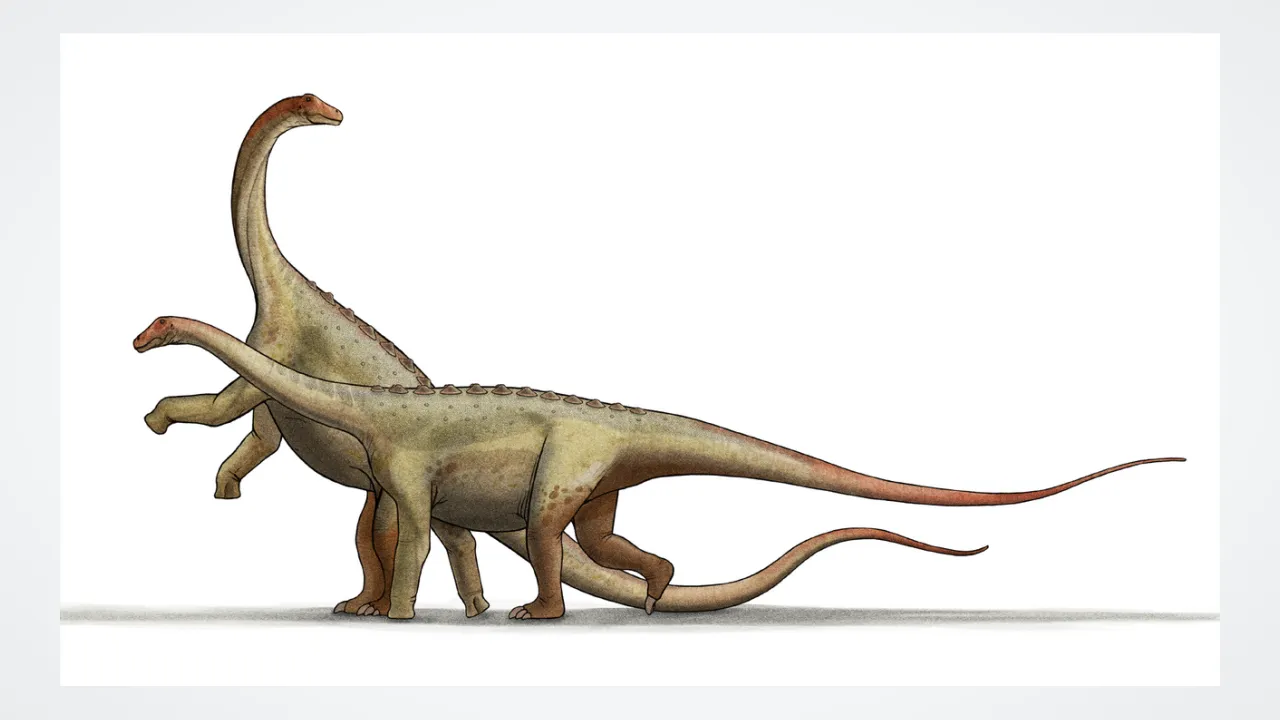
1. What grew inside the tough skin on Saltasaurus's back?
2. How big was Saltasaurus compared with super-giant long-necked dinosaurs?
🤯 Mind-Blowing Fact • Grade 2
Before Saltasaurus was discovered in 1980, scientists found loose titanosaur armor plates for decades and mistakenly labeled them as ankylosaur bones!
✨ Word Sparks (Grade 2 Glossary)
Tap 🔊 to hear
osteoderm
a bony plate growing directly inside animal skin
mosaic
a tight pattern made of many small pieces
ankylosaur
a low, heavily armored tank-like plant-eating dinosaur
🪝
How did one surprising dig in Argentina change how artists draw long-necked dinosaurs forever?
1
Wait—Whose Armor Is That?
For over a hundred years, scientists thought only tank-like and stegosaurs wore bony armor. Then in 1980, diggers in Salta, Argentina, uncovered a forty-foot long-necked dinosaur covered in fist-sized armor plates and pea-sized bony beads!
2
Why Wear a Bony Vest?
Super-giants like Argentinosaurus were too massive for predators to bother, so they didn't need armor. Weighing about seven tons—like one big bull elephant—Saltasaurus used its tough armored hide as extra protection!
3
Rearing Up for Treetop Treats
Extra-strong hip and tail bones let this sturdy plant-eater prop itself on its hind legs and tail to reach higher branches!
1. Why did scientists misidentify titanosaur armor plates for decades before 1980?
2. Why was body armor especially helpful for Saltasaurus?
🤯 Mind-Blowing Fact • Grade 3
Tiny pea-sized bony beads formed such a tight mosaic between Saltasaurus's larger back plates that its hide worked almost like flexible medieval chainmail!
✨ Word Sparks (Grade 3 Glossary)
Tap 🔊 to hear
ossicles
tiny pebble-sized bone nodules packed inside tough skin
embryo
an unhatched baby developing inside an egg
chainmail
flexible armor made of small linked pieces
🪝
What secrets did stony skin armor and thousands of fossilized eggs reveal about Saltasaurus and its family?
1
Armored Lizard From Salta
Imagine brushing dirt off five long-necked dinosaur skeletons in northwestern Argentina and finding hundreds of bony shields scattered right across their ribs! When José Bonaparte and Jaime Powell announced Saltasaurus loricatus ('armored lizard from Salta') in 1980, paleontology textbooks had to be rewritten overnight.
2
Two Kinds of Skin Shielding
Saltasaurus wore a clever two-part armor suit. Oval bony plates called osteoderms—some four to five inches wide with raised ridges—dotted its back in rows, while tight carpets of pea-sized bony protected the flexible skin in between like !
3
Wide Stance and Tripod Reach
Unlike narrow-walking Jurassic sauropods, Saltasaurus stood with a wide-gauge stance, planting its stumpy feet far apart for rock-solid balance. Six fused hip vertebrae helped it rear onto a tripod of back legs and tail.
4
Clues From Ancient Nesting Grounds
At Patagonia's famous Auca Mahuevo nesting site, thousands of close-cousin saltasaurid eggs preserved tiny unhatched already sporting beaded, rosette-patterned scaly skin!
1. How did the two sizes of bony armor in Saltasaurus's skin work together?
2. What does a 'wide-gauge stance' mean when describing Saltasaurus?
🤯 Mind-Blowing Fact • Grade 4
Saltasaurus and advanced titanosaurs completely lost all finger bones and claws on their front feet, walking directly on horseshoe-shaped rings of palm bones!
✨ Word Sparks (Grade 4 Glossary)
Tap 🔊 to hear
dermal
forming inside or belonging to the skin layer
calcium
essential mineral building strong bones and eggshells
clutch
a single group of eggs laid in one nest
🪝
Did Saltasaurus carry bony plates on its back solely to block predator jaws—or were they hidden mineral banks for laying eggs?
1
Rewriting the Sauropod Playbook
Seventy million years ago beside shallow lakes in northwestern Argentina's Lecho Formation, herds of compact, forty-foot sauropods browsed marshy groves. Until José Bonaparte and Jaime Powell excavated five overlapping Saltasaurus loricatus skeletons between 1975 and 1977, nobody imagined long-necked giants wore armor. Suddenly, isolated bony scutes found on three continents finally made sense!
2
Dual Function: Chainmail Defense and Mineral Vault
Across its flanks and back, packed pavements of seven-millimeter ossicles cushioned twelve-centimeter ridged osteoderms against bites from fast abelisaurid predators like Carnotaurus cousins. Yet CT scans of titanosaur osteoderms later revealed a second surprise: many adult plates contained spongy internal cavities! Paleontologists realized female titanosaurs could dissolve and phosphorus out of their own back plates during droughts or egg-laying seasons to build dozens of hard eggshells.
3
Stubby Forefeet Without Finger Bones
Saltasaurus also showcased extreme titanosaur foot evolution. Its horseshoe-shaped front feet had completely lost their finger bones and claws, walking straight on vertical columns of palm bones wrapped in a fleshy pad!
4
Nesting Colonies by the Thousands
Spectacular saltasaurid nesting horizons at Auca Mahuevo preserve of fifteen to forty spherical eggs—including fossilized embryonic skin with tiny scale rosettes, though full bony osteoderms grew only after hatching.
1. Besides protecting against predator bites, what surprising second job could hollow titanosaur armor plates perform?
2. What was remarkable about the front feet of Saltasaurus?
🤯 Mind-Blowing Fact • Grade 5
Inside its vertebrae, Saltasaurus replaced simple hollow pockets with 'camellate' bone—a super-light honeycomb foam of tiny bony struts similar to modern bird bones and airplane wings!
✨ Word Sparks (Grade 5 Glossary)
Tap 🔊 to hear
camellate
bone filled with tiny honeycomb-like air spaces
oogenesis
biological process of producing and shelling eggs
procoelous
vertebrae having a cup front and ball back
🪝
How did a seven-ton armored sauropod from Salta solve an eighty-year fossil mystery and unveil the reproductive secrets of Late Cretaceous titanosaurs?
1
Ending an Eighty-Year Taxonomic Misidentification
As early as 1896, French paleontologist Charles Depéret puzzled over large keeled bony plates mixed with sauropod bones in Madagascar, yet orthodoxy insisted sauropods were naked-skinned and assigned every scute to ankylosaurs. That dogma collapsed between 1975 and 1977 at Estancia El Brete in Argentina's Salta Province, where José Bonaparte and Jaime Powell excavated at least five individuals of a stocky 12.2-meter sauropod intimately draped in dermal armor—naming it Saltasaurus loricatus ('loricated/armored lizard from Salta') in 1980.
2
Histology of Osteoderms and Ossicle Pavements
Saltasaurus possessed two distinct classes of dermal ossifications: oval, keeled osteoderms measuring 10 to 12 centimeters across arranged along the dorsum, and tightly packed polygonal ossicles just 5 to 9 millimeters wide forming flexible chainmail-like pavements. Micro-CT analyses of saltasaurid osteoderms demonstrate extensive internal remodeling cavities, indicating that alongside deflecting abelisaurid theropod teeth, these vascularized plates functioned as labile calcium-phosphorus reservoirs mobilized during (eggshell formation) and seasonal nutritional stress.
3
Derived Saltasaurine Locomotion and Posture
Weighing roughly 7 metric tons, Saltasaurus exemplified derived lithostrotian biomechanics. Outwardly canted femora and wide-flaring iliac blades produced wide-gauge trackways, six fused sacral vertebrae reinforced the pelvis, strongly (ball-and-socket) caudal vertebrae lent tail mobility, and completely phalange-less, U-shaped metacarpal colonnades supported the forelimbs.
4
Spongy Pneumaticity From Neck to Tail
Instead of simple hollow chambers, Saltasaurus vertebrae contained bone—a honeycombed froth of millimeter-thin bony struts invaded by respiratory air sacs that maximized torsional strength while slashing skeletal mass.
5
Embryonic Skin at Auca Mahuevo
Complementing El Brete's adults, Patagonia's Auca Mahuevo nesting grounds yielded hundreds of saltasaurid clutches containing intact Late Cretaceous embryos with phosphatized non-overlapping tubercular scales—demonstrating that rosette skin patterns formed inside the egg before postnatal ossification hardened adult armor.