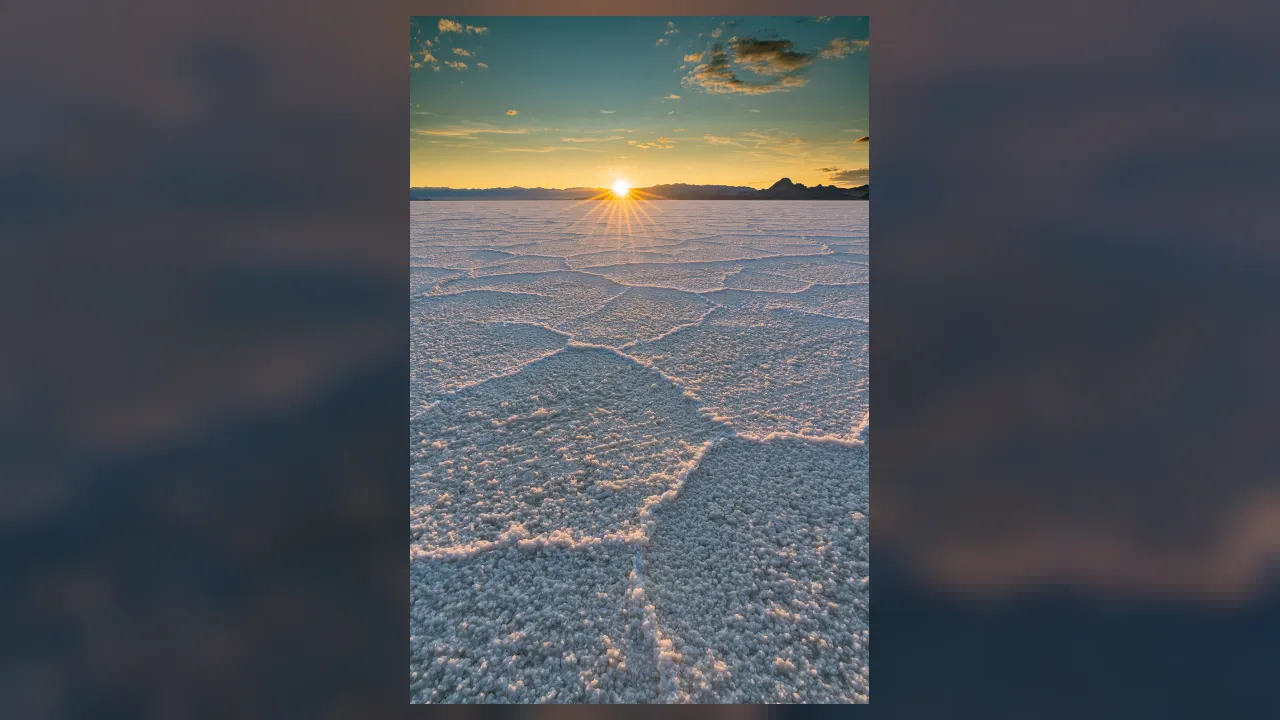
1. How did a salt flat get covered in so much white salt?
2. What happens when a thin layer of rainwater covers a flat salt crust?
🤯 Mind-Blowing Fact • Grade 2
Utah's Bonneville Salt Flats are so smooth, hard, and level that engineers test some of the fastest land-speed cars on Earth right on the salt!
✨ Word Sparks (Grade 2 Glossary)
Tap 🔊 to hear
Basin
Bowl-shaped valley surrounded by higher land
Dissolve
To mix completely into liquid water
Polygon
Flat geometric shape with straight sides
🪝
Why do rivers flowing into a closed desert bowl leave behind a crust of salt feet thick?
1
No River Out to the Sea
Most mountain creeks carry tiny specks of dissolved rock salt all the way to the ocean. In some dry desert valleys surrounded by mountains, however, streams flow into a low flat bowl with zero exit!
2
Sun Takes Water, Leaves Salt
Try stirring a spoonful of salt into a dish of warm water and leaving it on a sunny windowsill. In a few days, the water evaporates into invisible vapor, leaving sparkly square salt crystals in the dish! Over thousands of years, desert sun dried huge ancient lakes the exact same way.
3
Giant Honeycomb Shapes
As damp salt dries and expands, the white crust pushes up neat five- and six-sided ridges across miles of flat ground!
1. Why can't dissolved salt float up into the sky when lake water evaporates?
2. What neat shapes naturally form across the surface of many salt flats?
🤯 Mind-Blowing Fact • Grade 3
Bolivia's Salar de Uyuni is so gigantic, flat, and bright that space agencies use it as a giant natural target to calibrate satellite laser altimeters in orbit!
✨ Word Sparks (Grade 3 Glossary)
Tap 🔊 to hear
Halite
Mineral name for natural cubic rock salt
Evaporite
Sedimentary rock formed when mineral water evaporates
Brine
Water packed with extra-high dissolved salt
🪝
How did Ice Age giant lakes leave behind shimmering salt flats in Utah, California, and high in the Andes Mountains?
1
Meet Halite: Nature's Rock Salt
Pick up a magnifying glass on Death Valley's Badwater Basin salt flat, and you will spot tiny cube-shaped crystals! Geologists call natural rock salt ',' a sedimentary mineral with a Mohs hardness of 2.5—just about as hard as your fingernail.
2
Ghosts of Ice Age Lakes
During the cooler, wetter Ice Age twenty thousand years ago, a massive freshwater inland sea called Lake Bonneville covered much of Utah—nearly as big as Lake Michigan! When the climate warmed and dried, almost all that water evaporated, leaving behind the dazzling Bonneville Salt Flats and the Great Salt Lake.
3
World Champion Salar de Uyuni
High in Bolivia's Andes Mountains at nearly 12,000 feet elevation sits Salar de Uyuni—Earth's largest salt flat, covering over 4,000 square miles with salt up to thirty feet thick!
4
Pink Flamingos on White Salt
Even in salty puddles, tough pink microorganisms and tiny brine shrimp thrive, feeding flocks of bright pink Andean flamingos!
1. What crystal shape does the salt mineral halite naturally grow into?
2. Where is Salar de Uyuni, the largest salt flat on planet Earth?
🤯 Mind-Blowing Fact • Grade 4
Beneath the dry white crust of Bolivia's Salar de Uyuni sits a liquid saltwater sponge holding roughly ten billion tons of salt—plus one of Earth's largest reserves of dissolved lithium!
✨ Word Sparks (Grade 4 Glossary)
Tap 🔊 to hear
Endorheic Basin
Closed land bowl with no ocean outlet
Playa
Flat dry desert lakebed crusted with minerals
Gypsum
Soft white sulfate mineral forming before halite
🪝
Why do five- and six-sided geometric salt ridges match the exact same size across deserts from California to Chile?
1
Endorheic Basins and Rain Shadows
Why do salt flats cluster in places like California's Death Valley (282 feet below sea level—North America's lowest point!), Utah's Great Basin, and South America's Altiplano? Two geologic ingredients work together: 'rain shadows' behind tall mountain ranges block moist ocean clouds so annual evaporation far exceeds rainfall, and tectonic faulting drops 'endorheic' (closed) basins where weathered sodium, calcium, potassium, and chloride ions wash inward with zero river outlet.
2
Orderly Chemical Precipitation
As a desert lake evaporates, dissolved minerals don't all crystallize at once! Less-soluble carbonate minerals like calcite settle out first around basin edges, followed by (calcium sulfate—which wind at New Mexico's White Sands blows into dazzling white dunes!), and finally highly soluble halite (NaCl) crusts across the lowest center.
3
Underground Brine Convection Cells
For years, geologists puzzled over why polygonal salt ridges almost everywhere measure one to two meters wide regardless of crust thickness. In 2023, fluid-physics researchers proved why: beneath the dry crust, solar evaporation makes top groundwater extra salty and heavy, causing it to sink along narrow honeycomb boundaries while fresher brine wells up inside each cell!
4
Modern Battery Minerals
Deep brines beneath South American salt flats also hold dissolved lithium—a lightweight metal vital for rechargeable electric-vehicle and solar-storage batteries.
1. How does a mountain 'rain shadow' help create desert salt flats?
2. What hidden underground motion shapes the 1-to-2-meter honeycomb polygons on salt flats?
🤯 Mind-Blowing Fact • Grade 5
Deep beneath the Mediterranean Sea lies a buried layer of rock salt up to a mile thick—left behind nearly six million years ago when the Strait of Gibraltar closed and the whole sea dried into giant salt flats!
✨ Word Sparks (Grade 5 Glossary)
Tap 🔊 to hear
Solubility
How easily a mineral dissolves in water
Halophile
Microbe thriving in extreme salty water environments
Salt Dome
Underground column of buried buoyant rock salt
🪝
How did the entire Mediterranean Sea once dry up into a mile-thick salt flat—and how do Martian salt flats guide rovers searching for ancient life?
1
Mineralogy of Evaporite Sequences
Within Earth's rock cycle, salt flats (salars or sabkhas) represent active chemical sedimentary environments where ionic saturation drives mineral precipitation. As hydrologically closed lake water concentrates, minerals crystallize in strict inverse order of : calcite and dolomite precipitate first, gypsum (CaSO4·2H2O, Mohs hardness 2) crystallizes when brine shrinks to roughly one-fifth original volume, halite (NaCl, cubic isometric crystal lattice, Mohs 2.5) precipitates at one-tenth volume, and ultra-soluble potassium-magnesium bittern salts plus lithium-rich brines remain last.
2
Porous-Media Convection and Millimeter Flatness
At Bolivia's 10,582-square-kilometer Salar de Uyuni—remnant of Pleistocene paleolakes Minchin and Tauca—seasonal wet-season rains dissolve surface ridges and re-level the crust to an astonishing topographic relief variation of less than one meter across the entire horizon! That mirror smoothness plus high 0.65–0.80 optical albedo allows NASA's ICESat-2 laser altimeter and ESA radar satellites to calibrate orbital height measurements to centimeter precision.
3
The Messinian Salinity Crisis
Salt flats don't only form in small desert valleys: around 5.96 million years ago, tectonic uplift near Gibraltar pinched shut Atlantic inflow, causing the entire Mediterranean Basin to evaporate into scorching, kilometer-deep salt flats! Seismic cores beneath today's Mediterranean seafloor still reveal a buried evaporite layer over a kilometer thick before the catastrophic Zanclean Flood refilled the sea.
4
Buried Salt Domes and Halophiles
Once buried under younger muds and sandstones, low-density halite behaves plastically under pressure, rising slowly like blobs in a lava lamp to form underground ''—and even today, pink halophilic archaea thrive inside microscopic fluid inclusions trapped in salt crystals!
5
Planetary Salt Flats on Mars
Because evaporite minerals preserve microscopic organic molecules inside crystal fluid inclusions, NASA's Perseverance and Curiosity rovers actively target ancient sulfate and chloride salt-flat deposits inside Martian craters as prime astrobiological time capsules!