🧬 HUMAN BODY
🧬 Glandulae Salivariae • Digestive System
VA Science & Health SOL 1.1, 3.1, 4.2, 5.1 (Cells, Organs & Body Systems)
Salivary Glands
Hidden Mouth Faucets That Start Digestion Before You Swallow
Grade 1 • Early Reader • 68 words
🩺 Body System & LocationDigestive System • Three major pairs tucked in cheeks, jaw, and under the tongue
🔬 Size / Cell Count3 major pairs + ~800 minor glands • Produces 0.5–1.5 liters of saliva daily
⚙️ Core JobMoistens food for smooth swallowing, unlocks taste molecules, and starts starch digestion
⚡ Body SuperpowerSquirts digestive saliva at the mere smell or thought of sour lemons before you take a bite!
🤯 Mind-Blowing Fact • Grade 1
Just imagining a sour lemon or warm pizza can make your salivary glands squirt fresh saliva in seconds!
✨ Word Sparks (Grade 1 Glossary)
Tap 🔊 to hear
Gland
Small body part that makes helpful liquid
Saliva
Clear, watery liquid inside your mouth
Moisten
To make something dry turn soft and wet
🪝
Why does your mouth water just thinking about biting a juicy yellow lemon?
1
Secret Mouth Faucets
Close your eyes and picture biting into a super-sour lemon slice! Did your mouth just get watery? Hidden inside your cheeks and under your tongue sit little helpers called salivary .
2
Making Food Slippery
Try swallowing a dry cracker without water—it feels scratchy! Salivary squirt clear to turn crunchy bites soft and slippery.
3
Keeping Teeth Clean
All day long, fresh rinses crumbs off your teeth so your smile stays healthy!
1. Where are your main salivary glands tucked away?
2. How does saliva help when you munch a crunchy dry cracker?
🤯 Mind-Blowing Fact • Grade 2
Your salivary glands make enough saliva every single day to fill two or three tall drinking glasses!
✨ Word Sparks (Grade 2 Glossary)
Tap 🔊 to hear
Enzyme
Helper protein that snips food into tiny pieces
Starch
Energy chains found in bread, rice, and potatoes
Flavor
The tasty mix of smell and tongue taste
🪝
Did you know digestion actually begins in your mouth before food ever reaches your tummy?
1
Six Busy Teammates
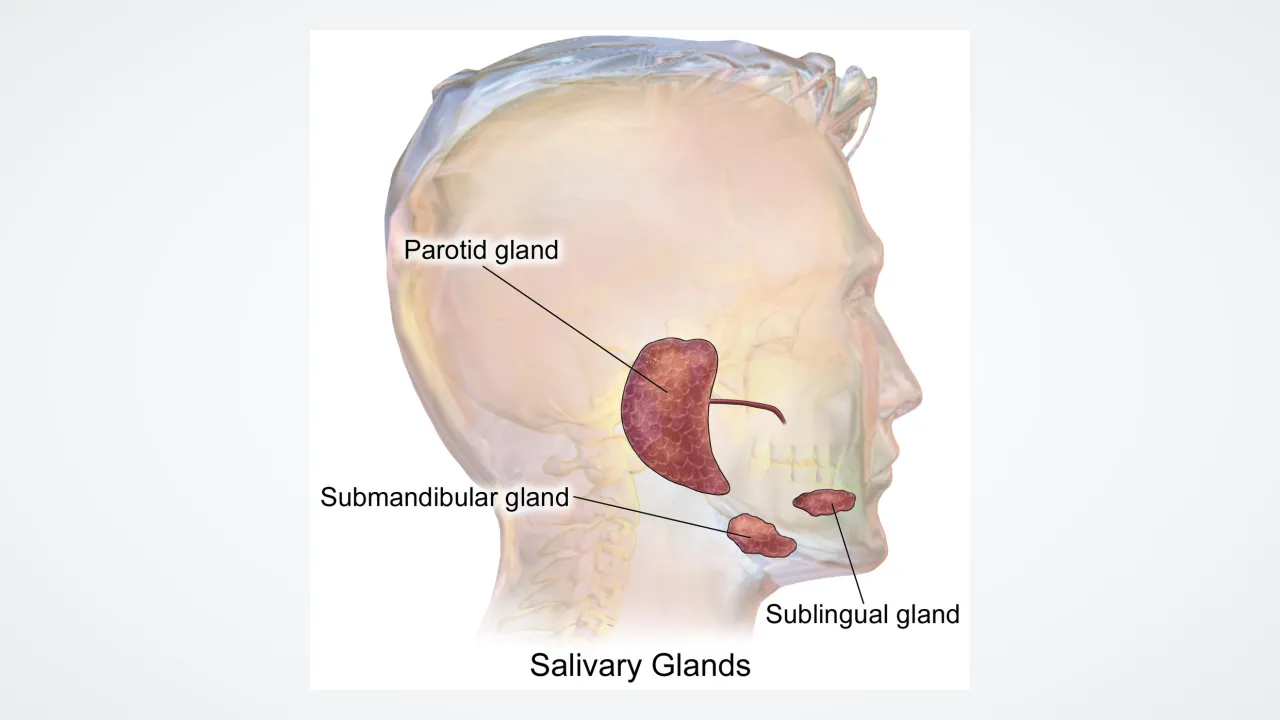
Whiff! The smell of baking bread floats from the kitchen, and your brain texts six busy salivary glands right away. One pair sits in front of your ears inside your cheeks, one pair rests along your lower jaw, and one pair hides right underneath your tongue!
2
Tiny Food Scissors
Saliva is 99 percent water, yet that last 1 percent holds amazing helper proteins called . Like invisible scissors, saliva enzymes start snipping bread into sweet sugars while you chew!
3
Unlocking Every Flavor
Dry taste buds cannot taste dry food! Saliva dissolves tiny bits from strawberries and pretzels so your tongue can taste every bite.
1. What happens to bread starches when saliva enzymes go to work while you chew?
2. Why do your taste buds need saliva to work properly?
🤯 Mind-Blowing Fact • Grade 3
In a single human lifetime, your salivary glands produce roughly 25,000 quarts of saliva—enough to fill two backyard swimming pools!
✨ Word Sparks (Grade 3 Glossary)
Tap 🔊 to hear
Amylase
Saliva enzyme that breaks starches into sugars
Lysozyme
Natural protein in saliva that pops bad germs
Duct
Tiny delivery tube carrying liquid from a gland
🪝
Why does waking up with 'morning breath' happen when your salivary glands take a nighttime nap?
1
Three Major Pairs Plus Hundreds More
Lift the tip of your tongue toward the roof of your mouth in front of a mirror. Right on the floor of your mouth sit tiny pinpoint openings— delivering fresh liquid from your salivary glands! Three major gland pairs—the parotid glands in your cheeks, submandibular glands inside your lower jaw, and sublingual glands under your tongue—team up with nearly 800 tiny minor glands.
2
Amylase and Germ Fighters
Each squirt of saliva packs specialized tools. An enzyme called salivary breaks long starch chains in pasta or crackers into simpler sugars. Meanwhile, a natural germ-fighting protein called pokes holes in harmful bacteria before you swallow them!
3
Day Shift Versus Night Shift
During the day, chewing and talking keep saliva flowing steadily to wash away food bits and protect tooth enamel with calcium.
4
Why Morning Breath Happens
While you sleep at night, your salivary glands slow down to a trickle—letting harmless mouth bacteria multiply until your morning toothbrush sweeps them clean!
1. What is the job of the enzyme salivary amylase?
2. Why do people often wake up with dry mouths or 'morning breath'?
🤯 Mind-Blowing Fact • Grade 4
Tiny accidental bites inside your cheek heal up to twice as fast as skin scrapes thanks to special tissue-growth proteins and germ fighters dissolved in saliva!
✨ Word Sparks (Grade 4 Glossary)
Tap 🔊 to hear
Parotid
Largest salivary gland tucked inside each cheek
Mucin
Slippery protein turning water into protective gel
Autonomic
Nerve system running automatic body functions smoothly
🪝
Why do different salivary glands mix watery spray for dry crackers yet slippery gel for crunchy chips?
1
Custom-Blended Recipes
Not all saliva is identical! Your three major gland pairs specialize in different liquid textures. Your cheek-mounted glands—the largest pair—brew watery 'serous' saliva rich in starch-snipping amylase, ideal for soaking dry toast. Under your tongue, sublingual glands brew thicker 'mucous' saliva loaded with slippery that coat sharp tortilla-chip edges so they never scratch your throat! Along your jaw, submandibular glands mix both recipes together, supplying about two-thirds of your resting daytime saliva.
2
Pavlov's Famous Reflex
How do your glands know which recipe to mix? Pressure sensors in your gums and taste receptors on your tongue flash instant messages to your brainstem, which fires nerves straight back to the glands. Around 1900, Russian physiologist Ivan Pavlov showed that this brain loop can even learn cues—demonstrating conditioned reflexes that explain why merely smelling popcorn makes your ducts tingle!
3
Why Stage Fright Dries Your Mouth
Ever noticed your mouth turning cotton-dry right before giving a class speech? 'Rest-and-digest' parasympathetic nerves stimulate watery flow, whereas nervous 'fight-or-flight' sympathetic signals temporarily slow watery output, leaving thicker saliva behind!
4
Faster Mouth Healing
Saliva also carries epidermal growth factors and blood-clotting helpers, which is why accidental cheek bites heal remarkably faster than skin scrapes!
1. How do your parotid and sublingual glands customize saliva for different foods?
2. Why does feeling nervous before a speech make your mouth feel dry?
🤯 Mind-Blowing Fact • Grade 5
A clever saliva protein called statherin keeps saliva packed super-high with tooth-rebuilding calcium without letting rocks crystallize inside your gland tubes!
✨ Word Sparks (Grade 5 Glossary)
Tap 🔊 to hear
Acini
Berry-shaped clusters of fluid-making gland cells
Hypotonic
Containing less dissolved salt than blood plasma
Lipase
Digestive enzyme that snips apart dietary fats
🪝
How could high-tech medical scanners discover a previously overlooked set of salivary glands in the human head as recently as 2020?
1
Acinar Clusters and Two-Stage Ion Pumping
Zooming into any salivary gland reveals grape-like secretory clusters called feeding branching ducts—architecture strikingly similar to a miniature tree! Acinar cells first filter blood plasma to secrete an isotonic fluid matching blood's salt concentration. As that fluid streams down striated ducts toward the mouth, specialized duct cells actively pump sodium and chloride ions back into the bloodstream without letting water follow, while secreting potassium and acid-neutralizing bicarbonate ions—delivering , alkaline saliva through Stensen's (parotid) and Wharton's (submandibular) ducts.
2
Enzymatic and Immunological Arsenal
Beyond alpha-amylase (ptyalin), which hydrolyzes alpha-1,4 glycosidic bonds in dietary amylose, lingual glands secrete lingual —an acid-tolerant fat-digesting enzyme especially vital for infants digesting milk lipids. Simultaneously, plasma cells nestled around salivary pump dimeric Secretory Immunoglobulin A (sIgA), lactoferrin (which starves bacteria of iron), histatins (antifungal peptides that accelerate wound closure), and statherin—a remarkable protein that prevents calcium-phosphate supersaturated saliva from crystallizing into stones inside the ducts while still remineralizing tooth enamel!
3
Cranial Nerve VII, IX, and Pavlov's Nobel Prize
Secretomotor fibers from the facial nerve (CN VII, via the chorda tympani) drive submandibular and sublingual secretion, while the glossopharyngeal nerve (CN IX) innervates the parotid glands. Studying quantitative salivary secretion earned Ivan Pavlov the 1904 Nobel Prize in Physiology or Medicine.
4
The 2020 Tubarial Gland Surprise
Even after centuries of anatomy textbooks, researchers in the Netherlands using ultra-sensitive PSMA PET/CT scans in 2020 identified macroscopic 'tubarial salivary glands' tucked high in the nasopharynx behind the nose to lubricate the upper throat!
5
Non-Invasive Diagnostic Liquid Biopsy
Because trace hormones, antibodies, and viral RNA cross into saliva, biomedical engineers now design rapid spit tests that screen health markers painlessly without a single needle.