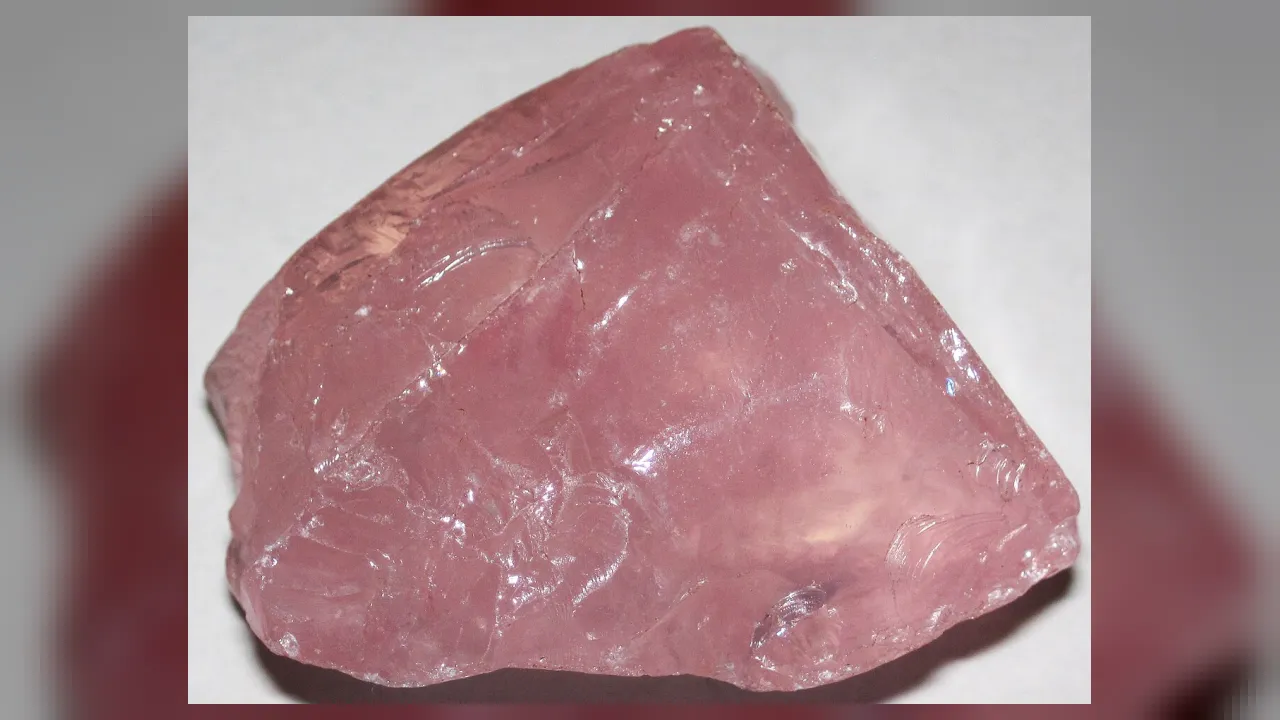
1. How does rose quartz usually grow in nature compared with clear quartz?
2. Which U.S. state is famous for big pink boulders of rose quartz?
🤯 Mind-Blowing Fact • Grade 2
Archaeologists uncovered polished rose quartz beads in ancient Mesopotamia that were crafted almost 5,000 years ago!
✨ Word Sparks (Grade 2 Glossary)
Tap 🔊 to hear
translucent
Letting soft light pass through without clear view
granite
Speckled hard rock cooled from underground magma
tumbler
A spinning barrel that polishes rough stones
🪝
Why does light shine partway through rose quartz like a glowing pink lantern?
1
Cloudy Glow Inside
Hold a polished piece of rose quartz up to a window. You cannot read words clearly through it like window glass, yet warm pink light shines right through! Scientists call materials that let blurry light pass through '.'
2
Slow-Baked Inside Granite
Deep underground, pockets of melted cool very slowly over millions of years. Inside the center of these pockets, pure silica crystallizes into giant pink seams of rose quartz.
3
Ancient Seals and Modern Gems
Nearly five thousand years ago in Mesopotamia, craftspeople carved smooth rose quartz beads. Today rock polish rough pink chunks into glossy pebbles for necklaces and museum displays.
1. What word describes a stone like rose quartz that lets soft light pass through without being see-through clear?
2. Where deep underground do large seams of rose quartz usually form?
🤯 Mind-Blowing Fact • Grade 3
Scientists solved the mystery of rose quartz's color by finding microscopic pink mineral fibers a hundred times thinner than a human hair woven right inside the stone!
✨ Word Sparks (Grade 3 Glossary)
Tap 🔊 to hear
microscopic
Too tiny to see without a microscope
fiber
A very thin thread-like strand of material
pegmatite
Magma rock pocket containing extra-large mineral crystals
🪝
What microscopic surprise did scientists discover hiding inside rose quartz with super-strong microscopes?
1
Solving the Pink Mystery
For decades, geologists guessed that dissolved titanium or manganese painted rose quartz pink. Then in the late 1990s, scientists dissolved away the surrounding quartz with special acid and peered through an electron microscope. Surprise! Tangled inside were ultra-thin pink mineral threads thinner than a spiderweb!
2
Built-In Starlight
Those also make rose quartz slightly milky. Even cooler, when tiny titanium-rich needles line up in three neat directions inside a polished round bead, shining a flashlight through the stone reveals a glowing six-pointed star!
3
Pegmatite Giant Pockets
Rose quartz crystallizes inside granite —underground magma chambers packed with water and rare elements that grow giant feldspar, mica, and beryl crystals.
4
Blue Ridge and Piedmont Finds
With Mohs hardness seven, rose quartz resists scratches easily. In Virginia's Amelia County and Blue Ridge foothills, collectors have uncovered lovely rosy-pink quartz chunks!
1. What actually gives common massive rose quartz its soft pink color?
2. Which Virginia county is famous among geologists for granite pegmatites holding minerals like rose quartz?
🤯 Mind-Blowing Fact • Grade 4
Unlike purple amethyst or rare pointed pink quartz, common chunky rose quartz gets its color from solid microscopic mineral fibers that resist fading in sunlight!
✨ Word Sparks (Grade 4 Glossary)
Tap 🔊 to hear
diasterism
A star effect seen when light shines through
luster
The way a mineral surface reflects light
streak
The color of a mineral's crushed powder
🪝
Why does massive rose quartz never fade in bright sunshine while rare pointed pink quartz crystals DO fade?
1
Two Different Pink Quartzes!
Walk into the Smithsonian's mineral hall and you can spot two surprisingly different stones sitting side by side: chunky translucent rose quartz and ultra-rare, transparent, six-sided 'pink quartz' points from Brazil. Geologists discovered they are colored by completely different mechanisms! Chunky rose quartz gets its permanent blush from solid nanofibers of a boron-iron-titanium mineral related to dumortierite.
2
Why Pointed Pink Quartz Fades
Rare pointed pink quartz crystals grow later in cooler hydrothermal pockets below 300 degrees Celsius. Instead of mineral fibers, phosphorus and aluminum atoms replace silicon inside the lattice and turn pink under natural radiation. Expose those rare transparent points to bright ultraviolet sunlight and their color fades away—whereas fiber-filled massive rose quartz keeps its color in the sun!
3
Diasterism: Shining Light Through the Back
Many star gems reflect a star off their top surface, yet star rose quartz displays '' too: hold a polished sphere in front of a small bright bulb and light passing straight THROUGH the gem projects a glowing six-rayed star!
4
Physical Traits in the Lab
Like all SiO2 varieties studied in Earth science, rose quartz has Mohs hardness 7, a white on a porcelain plate, vitreous (glassy) , and curved conchoidal fracture.
1. What color streak does pink rose quartz leave when rubbed on an unglazed porcelain streak plate?
2. How does chunky rose quartz differ from ultra-rare pointed 'pink quartz' crystals?
🤯 Mind-Blowing Fact • Grade 5
When Caltech mineralogists dissolved rose quartz in hydrofluoric acid in 2001, the leftover pink fuzz looked just like microscopic pink cotton wool under the microscope!
✨ Word Sparks (Grade 5 Glossary)
Tap 🔊 to hear
exsolution
Unmixing of dissolved elements into tiny separate crystals
euhedral
Having sharp well-formed natural crystal faces
nanofiber
An ultra-thin mineral thread measured in billionths
🪝
How did transmission electron microscopes overturn a century-old textbook explanation for rose quartz's color?
1
Overturning Textbook Assumptions
Throughout most of the twentieth century, mineralogy textbooks attributed the delicate blush of massive pegmatitic rose quartz to dissolved Ti3+ or Mn3+ ions substituting directly into the SiO2 lattice. In 2001, Caltech mineralogists George Rossman and Julia Goreva dissolved Brazilian, Madagascan, and South Dakotan rose quartz samples in hydrofluoric acid and examined the insoluble residue under transmission electron microscopy. Every specimen revealed dense meshes of pink fibrous borosilicate needles measuring just 0.1 to 0.5 micrometers wide!
2
Exsolution in Cooling Pegmatite Cores
Massive rose quartz crystallizes at elevated temperatures (400 to 700 degrees Celsius) inside the volatile-rich inner cores of granitic pegmatites. At peak heat, trace aluminum, boron, iron, and titanium dissolve into the growing quartz structure. As the pluton cools slowly over millions of years, those foreign ions unmix—a process called —crystallizing aligned closely related to the mineral dumortierite. Intervalence charge transfer between iron and titanium inside those fibers produces the pink hue, while Tyndall scattering across the fibers creates milky translucency.
3
Hydrothermal Euhedral Pink Quartz
By contrast, rare (well-formed) pink quartz prisms from Minas Gerais, Brazil, crystallize below 250 degrees Celsius inside late hydrothermal vugs. Free of , their transparent rose color stems from coupled substitution of Al3+ plus P5+ for two Si4+ ions, followed by natural ionizing radiation creating unstable hole-color centers.
4
Crystallographic Alignment and Asterism
When exsolved dumortierite-type or rutile lock onto three equivalent crystallographic directions perpendicular to quartz's trigonal c-axis, light scattering produces crisp six-rayed—and occasionally twelve-rayed—asterism in polished spheres.
5
Global Pegmatite Provinces
Major rose quartz mining districts span Madagascar, Brazil's Minas Gerais province, Namibia, the Black Hills of South Dakota, and Oxford County in Maine—each marking ancient continental collision zones where late-stage granitic melts concentrated boron, lithium, and silica.