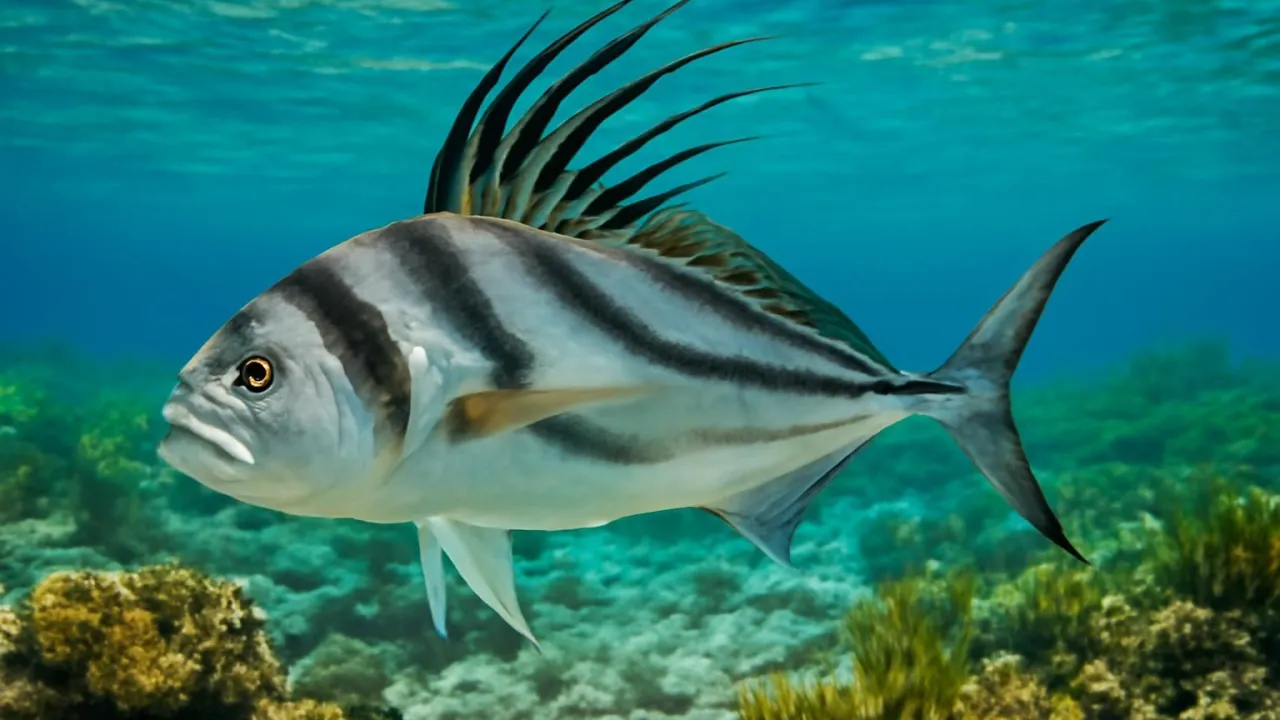
Roosterfish can raise and lower their tall fin like a rooster’s comb!
✨ Word Sparks (Grade 2 Glossary)
Tap 🔊 to hear
carnivore
An animal that eats other animals
prey
An animal that gets eaten by another
coast
The land next to the ocean
🪝
Have you ever seen a fish with a tall fin like a rooster’s comb?
1
A Fish with a Unique Fin
The roosterfish has a tall fin that looks like a rooster’s comb. This fin helps it swim quickly through the water. Its body is shiny silver with dark stripes. It uses its fin to scare away other fish.
2
Where Roosterfish Live
Roosterfish live in warm coastal waters of the eastern Pacific Ocean. They prefer shallow areas near sandy beaches and rocky reefs. These places give them good hiding spots. They swim close to shore to find food.
3
What Roosterfish Eat
Roosterfish are that eat small fish and crustaceans like crabs. They catch their using quick bursts of speed. Their sharp teeth help hold slippery food. Eating well helps them grow big and strong.
1. What does the roosterfish use its tall fin for?
2. What kind of food does a roosterfish eat?
🤯 Mind-Blowing Fact • Grade 3
Roosterfish can raise their dorsal fin to scare predators and attract mates.
✨ Word Sparks (Grade 3 Glossary)
Tap 🔊 to hear
camouflage
Colors that help animals hide in nature
predator
An animal that hunts other animals
adaptation
A body part that helps animals survive
🪝
Did you know the roosterfish’s fin helps it survive in the ocean?
1
Roosterfish’s Special Fin
The roosterfish has a tall dorsal fin shaped like a rooster’s comb. This fin can be raised or lowered to help it swim quickly or look bigger. Its shiny silver body has dark stripes for . These stripes help it hide from and prey.
2
Where Roosterfish Live and Hide
Roosterfish live in the warm eastern Pacific Ocean near sandy beaches and rocky reefs. They use these habitats to find shelter and hunt food. Their helps them blend into the water and avoid . They often swim close to shore where food is plentiful.
3
What Roosterfish Eat and How
Roosterfish are carnivores that eat smaller fish and crustaceans like crabs and shrimp. They use bursts of speed to catch their prey. Their sharp teeth hold slippery food tightly. This helps them get enough nutrients to grow strong and healthy.
4
Roosterfish in Their Ecosystem
Roosterfish play an important role as in coastal food webs. They help control populations of smaller fish and crustaceans. Humans also fish for roosterfish for sport and food. Protecting their habitat is important for keeping ocean ecosystems balanced.
2. What role do roosterfish play in their ecosystem?
🤯 Mind-Blowing Fact • Grade 4
Roosterfish can swim up to 30 miles per hour using their powerful fins and streamlined bodies.
✨ Word Sparks (Grade 4 Glossary)
Tap 🔊 to hear
symbiosis
When two animals help each other live
estuary
Where river water meets the ocean water
predator
An animal that hunts other animals for food
🪝
How does the roosterfish’s fin help it survive and thrive in the ocean?
1
The Roosterfish’s Unique Fin
The roosterfish’s tall dorsal fin looks like a rooster’s comb and can be raised or lowered as needed. This fin helps the fish swim faster by reducing water resistance when lowered. When raised, it makes the fish appear larger to scare and rivals. This adaptation is a key survival tool in its coastal habitat.
2
Habitat and Geographic Range
Roosterfish inhabit the warm coastal waters of the eastern Pacific Ocean, ranging from Baja California to Peru. They prefer shallow waters near sandy beaches, rocky reefs, and estuaries. These habitats provide shelter and abundant prey. Human activities like fishing and coastal development can impact these environments.
3
Role in the Ecosystem
As a top , the roosterfish controls populations of smaller fish and crustaceans, maintaining balance in coastal food webs. It competes with other predators for food and sometimes forms symbiotic relationships with cleaner fish. Fishermen prize roosterfish for sport fishing, which can affect their numbers if not managed responsibly.
4
Physical and Behavioral Adaptations
The roosterfish’s silver body with dark stripes provides camouflage in the shimmering ocean water, helping it avoid and sneak up on prey. Its sharp teeth and quick bursts of speed allow it to catch slippery fish and crustaceans. Raising its dorsal fin is both a defense mechanism and a way to attract mates during breeding season.
1. What happens when a roosterfish raises its dorsal fin?
2. Where do roosterfish usually live?
🤯 Mind-Blowing Fact • Grade 5
Roosterfish can swim up to 30 miles per hour and raise seven long spines on their dorsal fin.
✨ Word Sparks (Grade 5 Glossary)
Tap 🔊 to hear
taxonomy
How scientists group living things by type
streamlined
Shaped to move easily through water or air
ecosystem
All living and nonliving things in one place
🪝
What makes the roosterfish’s unique fin and body perfect for its coastal ocean life?
1
Taxonomy and Scientific Classification
The roosterfish, scientifically named Nematistius pectoralis, belongs to the family Sciaenidae, which includes drums and croakers. It is the only species in its genus, making it unique among coastal fishes. This species is native to the eastern Pacific Ocean, where it inhabits tropical and subtropical coastal waters. Understanding its classification helps scientists study its behavior and ecology.
2
Physiological Mechanics of Movement
The roosterfish’s tall dorsal fin, composed of seven long spines, can be raised or lowered to reduce drag or intimidate predators. Its , laterally compressed body allows it to swim efficiently at speeds up to 30 miles per hour. Powerful tail muscles provide bursts of acceleration, enabling it to catch fast prey. These physical adaptations optimize its hunting and escape capabilities.
3
Ecological Role and Conservation
As a top predator in coastal food webs, the roosterfish regulates populations of smaller fish and crustaceans, maintaining balance. It is a popular target for sport fishing, which has led to localized population declines in some areas. Conservation efforts include catch-and-release practices and habitat protection to ensure sustainable populations. Protecting estuaries and reefs is critical for its survival.
4
Botanical History and Human Interaction
Though not a plant, the roosterfish’s name comes from its distinctive dorsal fin resembling a rooster’s comb. This unique feature has fascinated fishermen and coastal communities for centuries. The fish is celebrated in local cultures and is an important species for recreational fishing economies. Understanding its biology promotes appreciation and responsible stewardship.
5
Quantitative Comparisons and Facts
Roosterfish can grow up to 4 feet (1.2 meters) long and weigh around 50 pounds (23 kilograms). They swim at speeds reaching 30 miles per hour (48 kilometers per hour). Their dorsal fin has seven long spines that can be raised like a fan. These impressive traits make the roosterfish an agile and formidable predator in coastal waters.