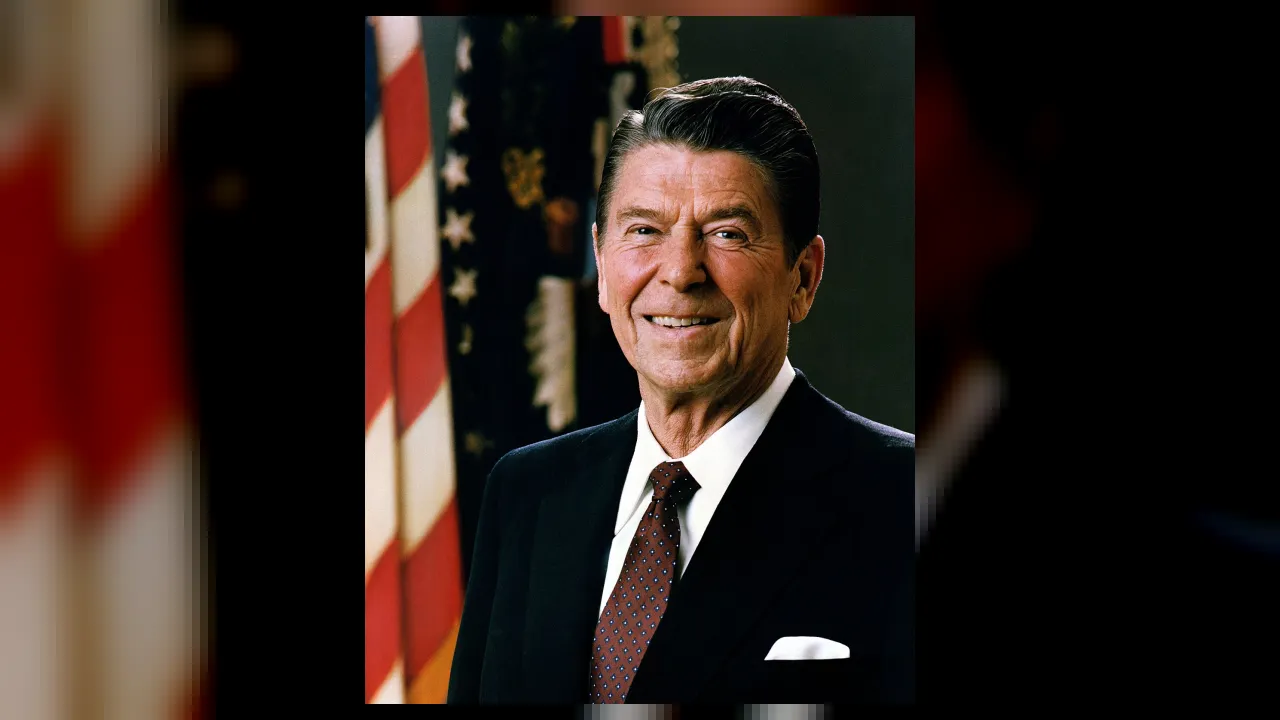
⚡ Historical SparkUsed warm optimism and steady diplomacy to help bring the Cold War toward peace
🤯 Mind-Blowing Fact • Grade 1
President Ronald Reagan loved colorful jelly beans so much that three and a half tons of red, white, and blue jelly beans were served at his 1981 inauguration celebrations!
✨ Word Sparks (Grade 1 Glossary)
Tap 🔊 to hear
lifeguard
A trained swimmer who keeps water swimmers safe
communicator
Someone who shares ideas clearly and warmly
optimism
Hopeful confidence that good things lie ahead
🪝
Did you know one of our presidents worked as a summer lifeguard who saved seventy-seven swimmers?
1
Lifeguard on the River
Splash, whistle! Before he was famous, young Dutch Reagan watched swimmers carefully along a fast river in Illinois. Over seven summers, he rescued seventy-seven people!
2
The Great Communicator
Later he worked on the radio, acted in movies, and governed California. As our fortieth president, his warm smile and clear stories earned him a nickname: 'The Great .'
3
Tear Down This Wall!
He named Sandra Day O'Connor as the first woman on the Supreme Court! He also spoke bravely in Berlin for freedom and signed peace treaties.
1. How many swimmers did young Ronald Reagan rescue while working as an Illinois river lifeguard?
2. Who did President Reagan appoint as the very first woman Justice on the U.S. Supreme Court?
🤯 Mind-Blowing Fact • Grade 2
When NASA created red, white, and blue jelly beans to cheer up space shuttle astronauts on Challenger in 1983, it was a friendly nod to President Reagan's famous White House candy jar!
✨ Word Sparks (Grade 2 Glossary)
Tap 🔊 to hear
announcer
Someone who describes news or games on radio
confirm
When the Senate officially approves a president's pick
missile
A rocket weapon guided to fly long distances
🪝
How did a small-town radio sports announcer grow up to become America's 'Great Communicator' in the White House?
1
Radio Voice to California Governor
Crack! 'There's a long drive to center field!' Young Ronald Reagan called exciting baseball games on Midwest radio before moving to California to become a movie actor, union leader, and two-term governor of California.
2
Sunny Optimism and Historic Firsts
Elected as our fortieth president in 1980, Reagan cheered up Americans with humor and faith in the country's future. In 1981, he made history by appointing Sandra Day O'Connor as the first woman to serve on the U.S. Supreme Court.
3
Speaking Up for Freedom and Peace
Standing beside the concrete Berlin Wall in 1987, Reagan called out, 'Mr. Gorbachev, tear down this wall!' Months later, he and Soviet leader Mikhail Gorbachev signed a landmark treaty eliminating thousands of nuclear .
1. Which famous sentence did President Reagan speak beside the Berlin Wall in 1987?
2. Which state did Ronald Reagan serve as governor before running for president?
🤯 Mind-Blowing Fact • Grade 3
In his farewell reflections, Ronald Reagan modestly said he wasn't really a 'Great Communicator'—he simply communicated great American ideas that originated in the Declaration and Constitution!
✨ Word Sparks (Grade 3 Glossary)
Tap 🔊 to hear
regulation
An official government rule guiding how businesses operate
summit
A face-to-face meeting between top world leaders
postpone
To move a planned event to a later date
🪝
Why did people call Ronald Reagan 'The Great Communicator,' and how did his summits help wind down the Cold War?
1
From Dixon, Illinois, to Public Life
Imagine recreating live Chicago Cubs baseball games on the radio just by reading short telegraph notes clicking off a wire! Growing up in Dixon, Illinois, Ronald Wilson Reagan worked as a river lifeguard, radio broadcaster, Hollywood actor, World War II Army Air Forces captain making training films, and two-term governor of California.
2
'Morning in America' and Justice O'Connor
Taking office in January 1981 as our fortieth president, Reagan promoted lower tax rates, fewer business , and renewed national confidence after the tough economy of the late 1970s. That summer, he fulfilled his pledge to appoint the first woman to the Supreme Court: Justice Sandra Day O'Connor.
3
Comforting the Nation in Sorrow
Years of radio and television experience helped Reagan speak directly to families' hearts. When the Space Shuttle Challenger was tragically lost in January 1986, Reagan postponed his State of the Union speech to comfort schoolchildren and honor the brave crew.
4
Brandenburg Gate and Arms Reduction
Believing in 'peace through strength,' Reagan built up U.S. defenses while meeting four times with reform-minded Soviet leader Mikhail Gorbachev. Following Reagan's famous 1987 Berlin speech—'Mr. Gorbachev, tear down this wall!'—the two leaders signed the INF Treaty destroying an entire class of nuclear missiles.
1. How did the 1987 INF Treaty signed by Reagan and Mikhail Gorbachev make the world safer?
2. What did President Reagan do on the evening of January 28, 1986, after the Space Shuttle Challenger accident?
🤯 Mind-Blowing Fact • Grade 4
Even when President Ronald Reagan and Democratic House Speaker Tip O'Neill debated policies all afternoon, the two Irish-American storytellers stayed warm personal friends after 6:00 p.m. and partnered to protect Social Security in 1983!
✨ Word Sparks (Grade 4 Glossary)
Tap 🔊 to hear
inflation
Rising prices that make each dollar buy less
deficit
Spending more money in a year than collected
verify
To check carefully and prove something is true
🪝
How did Ronald Reagan combine 'peace through strength' with personal diplomacy to help bring forty years of Cold War tension toward a peaceful close?
1
Midwestern Roots and Public Service Path
Raised in small Illinois towns during the 1920s, Ronald Reagan earned college tuition by washing dishes and guarding swimmers along the Rock River. After years as an Iowa radio sportscaster, film actor, Screen Actors Guild president, and World War II stateside officer, he entered politics, serving two terms as governor of California (1967–1975) before winning the presidency in November 1980.
2
Economic Shifts and Bipartisan Milestones
Inaugurated in January 1981 amid high and interest rates, Reagan advocated reducing federal income-tax rates, slowing domestic regulatory growth, and supporting Federal Reserve efforts to curb inflation. Though federal budget grew as defense spending rose, economic growth rebounded strongly by 1983, helping Reagan win forty-nine states in 1984. Working across party lines with House Speaker Tip O'Neill and Congress, he also signed a 1983 law strengthening Social Security, the Tax Reform Act of 1986, and the Civil Liberties Act of 1988 apologizing for World War II Japanese American internment.
3
Historic Supreme Court Appointment and Civic Eloquence
Fulfilling a 1980 campaign promise in July 1981, Reagan nominated Arizona judge Sandra Day O'Connor as the first woman Justice in the 192-year history of the U.S. Supreme Court. His warm storytelling and grace after surviving a March 1981 assassination attempt earned admiration across political lines, especially when his words united Americans after the 1986 Space Shuttle Challenger loss.
4
Summits With Gorbachev and the Berlin Wall
Reagan strengthened U.S. military readiness while remaining eager to reduce nuclear danger once Mikhail Gorbachev became Soviet leader in 1985. Across four summits—Geneva, Reykjavik, Washington, and Moscow—distrust turned into constructive partnership. Months after Reagan stood at Berlin's Brandenburg Gate on June 12, 1987, declaring, 'Mr. Gorbachev, tear down this wall!', the two leaders signed the landmark Intermediate-Range Nuclear Forces (INF) Treaty—setting the stage for the Berlin Wall's peaceful fall in 1989.
1. Which Russian proverb did President Reagan often quote during arms-reduction talks with Mikhail Gorbachev?
2. What historic wrong did the bipartisan Civil Liberties Act of 1988, signed by President Reagan, formally apologize for?
🤯 Mind-Blowing Fact • Grade 5
Under the 1987 INF Treaty signed by Reagan and Gorbachev, American and Soviet inspectors verified the physical destruction of 2,692 nuclear-capable missiles by June 1991—the first time nuclear arsenals actually shrank rather than grew!
Direct inspection proving a treaty promise was kept
rapport
Friendly trust and mutual understanding between two people
🪝
How did Ronald Reagan reshape late-twentieth-century American political debate and partner with Mikhail Gorbachev to unwind the nuclear arms race?
1
Midwestern Optimism and Political Realignment
Few American lives spanned twentieth-century media quite like Ronald Wilson Reagan's. Born in Tampico, Illinois, in 1911 and educated at Eureka College, he mastered intimate vocal cadence on live Des Moines sports radio before spending three decades in Hollywood—including six terms leading the Screen Actors Guild. Shifting gradually from New Deal Democrat to leading voice of modern American conservatism, he served two terms as governor of California (1967–1975) and won the 1980 presidential election amid '' and international anxiety.
2
Economic Policy, Deficits, and Bipartisan Legislation
Declaring in his 1981 Inaugural Address that government should empower rather than crowd out individual enterprise, Reagan worked with Congress to enact the Economic Recovery Tax Act of 1981, backed Federal Reserve Chairman Paul Volcker's anti-inflation monetary discipline, and later co-championed the bipartisan Tax Reform Act of 1986 simplifying tax brackets. Beginning in late 1982, the U.S. economy entered a ninety-two-month expansion creating roughly twenty million jobs—carrying Reagan to a forty-nine-state reelection sweep in 1984—though rising defense outlays and lower tax rates nearly tripled the national debt. Other enduring bipartisan measures included the 1983 Social Security Amendments, the 1986 Immigration Reform and Control Act, and the 1988 Civil Liberties Act.
3
Constitutional Appointments and Executive Trials
Reagan left a lasting mark on the federal judiciary, fulfilling his pledge to break the Supreme Court's gender barrier by appointing Justice Sandra Day O'Connor in 1981 (confirmed 99–0), elevating William Rehnquist to Chief Justice, and appointing Justices Antonin Scalia and Anthony Kennedy. During his second term, his administration weathered the Iran-Contra affair—involving unauthorized covert arms sales and diversion of funds by National Security Council staff—which Reagan addressed transparently before the American people following the bipartisan Tower Commission report.
4
Brandenburg Gate and the Gorbachev Summits
Though critics initially feared Reagan's 1981–1984 defense buildup and 'peace through strength' posture might heighten Cold War tensions, Reagan deeply abhorred nuclear weapons and sought actual arms reductions rather than mere caps. When reformer Mikhail Gorbachev assumed Soviet leadership in 1985, the two leaders forged genuine personal across summits at Geneva (1985) and Reykjavik (1986). Standing before West Berlin's Brandenburg Gate on June 12, 1987, Reagan challenged Soviet barriers directly: 'Mr. Gorbachev, open this gate! Mr. Gorbachev, tear down this wall!'
5
The INF Treaty and 'Shining City Upon a Hill'
Six months later, in December 1987, Reagan and Gorbachev signed the Intermediate-Range Nuclear Forces (INF) Treaty in Washington, D.C.—the first accord in history to abolish an entire class of U.S. and Soviet nuclear missiles (2,692 weapons destroyed under rigorous on-site ). Walking across Moscow's Red Square arm in arm with Gorbachev in May 1988 and evoking John Winthrop's 'shining city upon a hill' in his 1989 Farewell Address, Reagan exited office ten months before the Berlin Wall fell peacefully.