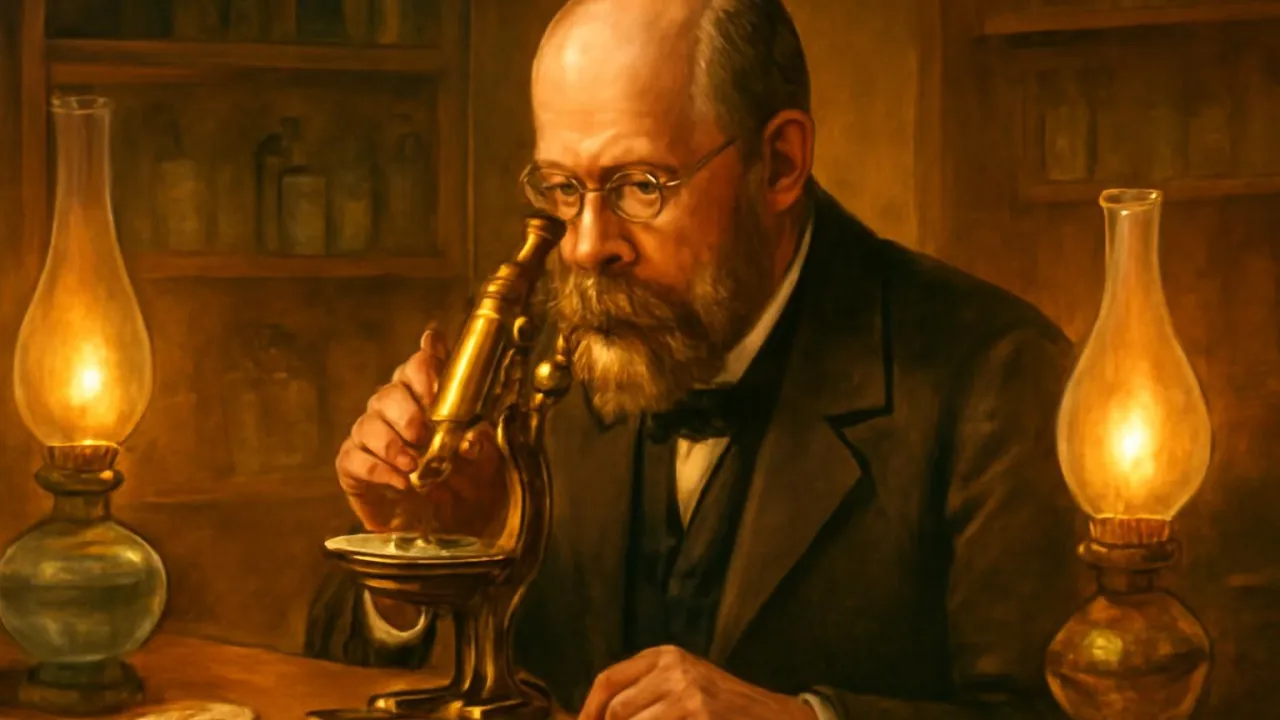
Robert Koch won the Nobel Prize for his amazing discoveries.
✨ Word Sparks (Grade 2 Glossary)
Tap 🔊 to hear
tuberculosis
A sickness that hurts your lungs
lab
A special place to do science
discovery
Finding something new or important
🪝
Have you ever wondered what makes people sick?
1
Looking for Clues
Robert was very curious about sickness and health. He wondered why people got sick and wanted to solve the mystery. He loved using his microscope to look at things too small to see.
2
Finding the Germs
Robert worked hard in his every day. He looked at blood and spit under the microscope and saw tiny living germs. He realized these germs could make people very sick.
3
Helping the World
Robert discovered the germ that causes a disease called . His helped doctors learn how to fight sickness. Many people became healthier because of his work.
Koch’s special rules for finding germs are called 'Koch’s Postulates.'
✨ Word Sparks (Grade 3 Glossary)
Tap 🔊 to hear
bacteria
Tiny living things too small to see
anthrax
A dangerous sickness caused by germs
Nobel Prize
A big award for important work
🪝
Can you imagine discovering invisible creatures that make people sick?
1
Curious Eyes and a Microscope
Robert Koch was fascinated by the mysteries of illness as a child. He spent hours peering through his microscope, searching for clues hidden in drops of water. The world of germs was invisible to most people, but Robert wanted to reveal its secrets. His curiosity led him to become a scientist and a doctor.
2
Solving the Germ Puzzle
In his laboratory, Robert worked carefully with glass slides and strange liquids. He noticed that certain germs were always found in people with the same sickness. Using his microscope, he proved that tiny caused diseases like and tuberculosis. This was a huge breakthrough in science.
3
Changing Medicine Forever
Before Robert’s discoveries, people did not understand how diseases spread. Doctors sometimes made mistakes because they could not see germs. Robert’s work helped them learn to wash hands and clean tools to stop sickness. Hospitals became safer places because of his research.
4
A Lasting Impact
Robert Koch’s discoveries saved many lives around the world. He won the for finding the cause of tuberculosis. Today, scientists still use his methods to study germs and fight new diseases. Robert’s curiosity and determination changed medicine forever.
2. Why did hospitals become safer after Robert's work?
🤯 Mind-Blowing Fact • Grade 4
Koch’s discovery of the tuberculosis germ helped reduce deaths from the disease worldwide.
✨ Word Sparks (Grade 4 Glossary)
Tap 🔊 to hear
cholera
A dangerous sickness from dirty water
sterilize
To make something very clean and germ-free
postulate
A rule or idea to test in science
🪝
What if you could solve a mystery that saves millions of lives?
1
A Childhood Spark for Science
As a young boy, Robert Koch was always curious about the world around him, especially the causes of sickness. He would collect pond water and peer through a homemade microscope, determined to find hidden secrets. This early fascination with tiny life forms set him on the path to becoming a scientist. His curiosity grew into a lifelong mission to understand disease.
2
Breaking Through with the Microscope
In the 1800s, many people did not believe that invisible germs could cause illness, but Robert was determined to prove them wrong. He spent long hours in his laboratory, carefully preparing slides and observing bacteria under powerful microscopes. His groundbreaking work showed that specific germs caused diseases such as anthrax, tuberculosis, and . These discoveries changed the way doctors thought about infection and health.
3
Koch’s Postulates: A New Way to Prove Disease
Robert Koch developed a set of rules called 'Koch’s ' to show exactly which germ caused a disease. These postulates required scientists to find the germ in every sick person, grow it in a lab, and then show it could make another healthy person sick. This careful scientific method helped other researchers study and fight many different diseases.
4
A Global Legacy in Medicine
Koch’s discoveries led to better hospital practices and inspired doctors worldwide to wash hands and equipment. He was awarded the Nobel Prize in 1905 for his work on tuberculosis, a deadly lung disease. Today, scientists still use his ideas to discover and treat new illnesses, making Robert Koch a true hero of medicine.
Robert Koch’s research helped reduce tuberculosis deaths by more than half in some countries.
✨ Word Sparks (Grade 5 Glossary)
Tap 🔊 to hear
bacteriology
The science of studying bacteria and germs
pandemic
A sickness that spreads to many countries
physiology
The science of how living things work
🪝
Imagine unlocking the secret code behind deadly diseases—what would you discover?
1
The Young Investigator’s Curiosity
Long before he became a world-famous scientist, Robert Koch was a boy with a keen sense of wonder about the natural world. He collected samples from ponds and fields, peering through magnifying glasses and homemade microscopes to glimpse the invisible. This early curiosity about what made people sick drove him to study medicine at university, where he became fascinated with the mysterious causes of deadly diseases that swept through towns and cities.
2
Pioneering Microbiology in the Lab
As a doctor in rural Germany, Koch transformed a small room into a scientific laboratory, using oil lamps, glass slides, and his prized microscope. He developed new ways to grow bacteria on solid surfaces, which allowed him to isolate and study individual germs. Through careful experiments, he identified the rod-shaped bacterium Bacillus anthracis as the cause of anthrax, proving for the first time that a specific microbe could cause a specific disease. His innovative methods revolutionized the field of microbiology.
3
Koch’s Postulates: Setting the Gold Standard
To convince the world that germs caused disease, Koch established a series of scientific steps known as 'Koch’s Postulates.' These postulates required scientists to isolate a suspected germ, grow it in pure culture, and show it could reproduce the same disease in a healthy host. By applying this method, Koch identified the bacteria responsible for tuberculosis and cholera, two of the most feared diseases of his era. His logical approach set the gold standard for disease research.
4
Transforming Medicine and Public Health
Koch’s discoveries had a profound impact on hospitals and public health systems worldwide. His work led to new rules for sterilizing medical tools, washing hands, and preventing the spread of infection. In 1905, he was awarded the Nobel Prize in or Medicine for his groundbreaking research on tuberculosis, a disease that killed millions each year. Thanks to Koch, doctors learned to fight diseases with science, saving countless lives.
5
A Lasting Legacy of Scientific Discovery
Today, Robert Koch is remembered as a founder of modern and a hero of medical science. His methods are still taught to scientists investigating new outbreaks and . Koch’s determination, careful experiments, and clear thinking showed the world how invisible germs could be tracked and defeated. His story inspires future generations to ask bold questions and use science to solve society’s greatest challenges.