1. Which famous musician thrilled 1920s listeners with his shiny jazz trumpet?
2. How did families in the 1920s listen to live music and baseball games together at home?
🤯 Mind-Blowing Fact • Grade 2
Movies had no spoken voices until 1927, when audiences gasped with excitement hearing actors talk and sing in 'talkies' for the first time!
✨ Word Sparks (Grade 2 Glossary)
Tap 🔊 to hear
improvisation
Making up music right on the spot
renaissance
Exciting rebirth of art writing and music
assembly line
Factory row where workers build parts fast
🪝
Why did people nickname the 1920s the 'Roaring Twenties'?
1
A New Beat Called Jazz
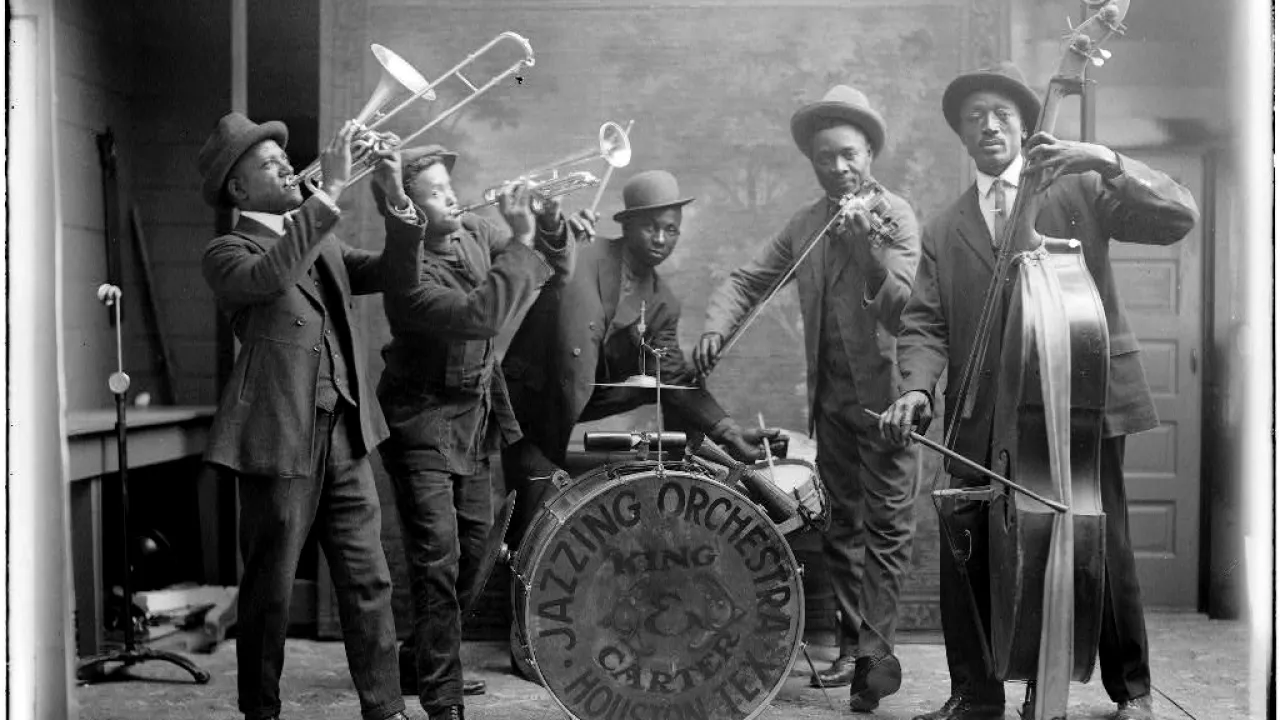
Snap your fingers to a bouncing piano beat! Born in New Orleans, jazz music blended African American rhythms, brass band horns, and joyful , where musicians made up melodies right on stage.
2
The Harlem Renaissance
In a New York City neighborhood called Harlem, talented Black writers, painters, and musicians sparked the Harlem . Poet Langston Hughes wrote rhythmic verses, while bandleader Duke Ellington dazzled crowds with swinging orchestra tunes.
3
Cars, Planes, and Talking Movies
Factory made automobiles affordable for millions of families, and electric refrigerators and vacuum cleaners saved chores at home. When Charles Lindbergh flew nonstop across the Atlantic Ocean in 1927, the whole nation cheered!
1. In which southern city did jazz music first take root before spreading nationwide?
2. What exciting milestone did pilot Charles Lindbergh achieve in 1927?
🤯 Mind-Blowing Fact • Grade 3
Inventor Garrett Morgan, an African American entrepreneur, patented a three-position traffic signal in 1923 to warn drivers before intersections changed from go to stop!
✨ Word Sparks (Grade 3 Glossary)
Tap 🔊 to hear
migration
Movement of many people to new regions
appliance
Household machine like a toaster or washer
patent
Government paper protecting an inventor's new idea
🪝
How did assembly lines, radio waves, and Harlem artists reshape everyday American life in a single decade?
1
Turning Dial Into a Shared Nation
Click! As evening falls in 1922, a family turns a glowing knob on a wooden radio cabinet, and clear music floats across hundreds of miles. Starting with Pittsburgh's KDKA in 1920, radio networks united coast-to-coast listeners with news, concerts, and Babe Ruth's home runs.
2
Jazz and the Harlem Renaissance
During the Great , hundreds of thousands of African Americans moved from the rural South to northern cities like Chicago, Detroit, and New York. In Harlem, poet Langston Hughes, author Zora Neale Hurston, painter Jacob Lawrence, and composer Duke Ellington created a proud cultural flowering known as the Harlem Renaissance.
3
Assembly Lines Put America on Wheels
Henry Ford's moving assembly line lowered the price of a Model T car below three hundred dollars! Suddenly, millions of families drove on newly numbered highways, prompting towns to invent three-color electric traffic lights, roadside diners, and gas stations.
4
Skyscrapers and Aviation Heroes
Electric brightened city apartments while steel skyscrapers climbed higher than ever. Pilots Charles Lindbergh and Amelia Earhart inspired young dreamers everywhere by proving airplanes could link distant continents.
1. Which Harlem Renaissance poet wrote rhythmic poems celebrating African American life and dreams?
2. How did Henry Ford's moving assembly line change automobile travel in the 1920s?
🤯 Mind-Blowing Fact • Grade 4
When Henry Ford perfected his moving assembly line, workers reduced the time needed to assemble one Model T chassis from more than twelve hours down to just ninety-three minutes!
✨ Word Sparks (Grade 4 Glossary)
Tap 🔊 to hear
syncopated
Music placing lively accents on unexpected beats
electrification
Wiring homes and towns with electric power
installment
Paying for an item in small parts
🪝
How did the Great Migration, mass media, and electrical engineering turn the 1920s into America's first modern consumer era?
1
From Quiet Parlors to Mass Media
Listen to the swing of Louis Armstrong's Hot Five crackling from a living-room loudspeaker while Model T horns honk outside! Following World War I, expanding electrical grids and assembly-line factories transformed daily routines. Commercial radio stations—growing from one licensed transmitter in 1920 to over six hundred by 1929—created a shared national culture overnight.
2
The Great Migration and Harlem's Creative Spark
Seeking factory jobs and greater civic opportunity during the Great Migration, more than a million African Americans relocated from southern states to northern urban centers. In New York's Harlem neighborhood, thinkers and artists—including Langston Hughes, Zora Neale Hurston, Aaron Douglas, Duke Ellington, and Virginia-born jazz vocalist Ella Fitzgerald in the years soon after—celebrated Black heritage and artistic excellence.
3
Electrification, Highways, and Aviation
By 1929, nearly seventy percent of urban homes had electricity, powering washing machines, irons, and refrigerators that reduced exhausting household labor. Meanwhile, twenty-three million registered automobiles spurred paved highways, suburban neighborhoods, and Garrett Morgan's T-shaped warning traffic signal, while Charles Lindbergh's 33.5-hour transatlantic flight in May 1927 launched commercial aviation.
4
Hidden Storm Clouds Beneath Prosperity
Despite booming city factories, many rural farmers struggled with falling crop prices, and shoppers increasingly bought goods on credit. Those economic imbalances set the stage for the dramatic stock market crash of October 1929.
1. How did the Great Migration help spark the Harlem Renaissance and the spread of jazz?
2. Which hidden economic problem quietly grew during the booming 1920s?
🤯 Mind-Blowing Fact • Grade 5
Newport News, Virginia native Ella Fitzgerald grew up listening to 1920s jazz records of Louis Armstrong and the Boswell Sisters before becoming the world-renowned 'First Lady of Song'!
✨ Word Sparks (Grade 5 Glossary)
Tap 🔊 to hear
demographic
Relating to population size and where people live
polyrhythm
Two or more contrasting rhythms played together
speculation
Risky buying hoping prices rise very fast
🪝
Why did the 1920s simultaneously produce dazzling artistic innovation, sweeping technological progress, and fragile economic debt?
1
America Crosses the Urban Threshold
When census takers tallied the 1920 U.S. Census, they uncovered a historic milestone: 51.2 percent of Americans now resided in urban towns and cities rather than rural communities. Powered by widespread electrification, mass manufacturing, and newly ratified women's suffrage, the decade became known as both the Roaring Twenties and—in author F. Scott Fitzgerald's famous phrase—the Jazz Age.
2
Jazz Improvisation and the Harlem Renaissance
Rooted in African American blues, ragtime, and brass-band traditions of New Orleans, jazz emphasized and solo improvisation—an artistic expression of individual freedom led by innovators Louis Armstrong, Jelly Roll Morton, Duke Ellington, and Bessie Smith. Concurrently, the Great Migration fueled the Harlem Renaissance, where poet Langston Hughes, anthropologist-novelist Zora Neale Hurston, and sculptor Augusta Savage reshaped American literature and visual art.
3
Mass Production and Mass Communication
Industrial productivity soared nearly forty percent during the 1920s as factories adopted electric motors and moving assembly lines. Automobile ownership tripled from eight million vehicles in 1920 to twenty-three million by 1929, catalyzing steel, rubber, glass, and petroleum industries. Simultaneously, NBC and CBS radio networks, mass-circulation magazines, and synchronized-sound motion pictures forged coast-to-coast cultural touchstones, from baseball broadcasts to Charles Lindbergh's 3,600-mile flight aboard the Spirit of St. Louis.
4
Uneven Prosperity Across Urban and Rural America
Yet the decade's roar did not reach every household equally. After wartime European demand faded, American farmers faced chronic crop surpluses, falling grain prices, and rural bank closures, while coal and textile workers saw stagnant wages.
5
Credit, Speculation, and the End of an Era
Easy installment buying encouraged households to purchase radios and cars on borrowed money, while investors speculated in stocks 'on margin' with as little as ten percent cash down. When Wall Street share prices collapsed in October 1929, the Jazz Age gave way to the Great Depression—leaving behind permanent gifts in music, literature, and modern engineering.