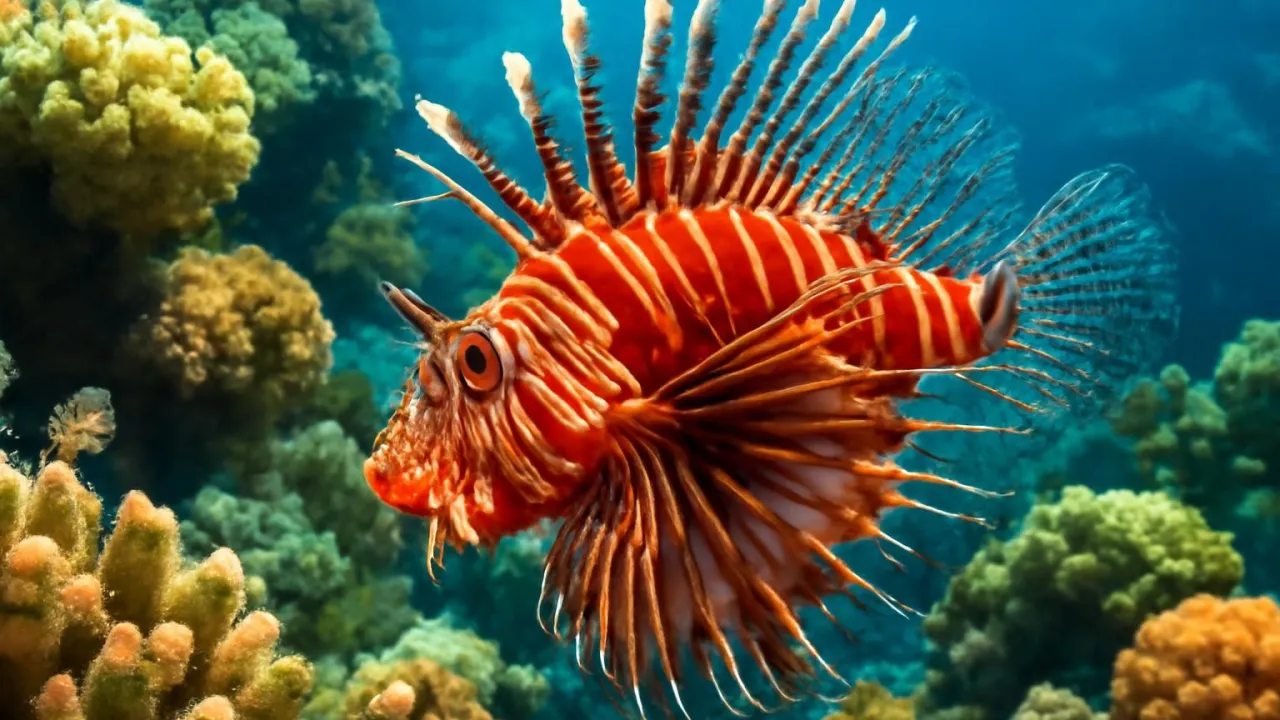
Red lionfish venom can cause pain and swelling if touched by humans!
✨ Word Sparks (Grade 2 Glossary)
Tap 🔊 to hear
predators
Animals that hunt other animals
coral reefs
Underwater homes made of tiny animals
venomous
Having poison that can hurt others
🪝
Have you ever seen a fish with long, sharp spines that glow?
1
Bright and Spiky Fish
The red lionfish has red and white stripes covering its body. Its long spines look like sharp needles. These spines help protect it from . The fish moves slowly but looks very bright.
2
Home in Coral Reefs
Red lionfish live in warm ocean waters near . They hide in rocky places and swim carefully. These reefs give them food and shelter from bigger fish. The water is usually clear and warm.
3
Hunters of Small Fish
This fish eats small fish and shrimp using its big, fan-like fins. It sneaks up on prey by moving quietly. The lionfish uses its spines to scare away enemies. It is a strong hunter in its home.
Red lionfish venom is powerful enough to cause serious pain but rarely causes death.
✨ Word Sparks (Grade 3 Glossary)
Tap 🔊 to hear
camouflage
Colors that help animals hide
predator
An animal that hunts others
venom
Poison that animals use to protect
🪝
Did you know the red lionfish uses venomous spines to defend itself?
1
Striking Appearance and Camouflage
The red lionfish has red and white stripes that help it blend with coral. Its long, venomous spines serve as a strong defense against . The fish’s spines look like sharp needles, warning others to stay away. This helps it hide while hunting.
2
Habitat and Ecosystem Role
Red lionfish live in warm Indo-Pacific coral reefs where they find food and shelter. They are that eat small fish and crustaceans, controlling prey populations. Their presence affects the balance of reef ecosystems by influencing other species. These fish adapt well to different reef environments.
3
Venom and Protection
The lionfish’s spines contain that can cause pain and swelling in or humans. This venom is a chemical defense that helps the fish survive attacks. When threatened, the lionfish spreads its spines to look bigger and more dangerous. This adaptation reduces the risk of being eaten.
4
Hunting and Feeding Behavior
Red lionfish use their large, fan-like fins to corner and trap prey like small fish and shrimp. They move slowly and quietly to avoid alerting their prey. Their hunting style relies on surprise and patience to catch food. This method helps them get enough nutrients to grow and survive.
1. How do red lionfish protect themselves from predators?
2. What is one way red lionfish hunt their prey?
🤯 Mind-Blowing Fact • Grade 4
Red lionfish have invaded new oceans, disrupting local fish and coral reef balance.
✨ Word Sparks (Grade 4 Glossary)
Tap 🔊 to hear
ecosystem
A community of living and nonliving things
invasive
A species that harms new environments
venomous
Having poison to protect or attack
🪝
Have you wondered how a fish’s venom helps it survive in coral reefs?
1
Colorful Defense and Camouflage
The red lionfish’s bright red and white stripes provide camouflage among coral reefs, blending with colorful surroundings. Its spines act as a powerful defense, deterring predators from attacking. This combination of camouflage and venom helps the lionfish survive in dangerous reef environments. Its spines also warn other animals to keep their distance.
2
Role in the Coral Reef Ecosystem
As a predator, the red lionfish controls populations of small fish and crustaceans, maintaining balance in the reef’s food web. However, when introduced outside its native range, it can harm local by outcompeting native species. The lionfish’s hunting affects the diversity and health of coral reef communities. Humans have tried to manage lionfish numbers to protect reefs.
3
Venom Mechanism and Effects
The lionfish’s spines contain venom glands that release toxins when touched, causing pain and swelling in predators or humans. This venom is a chemical adaptation that discourages attacks and increases survival chances. The fish spreads its spines wide to maximize the venom’s warning effect. fish like the lionfish play important roles in their habitats by influencing predator-prey relationships.
4
Geographic Distribution and Impact
Native to the Indo-Pacific, red lionfish have spread to the Atlantic and Caribbean, where they are species. Their rapid reproduction and lack of natural predators in new areas threaten native fish populations. This spread has led to ecological and economic concerns for coastal communities. Efforts include lionfish hunting and public education to reduce their impact.
2. What problem do red lionfish cause outside their native home?
🤯 Mind-Blowing Fact • Grade 5
Red lionfish venom contains proteins that cause intense pain and can affect human health for hours.
✨ Word Sparks (Grade 5 Glossary)
Tap 🔊 to hear
taxonomy
The science of naming and grouping living things
venomous
Having poison to defend or attack
invasive
A species that spreads and harms new places
🪝
How does the red lionfish’s venomous spines influence marine ecosystems and human health?
1
Scientific Classification and Taxonomy
The red lionfish, scientifically named Pterois volitans, belongs to the Scorpaenidae family, known for fin spines. It is part of the order Scorpaeniformes, which includes many predatory fish with specialized defenses. Its reflects evolutionary adaptations for survival in coral reef habitats. Understanding its classification helps scientists study its ecological impact.
2
Physiological Mechanics of Venom Delivery
Red lionfish possess 13 long dorsal spines containing venom glands connected to sheath tissues that release toxins when punctured. The venom is a complex mixture of proteins causing intense pain, swelling, and sometimes systemic effects in predators or humans. This physiological mechanism allows the lionfish to defend itself effectively against threats. The spines also serve as visual warnings to potential attackers.
3
Ecological Impact and Conservation Challenges
Native to the Indo-Pacific, red lionfish have become in the Atlantic and Caribbean, where they disrupt native fish populations by preying on juveniles and competing for resources. Their rapid reproduction and lack of natural predators in these areas lead to ecological imbalance. Conservation efforts focus on controlled removal and public awareness to protect reef biodiversity. The lionfish invasion poses ongoing management challenges.
4
Botanical and Biological Comparisons
Unlike many marine species, the red lionfish’s spines are a rare adaptation among fish, similar in function to venomous terrestrial animals. Its predatory behavior contrasts with herbivorous reef fish that feed on algae or plants. The lionfish’s ability to thrive in diverse reef environments shows remarkable evolutionary adaptation. These comparisons highlight its unique role in marine biology.
5
Quantitative Facts and Records
Red lionfish can grow up to 15 inches (38 cm) long and weigh about 2 pounds (0.9 kg). They inhabit depths from 10 to 300 feet (3 to 91 meters) in warm waters between 72°F and 82°F (22°C and 28°C). Their spines can cause pain lasting several hours if touched. This fish’s slow swimming speed contrasts with its effective hunting strategy using stealth and venom.