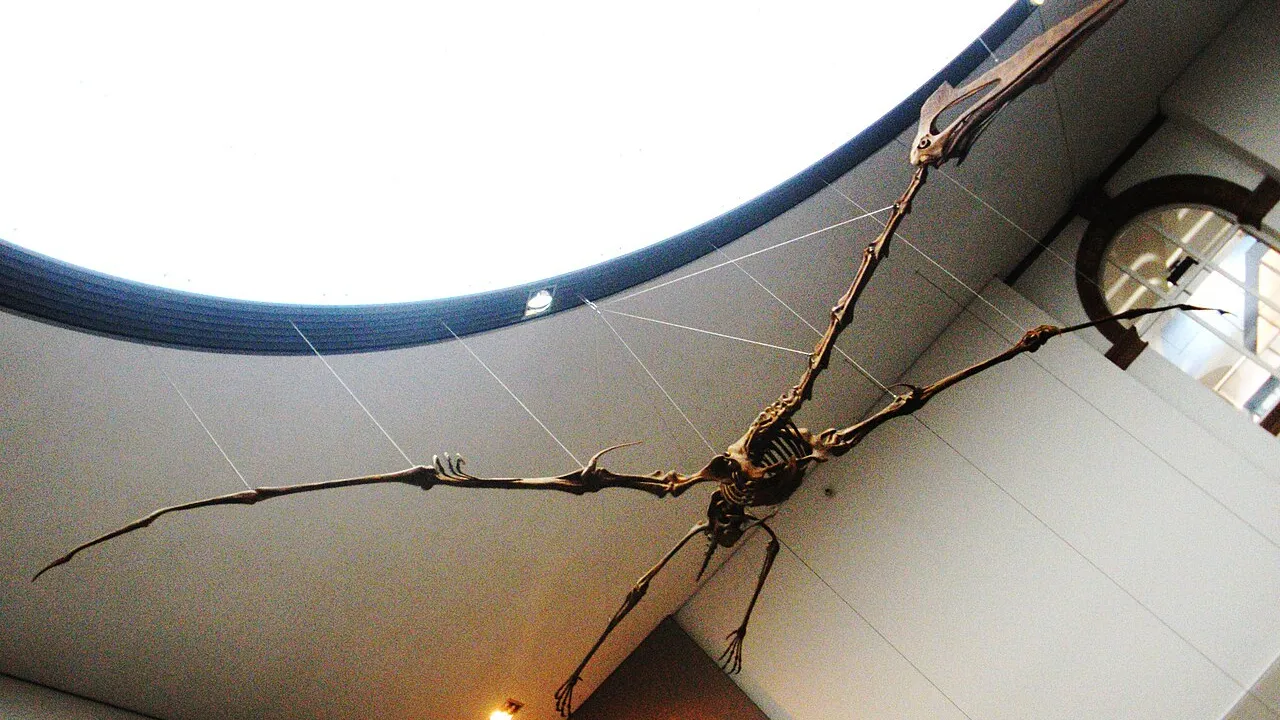
1. How tall did Quetzalcoatlus stand when walking on the ground?
2. What kind of animal was Quetzalcoatlus?
🤯 Mind-Blowing Fact • Grade 2
Scientists named Quetzalcoatlus after Quetzalcoatl, the famous feathered serpent deity of ancient Aztec culture in Mesoamerica!
✨ Word Sparks (Grade 2 Glossary)
Tap 🔊 to hear
Vault
To leap high by pushing with arms
Floodplain
Flat land beside rivers that floods seasonally
Beak
Hard, pointed jaws without any teeth
🪝
How did an animal with a thirty-six-foot wingspan jump off flat ground into the sky?
1
Giant of Big Bend
Step onto a warm in Texas sixty-seven million years ago. Striding across the mud on four long limbs comes Quetzalcoatlus, one of the largest animals ever to fly! Although its wings spanned thirty-six feet, hollow air-filled bones kept its body around five hundred pounds.
2
The Pole-Vault Jump
How did such a giant take off? Instead of running like an airplane, Quetzalcoatlus crouched low and pushed off explosively with its super-strong folded wing arms! That four-limbed launched it eight feet into the air so its wings could flap cleanly.
3
Stalking Like a Stork
With a toothless, pointed longer than a grown-up, it walked inland plains snapping up lizards, frogs, crabs, and baby dinosaurs.
1. How did Quetzalcoatlus launch itself from the ground into flight?
2. Did Quetzalcoatlus have sharp teeth inside its long jaws?
🤯 Mind-Blowing Fact • Grade 3
Quetzalcoatlus's species name northropi honors aviation pioneer Jack Northrop, designer of sleek tail-less 'flying wing' aircraft!
✨ Word Sparks (Grade 3 Glossary)
Tap 🔊 to hear
Thermal
Column of warm air rising skyward
Strut
Thin internal bar bracing a hollow structure
Azhdarchid
Family of giant long-necked toothless pterosaurs
🪝
Why did a young geology student in Texas stumble across a single wing bone bigger than his own arm?
1
A Mind-Boggling Find in Texas
In 1971, graduate student Douglas Lawson was hiking through Big Bend National Park in Texas when he spotted hollow bone fragments eroding out of Late Cretaceous rock. Digging carefully, he uncovered a pterosaur forearm bone more than twice the size of any flying animal known at the time!
2
Engineered for Lightness
Named Quetzalcoatlus northropi, this giant belonged to the —stiff-necked, toothless pterosaurs. Its wingspan reached thirty-three to thirty-six feet, matching a Cessna light airplane! Inside its bones, crisscrossing tiny supported walls thin as a credit card, keeping its weight near five hundred pounds.
3
A Giant Ground Stalker
Earlier scientists guessed Quetzalcoatlus skimmed oceans for fish. However, Big Bend lay hundreds of miles inland from the sea! Trackways and leg joints show it walked efficiently on land like a supersized marabou stork, plucking up small animals whole.
4
Soaring Across Continents
Once aloft after an eight-foot vaulting jump, Quetzalcoatlus rode warm rising air currents called at highway speeds.
1. Why do paleontologists think Quetzalcoatlus hunted on land rather than skimming ocean waves?
2. Who inspired the second part of the scientific name Quetzalcoatlus northropi?
🤯 Mind-Blowing Fact • Grade 4
Computer flight models estimate that once riding high thermal air currents, Quetzalcoatlus could soar at up to 80 miles per hour for thousands of miles!
✨ Word Sparks (Grade 4 Glossary)
Tap 🔊 to hear
Quadrupedal
Moving or launching using all four limbs
Pycnofiber
Fuzzy hair-like filament covering pterosaur skin
Pneumatic
Filled with air spaces connected to lungs
🪝
How did biomechanical engineers prove a 500-pound reptile could vault eight feet straight up and cruise across continents?
1
Titan of the Javelina Floodplains
Imagine standing in West Texas 67 million years ago as a shadow wider than a school bus sweeps silently across a floodplain. Touching down with measured grace, Quetzalcoatlus northropi folds its 10-to-11-meter (33-to-36-foot) wings and stands five meters tall on four pillar-like limbs. Covered in fine hair-like rather than bird feathers, this azhdarchid pterosaur shared its inland habitat with giant Alamosaurus and horned Torosaurus.
2
Solving the Heavy-Flight Paradox
For decades, physicists debated how a 200-to-250-kilogram animal could ever become airborne, because birds launch solely with their hind legs—limiting maximum bird weight because heavy leg muscles become dead weight aloft. Pterosaurs solved that bottleneck brilliantly: their massive flight-powering pectoral muscles also drove a vault!
3
The 2021 Biomechanical Breakthrough
In landmark 2021 studies examining dozens of Texas pterosaur bones, Kevin Padian, Matthew Brown, Brian Andres, and colleagues mapped Quetzalcoatlus's exact joint motion. Before flapping, it crouched deeply and leaped at least 2.5 meters (8 feet) upward so its 5-meter wingtips cleared the ground on the first downstroke.
4
Two Species Side by Side
Those same Big Bend rocks also held a smaller cousin named Quetzalcoatlus lawsoni with a 4.5-meter (15-foot) wingspan. While giant northropi stalked solitary meadows like an enormous heron, lawsoni gathered in flocks around alkaline lakes probing mud for invertebrates.
1. Why could pterosaurs grow much heavier than any flying bird without losing the ability to take off?
2. How did the newly named smaller relative Quetzalcoatlus lawsoni differ from giant Quetzalcoatlus northropi?
🤯 Mind-Blowing Fact • Grade 5
Inside Quetzalcoatlus's gigantic hollow wing bones, internal crisscrossing bony struts created a honeycomb structure so strong and light that aerospace engineers study it for modern aircraft wings!
✨ Word Sparks (Grade 5 Glossary)
Tap 🔊 to hear
Actinofibril
Stiffening fiber woven inside pterosaur wing skin
Trabecular
Spongy network of tiny internal bone struts
Kinematics
Scientific study of body and joint motion
🪝
What happens at the absolute physical limit of vertebrate powered flight—and how did Quetzalcoatlus push nature's aerodynamic envelope?
1
Discovery at the Edge of the Mesozoic
During the Maastrichtian finale of the Late Cretaceous (~68 to 66 million years ago), semiarid alluvial plains in what is now Texas's Big Bend National Park formed the Javelina Formation. In 1971, geology student Douglas A. Lawson spotted a colossal fragmentary humerus protruding from claystone cliffs, announcing Quetzalcoatlus northropi in Science in 1975. Nearly fifty years later, a comprehensive 2021 monograph formally diagnosed both giant Q. northropi and the abundant 4.5-meter-wingspan species Q. lawsoni.
2
Ultralight Pneumatization and Wing Membranes
Stretching 10 to 11 meters across the wings and standing roughly 5 meters tall, Q. northropi achieved structural strength at a mass of 200 to 250 kilograms through extreme skeletal pneumatization. Subcutaneous air sacs connected to the respiratory system invaded long bones and elongated cervical vertebrae, leaving cortical bone walls scarcely a millimeter thick reinforced by internal struts. Its multi-layered wing membrane (actinopatagium), stiffened by keratinous structural fibers called , trailed from a hyper-extended fourth manual digit.
3
Kinematics of the Quadrupedal Launch
Biomechanical modeling by Michael Habib and kinematic reconstructions by Kevin Padian's team resolved long-standing controversies over giant pterosaur flight. Rather than requiring cliff drops, Q. northropi executed a ballistic quadrupedal launch: flexing its hindlimbs to spring vertical ~2.5 meters while pivoting forward onto robust metacarpals to vault skyward at nearly 4G acceleration before initiating its first sweeping wingbeat.
4
Terrestrial Foraging Mechanics
Rigid tubular neck vertebrae prevented twist stresses during aerial skimming, overturning older hypotheses of gull-like wave trawling. Instead, narrow chopstick-like jaws functioned as precision tongs for terrestrial stalking—allowing Q. northropi to pace floodplains like a titanic heron, seizing juvenile dinosaurs, amphibians, and arthropods whole.
5
Continental Soaring
Aloft, high-aspect-ratio wings harnessed convective thermals like modern condors, enabling effortless transcontinental gliding until the end-Cretaceous asteroid impact closed the age of pterosaurs.