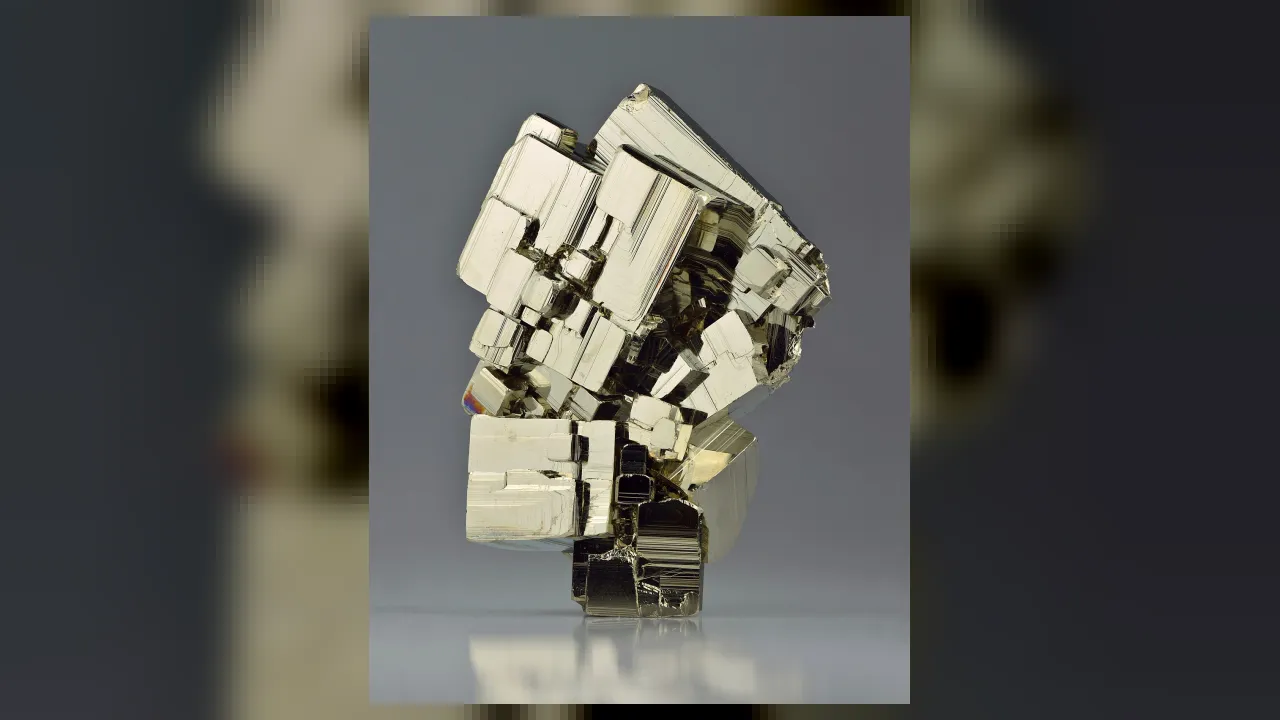
⚡ Planet Earth SparkGrows ruler-straight golden metal cubes in rock and throws real fiery sparks when struck
🤯 Mind-Blowing Fact • Grade 1
In Spain, pyrite grows into mirror-smooth golden cubes so square and flat they look made in a robot factory!
✨ Word Sparks (Grade 1 Glossary)
Tap 🔊 to hear
cube
A box shape with six equal squares
spark
A tiny flying bit of bright fire
brassy
Shiny pale yellow like a brass horn
🪝
Why did shiny golden cubes in rivers trick treasure hunters?
1
Wait—Is That Real Gold?
Glint! A shiny " onclick="pulseWordSpark(1, 0)" title="Tap to highlight Word Spark">cube winks from a creek bed. Excited diggers shout 'Gold!'—until they learn it is fool's gold!
2
Square Like Toy Blocks
Nature grows pyrite in super neat square " onclick="pulseWordSpark(1, 0)" title="Tap to highlight Word Spark">cubes with flat mirror sides. Nobody carved them—atoms stacked that way underground!
3
Fire Stone Sparks
Bang pyrite hard against steel or flint and real hot fly out! People long ago used those sparks to start campfires.
1. What cool geometric shape does pyrite often grow into naturally?
2. What happens if you strike pyrite sharply against steel or flint?
🤯 Mind-Blowing Fact • Grade 2
Captain John Smith complained at Jamestown, Virginia, that early settlers wasted weeks digging shiny 'gilded dirt' full of fool's gold instead of planting food!
✨ Word Sparks (Grade 2 Glossary)
Tap 🔊 to hear
brittle
Hard yet easy to snap or shatter
streak
Powder color left on a test tile
colonist
A settler living in a new land
🪝
In 1607 at Jamestown, Virginia, why did settlers accidentally ship boatloads of pyrite back to England?
1
Jamestown's Shiny Mistake
Imagine stepping off a wooden ship in Virginia in 1607 and spotting glittering yellow flecks in creek mud! Excited Jamestown shoveled barrels of shiny yellow dirt onto ships bound for London—only for scientists there to test it and announce it was worthless fool's gold!
2
Three Easy Gold Tests
Real gold is soft enough to dent with a pin, bends without breaking, and leaves a bright yellow mark. pyrite shatters under a hammer, is harder than a steel knife, and leaves a dark greenish-black powder !
3
Made of Iron and Sulfur
Geologists know pyrite as iron sulfide. Strike two pieces together and you can even smell a faint whiff of sulfur like a struck match!
1. What color powder streak does brassy pyrite leave on a white porcelain tile?
2. Which two elements combine to build pyrite?
🤯 Mind-Blowing Fact • Grade 3
When archaeologists examined Ötzi the 5,300-year-old Iceman in the Alps, they found tiny grains of pyrite inside his belt pouch for striking campfires!
✨ Word Sparks (Grade 3 Glossary)
Tap 🔊 to hear
ammonite
An extinct sea creature with coiled shell
pyritohedron
A twelve-sided crystal with five-edged faces
metallic luster
Shining brightly like polished solid metal
🪝
How can ancient sea snails turn into glittering golden statues made of pyrite?
1
Golden Seafloor Fossils
Picture a coiled shell sinking into dark, oxygen-free mud at the bottom of a prehistoric sea. Hungry bacteria in the mud release sulfur that teams up with dissolved iron, replacing the shell atom by atom with glittering brassy pyrite! Today collectors find golden ammonites, trilobites, and brachiopods gleaming like metal sculptures.
2
Cubes, Twelve-Sided Gems, and 'Suns'
Pyrite doesn't only form six-sided cubes! It also crystallizes into twelve-sided shapes with five-sided faces called ',' plus flat golden discs squeezed between layers of black coal shale nicknamed 'pyrite suns.'
3
Mohs Six-Point-Five Spark Maker
Ranking 6 to 6.5 on the Mohs Hardness Scale, pyrite easily scratches glass! Prehistoric humans carried pyrite nodules with flint in survival kits—including Ötzi the 5,300-year-old Iceman found frozen in the Alps!
4
Virginia's Historic Pyrite Belt
Across Louisa and Prince William counties in Virginia, big underground mines once harvested tons of pyrite—not for gold, but to manufacture sulfur chemicals and fertilizer!
1. Why did mines in Louisa and Prince William counties, Virginia, dig up tons of pyrite in the late 1800s and early 1900s?
2. What are flat, radiating golden discs of pyrite formed between dark shale layers called?
🤯 Mind-Blowing Fact • Grade 4
In the 1910s and 1920s, pioneers of wireless radio used natural pyrite crystals as semiconductor detectors inside battery-free 'crystal radio' receivers!
✨ Word Sparks (Grade 4 Glossary)
Tap 🔊 to hear
malleable
Able to bend or flatten without shattering
semiconductor
Material that controls electric current in electronics
perpendicular
Meeting at a crisp ninety-degree right angle
🪝
Could 'fool's gold' actually hide real invisible gold locked inside its crystal structure?
1
Classroom Star of Mineral Identification
Every Virginia fourth- and fifth-grade Earth science mineral kit includes pyrite because it teaches why you should NEVER trust color alone! Both gold and pyrite display bright metallic luster and brassy-yellow color. Compare three diagnostic properties, however, and they couldn't be more different: gold has Mohs hardness 2.5 (), golden-yellow streak, and specific gravity 19.3; pyrite has Mohs hardness 6–6.5 (brittle), greenish-black streak, and specific gravity 5.0.
2
Perpendicular Striations on Cube Faces
Look closely at the six square faces of a natural pyrite cube and you will spot fine parallel grooves called striations. Even cooler, the lines on each square face run —at right angles—to the lines on every neighboring face!
3
Surprise: Invisible Real Gold Inside!
Ironically, prospectors who threw pyrite away sometimes tossed out real treasure! Hydrothermal pyrite crystals containing trace arsenic can trap microscopic nanoparticles and dissolved atoms of genuine gold—creating major 'refractory gold' deposits mined in Nevada today.
4
Early Crystal Radios
Before batteries and microchips, 1920s kids built 'cat's-whisker' crystal radios by touching a thin wire to a semiconducting chunk of pyrite to pull live music straight out of radio waves! Later in the 16th and 17th centuries, clockwork 'wheellock' mechanisms spun grooved steel against pyrite cubes to shower reliable ignition sparks.
1. How do real gold and pyrite compare in density (specific gravity)?
2. How are the fine growth striations arranged on adjacent square faces of a pyrite cube?
🤯 Mind-Blowing Fact • Grade 5
At Beecher's Trilobite Bed in New York, rapid seafloor pyrite growth preserved 450-million-year-old trilobites in solid golden iron sulfide—right down to their delicate antennae and tiny walking legs!
✨ Word Sparks (Grade 5 Glossary)
Tap 🔊 to hear
sulfide
Mineral compound pairing sulfur with a metal
framboid
Microscopic raspberry-shaped cluster of pyrite microcrystals
remediation
Cleaning up and restoring polluted natural environments
🪝
How does Earth's most common sulfide mineral regulate atmospheric oxygen across geological eons?
1
Disulfide Dumbbells and Isometric Symmetry
Inside pyrite's cubic lattice (FeS2), ferrous iron cations (Fe2+) alternate with covalently bonded sulfur pairs (S2^2−) shaped like tiny atomic dumbbells—an architecture modeled on sodium chloride rock salt, except tilted disulfide pairs lower the rotational symmetry from full octahedral to 'diploidal' isometric symmetry! That subtle internal tilt explains why striations on adjacent cube faces run strictly perpendicular to one another and why pyrite forms pentagonal-faced twelve-sided pyritohedrons—most famously at Peru's Huanzala mine and Navajún, Spain.
2
Pyritization of Soft-Bodied Fossils
At extraordinary fossil sites called Konservat-Lagerstätten—including New York's Ordovician Beecher's Trilobite Bed and Germany's Devonian Hunsrück Slate—rapid mud burial sealed organisms away from oxygen. Sulfate-reducing microbes consumed decaying tissues and released hydrogen , precipitating microcrystalline pyrite '' fast enough to preserve delicate trilobite antennae, legs, and gill filaments in gleaming brassy three-dimensional detail!
3
Planetary Oxygen Thermostat
Geochemists track sedimentary pyrite burial across billions of years because locking iron and sulfur underground prevents them from reacting with atmospheric oxygen! Periods of massive seafloor pyrite burial helped boost Earth's breathable oxygen levels.
4
Acid Mine Drainage and Environmental Remediation
Conversely, when mining or roadcuts expose buried pyrite to air, water, and iron-oxidizing bacteria, FeS2 oxidizes rapidly into sulfuric acid and rusty orange iron-hydroxide sludge ('yellow boy')—a challenge environmental engineers neutralize at historic sites like Cabin Branch in Prince William Forest Park, Virginia, using crushed limestone channels.
5
Photovoltaic Research Horizons
Because abundant, non-toxic iron disulfide absorbs sunlight a hundred times more strongly than silicon, materials scientists are investigating ultra-thin synthetic pyrite films for next-generation low-cost solar cells. Meanwhile, lithium-iron-disulfide (Li/FeS2) primary batteries already deliver lightweight, long-shelf-life power for cold-weather expedition cameras and scientific sensors.