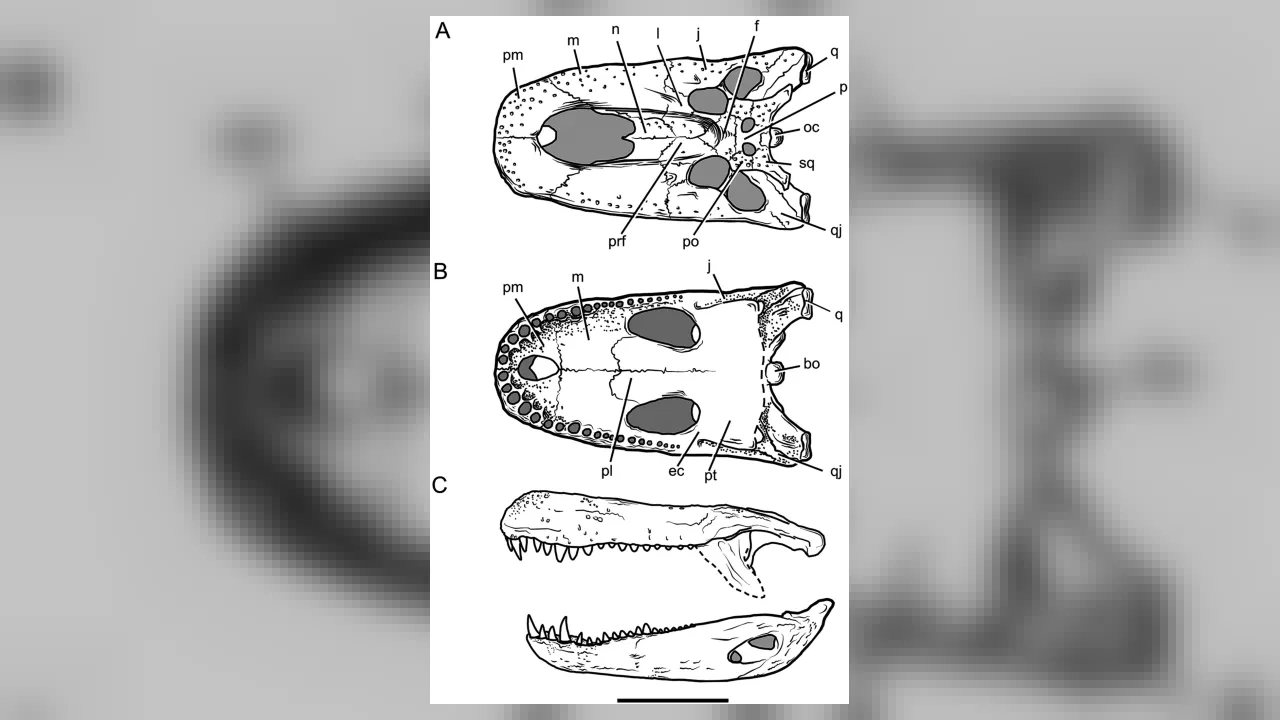
⚡ Survival SuperpowerColossal blunt five-foot caiman skull clamping down with ~15,500 pounds of force
🤯 Mind-Blowing Fact • Grade 1
A single tooth of Purussaurus was thick as an ice cream cone and had tiny saw-like ridges along its edges!
✨ Word Sparks (Grade 1 Glossary)
Tap 🔊 to hear
Caiman
South American cousin of the alligator
Wetland
Huge area of shallow lakes and marshes
Mighty
Having super strong power and force
🪝
What giant Amazon reptile had a head as wide as a dining table?
1
Splash in the Giant Swamp
BOOM! Water sprays high as giant jaws snap shut. Meet Purussaurus! Millions of years after dinosaurs were gone, this huge ruled warm lakes in South America.
2
Longer Than a Bus
Modern are smaller cousins of alligators. Purussaurus grew thirty-five feet long and heavier than an elephant! Its thick blunt snout looked like a stone battering ram.
3
Cracking Giant Shells
Car-sized river turtles swam in those same warm lakes. Purussaurus crunched right through tough shells with one chomp!
2. When did Purussaurus rule its giant wetland home?
🤯 Mind-Blowing Fact • Grade 2
The opening for Purussaurus's nostrils on top of its fossil skull is so cavernous you could drop a basketball almost straight inside!
✨ Word Sparks (Grade 2 Glossary)
Tap 🔊 to hear
Basin
Huge bowl-shaped lowland drained by rivers
Rodent
Gnawing mammal group including mice, beavers, and capybaras
Colossal
Extraordinarily huge and heavy in size
🪝
What happens when the Amazon Basin turns into a swamp ten times bigger than Great Britain?
1
Before the Amazon River Flowed East
Imagine visiting South America eight million years ago! The Andes Mountains were still pushing upward, trapping vast warm lakes and marshes called the Pebas Mega-Wetland. Swimming at the top of that watery food chain was Purussaurus, a caiman up to thirty-six feet long!
2
Built for Super Prey
Everything in that ancient wetland grew supersized! Giant freshwater turtles wore shells eight feet long, and plant-eating called Phoberomys grew as big as buffaloes. Purussaurus needed an extra-deep, blunt skull nearly five feet long to tackle them.
3
Hungry Every Day
Scientists calculate that an eight-ton Purussaurus needed roughly ninety pounds of food per day—about twenty times what a modern caiman eats!
1. What oversized neighbors shared the Pebas Mega-Wetland with Purussaurus?
2. About how much food did an adult Purussaurus need on average each day?
🤯 Mind-Blowing Fact • Grade 3
Giant fossilized turtle shells from the Miocene Amazon still carry deep circular holes punched straight through solid bone by Purussaurus teeth!
✨ Word Sparks (Grade 3 Glossary)
Tap 🔊 to hear
Miocene
Warm epoch in the Age of Mammals
Uplift
Slow rising of Earth's crust into tall mountains
Vaulted
Arched high like a strong curved ceiling
🪝
How did rising mountains accidentally build—and then drain—the kingdom of Earth's heaviest caiman?
1
Found Along the Purus River
In 1892, Brazilian botanist and explorer João Barbosa Rodrigues described a massive fossilized jawbone eroded from muddy riverbanks along the Purus River in western Brazil. Naming it Purussaurus brasiliensis, he introduced science to the largest crown-group alligatorid ever discovered!
2
Record-Shattering Bite Force
Modern black caimans rarely pass sixteen feet, yet Late Purussaurus reached 10.3 to 11 meters (34–36 feet) and weighed up to eight metric tons. In 2015, scientists measured its 1.45-meter skull and calculated a sustained bite force of 69,000 Newtons—nearly 15,500 pounds of crushing power, four times stronger than today's largest saltwater crocodile!
3
Arch-Shaped Snout Strength
Why didn't its own skull crack under seven tons of bite pressure? Thick, snout bones acted like a curved stone bridge, spreading shock waves safely backward while sturdy conical teeth punctured Stupendemys turtle shells.
4
The Andes Change Everything
Around five million years ago, rapid of the Andes Mountains filled the Pebas lakes with sediment and carved the modern eastward-flowing Amazon River. Giant calm swamps shrank into fast channels, favoring smaller, more flexible modern caimans.
1. How strong was Purussaurus's estimated bite force compared to modern saltwater crocodiles?
2. What geological change caused Purussaurus's giant wetland home to vanish around five million years ago?
🤯 Mind-Blowing Fact • Grade 4
Purussaurus's skull had such an enormous bony nostril basin—over a foot wide and nearly two feet long—that paleontologists think fleshy chambers inside helped boom low-frequency calls miles across the marshes!
✨ Word Sparks (Grade 4 Glossary)
Tap 🔊 to hear
Megafauna
Unusually large animals sharing a particular habitat
Tectonics
Movement of Earth's crust plates building mountains
Compressive
Pushing or squeezing downward under heavy weight
🪝
Why did Purussaurus lose a joint in its ankle that almost every other walking animal on land still keeps?
1
Colossus of the Pebas System
Drift across the glassy lagoons of the Pebas Mega-Wetland ten million years ago—a million-square-kilometer mosaic of lakes, swamps, and tidal channels covering western Amazonia across Brazil, Peru, Colombia, and Venezuela. Surfacing beside a palm island is Purussaurus brasiliensis, an eight-metric-ton crown caiman whose 1.45-meter skull combined immense width with high-domed rostral arches.
2
Built for 69-Kilonewton Crushing and Death Rolls
In 2015, Tito Aureliano and colleagues reconstructed Purussaurus's biomechanics, calculating a sustained bite force around 69,000 Newtons (~7 metric tons-force). Pseudo-ziphodont teeth—conical crowns flanged by fine enamel ridges—resisted snapping while cracking three-meter Stupendemys geographicus turtles and ambushing hippo-sized toxodonts, ground sloths, and giant rodents like Josephoartigasia and Phoberomys. Thickened cranial walls absorbed violent twisting forces during underwater death rolls.
3
Gravity Rewrites the Hindlimb
Supporting eight tons out of water pushed crocodilian limbs to their absolute structural limit. In 2022, paleontologists discovered that giant Purussaurus exhibited only two sacral hip vertebrae like living caimans, yet reorganized its hind-foot bones and modified ankle ligaments to bear immense weight along muddy shorelines without fracturing.
4
Specialists Pay the Price
Requiring an estimated forty kilograms of meat daily, Purussaurus thrived only while the stable Pebas wetland teemed with megafaunal prey. When Andean birthed the modern Amazon River (~5.3 MYA), generalist medium-sized caimans survived while the specialist titan vanished.
1. Why were small modern caimans able to survive the birth of the modern Amazon River while giant Purussaurus went extinct?
2. How did Purussaurus's teeth combine piercing strength with cutting power?
🤯 Mind-Blowing Fact • Grade 5
Unlike every living crocodilian—which all have exactly two hip vertebrae anchored to the pelvis—at least one specimen of Venezuela's Purussaurus mirandai evolved a fused third sacral vertebra from birth just to help hold up its multi-ton body!
✨ Word Sparks (Grade 5 Glossary)
Tap 🔊 to hear
Brevirostral
Having a broad, relatively short and blunt snout
Osteophagous
Capable of biting through and digesting solid bone
Lentic
Relating to calm still waters like lakes and swamps
🪝
How did Andean mountain-building both forge and doom the heaviest crown-group crocodylian ever to inhabit South America?
1
Crown-Group Giant of Neogene Amazonia
Unlike Mesozoic crocodyliform giants such as pholidosaurid Sarcosuchus or basal alligatoroid Deinosuchus, Purussaurus belonged squarely within crown-group Caimaninae (family Alligatoridae). First named by Brazilian naturalist João Barbosa Rodrigues in 1892 from Brazil's Solimões Formation, three species—Purussaurus neivensis in Colombia's La Venta fauna, Purussaurus mirandai in Venezuela's Urumaco Formation, and culminating Late Miocene Purussaurus brasiliensis (13–5.3 MYA)—achieved lengths of 10.3 to 11.0 meters and body masses estimated between 5.2 and 8.4 metric tons.
2
Cranial Vaulting and 69-Kilonewton Mechanics
Measuring up to 1,453 millimeters from premaxillary tip to quadrate condyles, the skull of Purussaurus brasiliensis combined extreme width with a tall, vaulted rostrum housing a cavernous external narial fossa (45 by 32 centimeters). Biomechanical regressions and finite-element stress analyses (Aureliano et al., 2015; Blanco et al., 2015) indicate sustained posterior bite forces near 69,000 Newtons (~7 metric tons-force). Crucially, bone-remodeling trabeculae and arched nasomaxillary struts dissipated torsional and bending moments, enabling both shell-crushing and vigorous rotational dismemberment without cranial fracture.
3
Axial and Appendicular Limits of Terrestriality
Whereas all extant crocodylians possess two sacral vertebrae and retain terrestrial high-walk and bounding capabilities when small, scaling past seven metric tons subjected Purussaurus's appendicular skeleton to severe gravitational stress. Osteological analyses by Paiva and colleagues (2022) revealed robust, thickened pelvic and tarsal articulations paired with an extra-stiffened sacral-pelvic brace—confining adults largely to buoyant aquatic channels except for brief shoreline basking and nesting.
4
Apex Trophic Role in the Pebas Mega-Wetland
Across a million square kilometers of nutrient-rich lacustrine-estuarine swamps ponded behind the rising northern Andes, Purussaurus consumed an estimated 40 kilograms of biomass daily. Punctured carapaces of giant pleurodiran turtles (Stupendemys), alongside caviomorph megafauna (Phoberomys), astrapotheres, and freshwater cetaceans, attest to top-down ecosystem control.
5
Drainage Reversal and Megafaunal Collapse
Near the Miocene-Pliocene transition (~5.3 MYA), accelerating Andean uplift breached eastern divides, draining the Pebas Mega-Wetland into the transcontinental Amazon River. Loss of expansive habitats extinguished giant turtles and giant rodents simultaneously, collapsing the trophic base required to sustain eight-ton caimans.