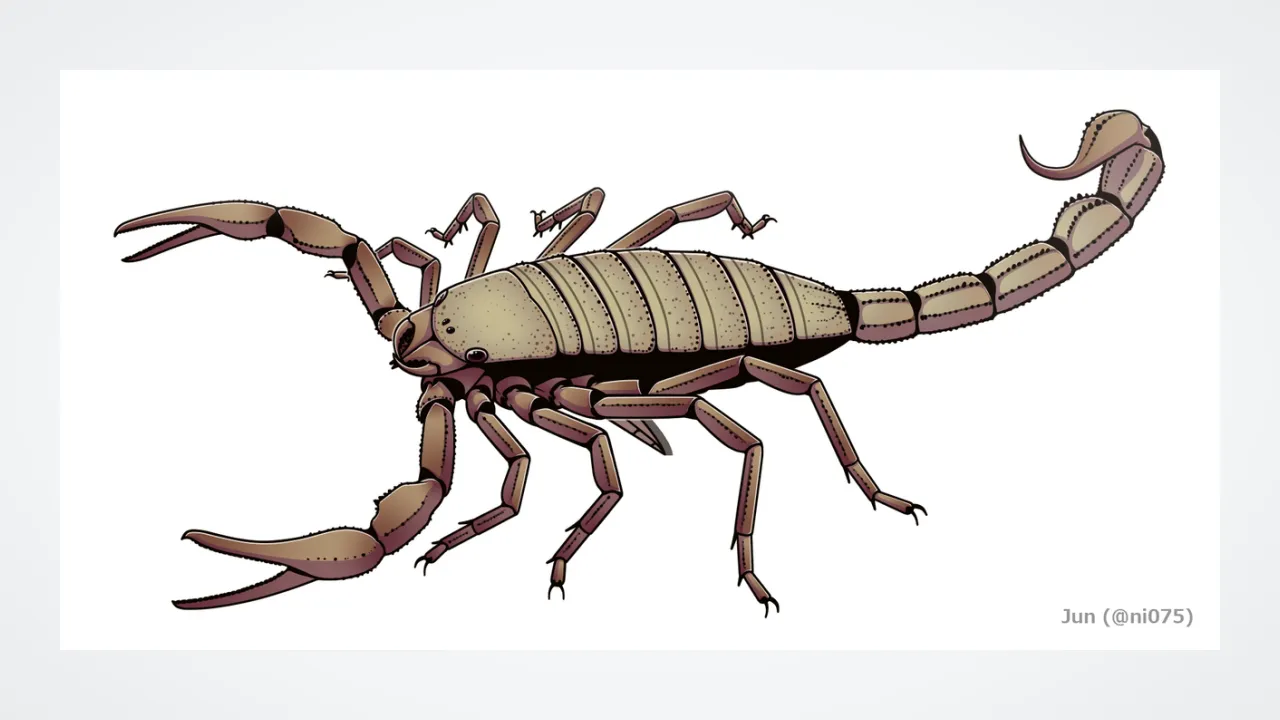
⚡ Survival SuperpowerAir-breathing book lungs and big side eyes built for daytime land hunting
🤯 Mind-Blowing Fact • Grade 1
Pulmonoscorpius means 'breathing scorpion' because fossils preserved its folded air-breathing lungs in stone!
✨ Word Sparks (Grade 1 Glossary)
Tap 🔊 to hear
Scorpion
An eight-legged cousin of spiders with pincers
Stinger
Sharp tail tip used to stop quick prey
Lung
Body part inside animals for breathing air
🪝
What if a scorpion on dry land grew as long as a housecat?
1
Tiptoe on Eight Legs
Tap, tap, tap! Eight jointed legs creep over warm mossy rocks. Watch out for Pulmonoscorpius! This giant lived in ancient forests long before dinosaurs.
2
Breathing Fresh Air
Earlier lived underwater and breathed with gills. Pulmonoscorpius had special air inside its belly! It walked right out in the bright sunshine.
3
Claws and a Curved Tail
Two slim front pincers grabbed quick forest bugs. A long curved tail arched high above its back. That sharp meant business!
2. Why is Pulmonoscorpius named the 'breathing scorpion'?
🤯 Mind-Blowing Fact • Grade 2
Pulmonoscorpius had narrow pincers and a huge tail bulb, telling scientists it relied on its fast stinger more than squeezing claws!
✨ Word Sparks (Grade 2 Glossary)
Tap 🔊 to hear
Book lung
Folded breathing organ found in spiders and scorpions
Equator
Warm imaginary line around the middle of Earth
Predator
An animal that hunts other animals for food
🪝
Why did an ancient Scottish scorpion hunt in bright daylight when modern scorpions hide until dark?
1
When Scotland Was Tropical
Picture Scotland 330 million years ago—not chilly and rainy, but warm, steamy, and near the ! Prowling among ferns and hot springs was Pulmonoscorpius, the biggest land scorpion ever found. Full-grown adults stretched more than two feet from pincers to stinger.
2
Pages That Breathe Air
Inside its underside sat four organs called . Thin folded sheets of tissue stacked like pages in a book soaked up oxygen from the air, letting Pulmonoscorpius live completely on dry land.
3
Big Eyes for Daylight
Modern scorpions have tiny eyes and hunt mostly at night by feeling vibrations. Pulmonoscorpius had large side eyes as well as center eyes, showing it spotted insects, spiders, and small lizard-like animals in daylight!
1. How do scientists know Pulmonoscorpius likely hunted during the daytime?
2. What let scientists tell that Pulmonoscorpius used its stinger more than its claws to subdue prey?
🤯 Mind-Blowing Fact • Grade 3
The fossilized outer skin of Pulmonoscorpius is so thin and well preserved that scientists dissolved the rock in weak acid to lift out genuine 335-million-year-old brown cuticle!
✨ Word Sparks (Grade 3 Glossary)
Tap 🔊 to hear
Arachnid
Eight-legged animal group including spiders and scorpions
Pedipalps
Front pair of appendages shaped into scorpion pincers
Terrestrial
Living on dry land rather than in water
🪝
How did fossil hunters in a Scottish quarry discover flattened scorpion skins so detailed you can still see hairs under a microscope?
1
Treasure at East Kirkton Quarry
In the 1980s, fossil collector Stan Wood explored a mossy limestone wall at East Kirkton Quarry near Edinburgh, Scotland. Inside rocks formed around mineral-rich volcanic hot springs 335 million years ago, he uncovered early land amphibians, millipedes, and sixteen remarkable specimens of a new giant : Pulmonoscorpius kirktonensis.
2
From Ancient Seas to Forest Floors
The earliest Silurian and Devonian scorpions lived in shallow seas and breathed underwater with gills. Pulmonoscorpius preserved clear microscopic structures of book lungs—air-filled pockets lined with thin blood-rich flaps—making it one of the oldest indisputable fully scorpions.
3
Claw-to-Tail Clue
In living scorpions, species with thick muscular claws grab prey safely without stinging much, while species with slender pincers rely on fast-acting venom. Pulmonoscorpius combined narrow pedipalp claws with a swollen venom bulb, pointing to an active stinging strike.
4
Visual Hunter of the Bush
Equipped with two median eyes and up to sixty lenses in each lateral eye cluster, Pulmonoscorpius tracked large insects, myriapods, and perhaps tiny juvenile tetrapods across sunlit woodland litter.
1. Who discovered the famous East Kirkton Quarry fossils of Pulmonoscorpius in Scotland?
2. How did scientists free delicate Pulmonoscorpius skin fragments from East Kirkton limestone?
🤯 Mind-Blowing Fact • Grade 4
Tiny comb-like sensory organs called pectines hung underneath Pulmonoscorpius's belly, brushing the ground to 'taste' chemical trails left by passing prey!
✨ Word Sparks (Grade 4 Glossary)
Tap 🔊 to hear
Lamellae
Thin plate-like layers inside book lungs for breathing
Diurnal
Active during daytime rather than at night
Pectines
Comb-shaped sensory organs underneath a scorpion's body
🪝
What anatomical transformation allowed scorpions to crawl out of Paleozoic oceans and become seventy-centimeter forest stalkers?
1
A Hot-Spring Window into Land Life
Journey back 335 million years to the Viséan Stage of the Early Carboniferous, when Scotland drifted across Earth's equator amid steaming volcanic vents and lush fern woodlands. Laminated limestones at East Kirkton Quarry captured an extraordinary terrestrial community right as vertebrates and arthropods were establishing complex land food webs. Towering over the leaf litter was Pulmonoscorpius kirktonensis, reaching seventy centimeters (28 inches) from chelae to aculeus.
2
Book Lungs Confirm Full Terrestriality
Earlier Paleozoic scorpions possessed aquatic gills homologous to horseshoe crab book gills. When paleontologist Andrew Jeram dissolved East Kirkton matrix in dilute acid in 1994, translucent amber-brown cuticle fragments emerged intact. Microscopic lining the ventral sternites revealed unmistakable air-breathing book lungs, proving Pulmonoscorpius breathed atmospheric oxygen exclusively.
3
Diurnal Vision Versus Modern Nocturnal Habits
Nearly all modern scorpions are nocturnal burrowers with tiny lateral ocelli, relying on slit sensilla and to detect substrate vibrations in the dark. Pulmonoscorpius retained large, multi-faceted compound lateral eyes alongside paired median eyes—an optical toolkit suited to chasing fast insects and myriapods in bright daylight before swift insectivorous reptiles and birds existed.
4
Morphology of a Venom Specialist
Allometric comparisons show slender, elongated pedipalp chelae paired with a robust metasoma (tail) and large telson vesicle. Following the ecological rule seen in living buthid scorpions, narrow claws gripped wriggling arthropods or small stem-tetrapods just long enough for the curved aculeus to deliver disabling venom.
1. Why did Pulmonoscorpius evolve diurnal (daytime) hunting habits whereas modern scorpions are almost strictly nocturnal?
2. What were the comb-like pectines on the underside of Pulmonoscorpius used for?
🤯 Mind-Blowing Fact • Grade 5
Fossils at East Kirkton preserved tiny 1.3-centimeter baby Pulmonoscorpius alongside seventy-centimeter giants—showing an astonishing fifty-fold increase in length from hatchling to adult!
✨ Word Sparks (Grade 5 Glossary)
Tap 🔊 to hear
Trabeculae
Microscopic pillars keeping book lung pages separated
Aculeus
Curved hollow needle at a scorpion's stinger tip
Epigean
Living actively out on the ground surface
🪝
How did acid-extracted organic cuticle from a Scottish volcanic lakebed prove when and how scorpions conquered dry land?
1
Romer's Gap Ends at East Kirkton
During the Viséan Stage of the Early Carboniferous (~336–326 MYA), geothermal hot springs and volcanic ash falls near present-day Bathgate, Scotland, formed the finely laminated East Kirkton Limestone. Excavated intensively after Stan Wood's mid-1980s discoveries and formally described by Andrew Jeram in 1994, this Konservat-Lagerstätte yielded sixteen specimens—ranging from 13-millimeter juveniles to reconstructed 70-centimeter adults—of Pulmonoscorpius kirktonensis, the largest terrestrial arachnid known to science.
2
Micro-Anatomical Proof of Pulmonary Respiration
Silurian and Devonian stem-scorpions inhabited marine and estuarine environments, respiring via external or opercular gills. By macerating East Kirkton carbonate slabs in weak hydrochloric and hydrofluoric acids, Jeram isolated flexible, unmineralized chitinous cuticle preserving micron-scale internal structures. Stacked parallel lamellae reinforced by tiny cuticular struts () prevented air spaces from collapsing—unequivocal respiratory book lungs homologous to those of crown-group terrestrial arachnids.
3
Mesoscorpion Optics and Ecological Niche
Taxonomically placed within the Paleozoic 'mesoscorpions,' Pulmonoscorpius differed markedly from modern fossorial scorpions. Each anterolateral margin of the carapace bore a prominent compound eye comprising forty to sixty lenses alongside large median ocelli, while the tail carried a longitudinal keel stabilization system. Such high visual investment indicates an active, (surface-dwelling) diurnal hunter rather than a cryptic nocturnal ambush predator.
4
Biomechanical Inference of Envenomation
In extant scorpions, force-ratio studies demonstrate an inverse relationship between chela robustness and venom potency. Pulmonoscorpius combined gracile, narrow-fingered pedipalps with a thick five-segmented metasoma terminating in a bulbous venom vesicle and curved —morphological hallmarks of rapid neurotoxic or cytolytic prey immobilization directed at large arthropods and juvenile stem-amniotes like Westlothiana.
As swift, sharp-eyed terrestrial amniotes and amphibians diversified through the Late Carboniferous and Permian, exposed daytime giants became vulnerable targets, selecting for smaller, crevice-dwelling nocturnal scorpions that thrive today.