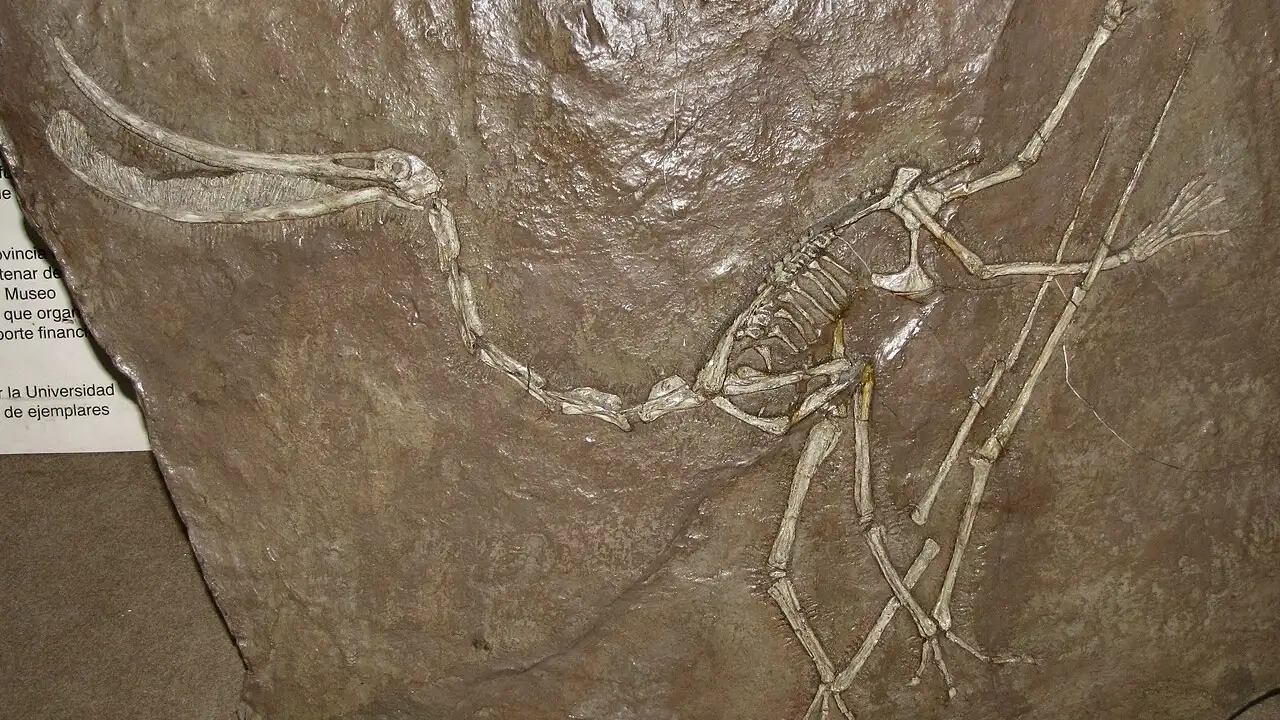
1. How did Pterodaustro use its 1,000 skinny lower teeth?
2. Which modern wading bird feeds a lot like Pterodaustro did?
🤯 Mind-Blowing Fact • Grade 2
If Pterodaustro ate lots of carotenoid-rich tiny lake shrimp just like modern flamingos do, its fuzzy coat and beak may have turned rosy pink!
✨ Word Sparks (Grade 2 Glossary)
Tap 🔊 to hear
Gastrolith
Swallowed stone helping grind food inside stomachs
Crustacean
Shelled water creature like shrimp or crab
Webbed
Toes joined by skin for paddling or mud
🪝
Why did Pterodaustro swallow tiny smooth pebbles along with its shrimp dinners?
1
Southern Wing of Argentina
Travel 105 million years back to a warm shallow lake in central Argentina! Hundreds of long-necked flying reptiles wade side by side on big feet. Named Pterodaustro—meaning southern wing—each adult stretched over eight feet from wingtip to wingtip.
2
Brush on Bottom, Bumps on Top
Pterodaustro's long curved snout held two totally different tooth styles! One thousand hair-thin bristles lined the lower jaw to strain tiny shellfish out of muddy water, while tiny flat button teeth along the upper jaw mashed the catch.
3
Tummy Grinding Stones
Because its bristle teeth could not chew crunchy shells, Pterodaustro swallowed tiny pebbles called that tumbled inside its muscular stomach like a food mill!
1. Why did Pterodaustro swallow clusters of tiny smooth stones called gastroliths?
2. What does the name Pterodaustro translate to?
🤯 Mind-Blowing Fact • Grade 3
In 2004, scientists in Argentina discovered a 105-million-year-old fossilized egg holding an unhatched baby Pterodaustro curled neatly inside!
✨ Word Sparks (Grade 3 Glossary)
Tap 🔊 to hear
Embryo
Unborn baby growing safely inside an egg
Baleen
Comb-like plates whales use to strain food
Alkaline
Mineral-rich water common in desert lakes
🪝
What did a tiny fossilized egg in Argentina reveal about baby Pterodaustro before it even hatched?
1
Loma del Pterodaustro
In Argentina's Sierra de las Quijadas National Park sits a famous sandstone hillside nicknamed 'Pterodaustro Hill.' Roughly 105 million years ago, whole flocks of Pterodaustro guinazui nested and fed around calm lakes there, leaving behind more than 750 fossils from tiny babies to eight-foot-wingspan adults!
2
Whale-Style Filter Feeding
Like whales in miniature, Pterodaustro pumped mouthfuls of shallow water through two neat rows of 500 flexible, needle-thin teeth on each side of its upturned lower jaw. Tiny spatulate teeth along its upper jaw then pressed water out and nudged trapped plankton and brine shrimp down its throat.
3
The Famous Fossil Embryo
In 2004, Argentine paleontologist Laura Codorníu and Luis Chiappe announced an astonishing find: an elongated two-inch fossil egg with a curled-up baby Pterodaustro still preserved inside!
4
Soft Leathery Shells
Thin, cracked eggshell layers showed that Pterodaustro buried soft, parchment-like eggs in moist lakeside mud much like modern turtles do.
1. What incredible discovery from Argentina in 2004 let scientists see an unhatched Pterodaustro?
2. How were Pterodaustro's eggshells different from hard chicken eggshells?
🤯 Mind-Blowing Fact • Grade 4
Unlike almost all other reptiles whose teeth sit in individual bone sockets, Pterodaustro's 1,000 bristle teeth grew tightly side-by-side inside one long continuous jaw groove!
✨ Word Sparks (Grade 4 Glossary)
Tap 🔊 to hear
Ostracod
Tiny seed-sized crustacean living in lakes
Gizzard
Muscular stomach part that grinds tough food
Ctenochasmatid
Family of comb-toothed filter-feeding pterosaurs
🪝
How can microscopic growth rings inside Pterodaustro's bones reveal how fast a prehistoric flying reptile grew up?
1
Flocks of the Lagarcito Lakes
Imagine standing beside a shimmering oasis lake in central Argentina 105 million years ago during the Albian stage of the Early Cretaceous. Wading across muddy shallows on broad four-toed feet are hundreds of Pterodaustro guinazui, named in 1970 by legendary paleontologist José Bonaparte to honor geologist Román Guiñazú. With 2.5-meter (8.2-foot) wingspans, long torsos, and small webbed feet prevented from sinking in soft silt, they dominated South America's inland wetlands.
2
Precision Sieve Mechanics
Pterodaustro pushed filter-feeding to its evolutionary peak. Nearly 85 percent of its 29-centimeter skull consisted of slender, sharply upturned jaws! Anchored in a continuous groove rather than separate sockets, roughly 1,000 tightly packed, three-centimeter lower teeth possessed true enamel and dentine yet remained slightly flexible—straining , copepods, and insect larvae while tiny blunt upper teeth scraped the catch inward.
3
First Fossil Gastroliths in Any Pterosaur
In 2013, Laura Codorníu and colleagues discovered compact clusters of angular quartz stones tucked precisely inside the region of several skeletons—the first undeniable gastroliths ever documented in a pterosaur! Those stones confirmed Pterodaustro mechanically ground hard-shelled micro-crustaceans inside a muscular stomach.
4
Reading Bone Growth Rings
Slicing microscopic cross-sections of wing bones from hatchlings to adults revealed rapid juvenile growth for two years until reaching reproductive maturity, followed by three or four slower years of adult growth!
1. How were Pterodaustro's 1,000 lower bristle teeth anchored into its jawbone?
2. What did microscopic growth rings inside Pterodaustro wing bones reveal about its life cycle?
🤯 Mind-Blowing Fact • Grade 5
Eye-ring measurements indicate Pterodaustro frequently waded and strained lake water at night, right when tiny freshwater crustaceans swim upward toward the surface!
✨ Word Sparks (Grade 5 Glossary)
Tap 🔊 to hear
Osteohistology
Microscopic study of internal bone tissue growth
Crepuscular
Most active during twilight dawn and dusk
Suspension Feeding
Straining tiny food particles floating in water
🪝
Why does Argentina's Loma del Pterodaustro rank among the world's richest windows into pterosaur embryology, histology, and filter-feeding biomechanics?
1
Gregarious Colonies of the Lagarcito Formation
Roughly 105 million years ago during the Albian stage of the Early Cretaceous, ephemeral perennial lakes across San Luis Province, Argentina, laid down fine-grained siltstones and mudstones of the Lagarcito Formation. First discovered by Román Guiñazú and formally described by José F. Bonaparte in 1970, Pterodaustro guinazui has yielded more than 750 specimens from a single 50-square-meter horizon—documenting dense colonial flocks with 2.5-meter wingspans.
2
Extreme Cranial Specialization for Suspension Feeding
As the most derived member of Ctenochasmatidae, Pterodaustro elongated and dorsally recurved its rostrum until the preorbital snout comprised 85 percent of its 29-centimeter skull. Set within a continuous mandibular alveolar groove were roughly 1,000 filamentous teeth—each 3 centimeters long, oval in cross-section, and composed of true enamel, dentine, and cementum! Opposing this dense baleen-like comb, the maxilla bore minuscule, spatulate ossicles that squeezed water outward while retaining planktonic arthropods.
3
Gastrolithic Mill and Nocturnal Ecology
In 2013, Laura Codorníu, Ariana Paulina Carabajal, and collaborators reported clustered, small angular clasts inside the abdominal cavities of articulated skeletons—providing the first definitive proof of a lithophagic gizzard mill in Pterosauria for triturating chitinous ostracod and branchiopod tests. Moreover, scleral ring morphometrics suggest scotopic vision adapted for nocturnal or wading when zooplankton migrate toward surface waters.
4
Embryology and Osteohistology
Discovery of a three-dimensionally preserved 60-by-22-millimeter egg containing an advanced embryo in 2004 demonstrated thin (30-micron) calcareous shells deposited in moist substrates. Complementary osteohistological studies by Alejandro Chinsamy and Codorníu revealed fibrolamellar bone indicating rapid endothermic-like juvenile growth for two years, followed by cyclical lines of arrested growth (LAGs) upon sexual maturity.
5
Convergent Marvel
Across anatomy, diet, colonial nesting, and even potential carotenoid pigmentation, Pterodaustro achieved breathtaking ecological convergence with modern Phoenicopteridae flamingos.