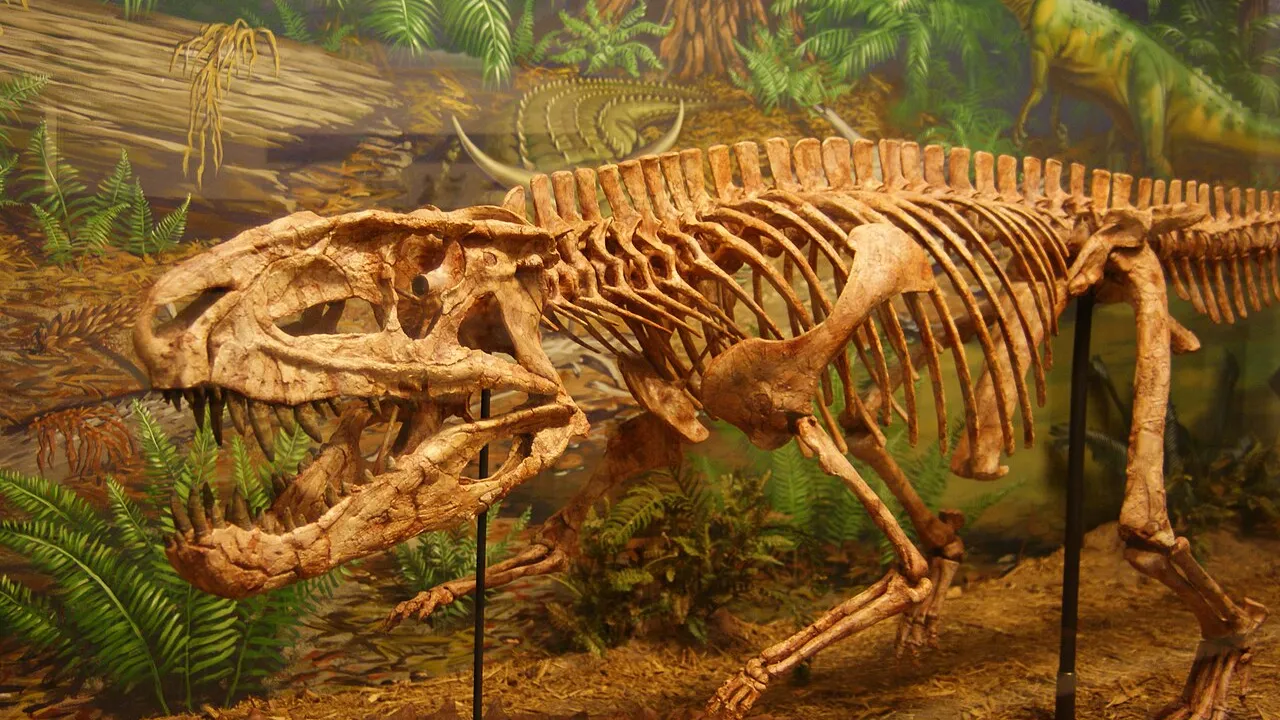
⚡ Survival SuperpowerCrocodile relative that sprinted upright on two long hind legs with armored back plates
🤯 Mind-Blowing Fact • Grade 1
When Postosuchus ruled ancient Texas and Arizona, early meat-eating dinosaurs were so small they had to dodge around its ankles!
✨ Word Sparks (Grade 1 Glossary)
Tap 🔊 to hear
Upright
Standing tall with legs straight under the body
Armor
Hard bony plates protecting an animal's back
Cousin
Related member of the same big family tree
🪝
What looks like a mini T. rex, wears crocodile armor, and is NOT a dinosaur?
1
Stomp Through the Forest
Thump, thump, stomp! A tall hunter strides out from giant fern trees. Meet Postosuchus! With a big head, short arms, and long back legs, it looks just like a dinosaur.
2
Surprise—A Crocodile Cousin!
Look closer at its ankles and scaly plates. Postosuchus was actually an ancient land of crocodiles! Early dinosaurs were tiny when Postosuchus was boss.
3
Running on Two Legs
Its front arms were less than half as long as its legs. Postosuchus balanced its long tail and dashed on two feet!
1. Which modern animals are actually Postosuchus's closest living relatives?
2. How did Postosuchus walk and run across Triassic forests?
🤯 Mind-Blowing Fact • Grade 2
A fossilized Postosuchus skeleton found in North Carolina still had the bones of four different prey animals—including an armored reptile—preserved inside its stomach!
✨ Word Sparks (Grade 2 Glossary)
Tap 🔊 to hear
Osteoderm
Bony armor plate growing inside reptile skin
Triassic
First geologic period of the Mesozoic Era
Bipedal
Walking upright on two back legs
🪝
How did a crocodile relative invent the T. rex body plan 140 million years before T. rex hatched?
1
The Crocodile From Post, Texas
Imagine visiting western Texas 215 million years ago during the Late Period! Lush river forests echoed with the footsteps of Postosuchus, whose name means 'crocodile from Post' after the Texas town where fossil hunters found its bones.
2
Pillar-Straight Legs
Modern crocodiles sprawl low with legs bent out to the sides. Postosuchus flipped that rule upside down! Its hip bones pointed straight down like stone pillars, holding its legs directly underneath its sixteen-foot body so it could stride swiftly on two feet.
3
Armored Back, Sharp Bite
Two rows of overlapping bony plates called shielded its neck and spine. With three-inch serrated teeth and a deep skull, it was the top land hunter of North America.
1. Where did Postosuchus get the 'Post' part of its scientific name?
2. How were Postosuchus's hip sockets arranged to hold up its heavy body?
🤯 Mind-Blowing Fact • Grade 3
Postosuchus's ankle bent with a rotary crocodile-style joint instead of the simple hinge joint found in all dinosaurs and birds!
✨ Word Sparks (Grade 3 Glossary)
Tap 🔊 to hear
Pseudosuchia
Reptile branch containing crocodiles and their extinct cousins
Obligate biped
Animal built to walk exclusively on two legs
Archosaur
Ruling reptile group uniting crocodilians, pterosaurs, and dinosaurs
🪝
How did paleontologists prove whether sixteen-foot Postosuchus walked on four legs or sprinted on two?
1
When Croc-Line Reptiles Outshone Dinosaurs
During the Late Triassic Period (228–202 million years ago), two great reptile branches shared Pangaea: the bird-dinosaur line and the crocodile line, called . Surprisingly, dinosaurs were mostly slender, dog-to-horse-sized runners back then, while giant pseudosuchians like Postosuchus ruled the top of the food chain!
2
Solving the Posture Debate
For years, scientists debated whether Postosuchus dropped onto all fours to walk or stood purely on two hind legs. In 2013, researchers measured its limb proportions, spine balance, and internal bone structure. Because its delicate arms were only sixty percent the length of its massive hind legs and its center of mass sat right near the hips, Postosuchus was an —walking upright full-time!
3
Built Like a Triassic Tyrannosaur
Convergent evolution gave Postosuchus a tall, narrow snout, huge eye sockets for forward depth perception, and dagger-like serrated teeth remarkably similar to later theropod dinosaurs.
4
Turnover at the End of the Triassic
When giant volcanic rifting split Pangaea 201 million years ago, large land pseudosuchians went extinct—opening the door for meat-eating dinosaurs to grow huge in the Jurassic Period!
1. What evidence convinced scientists in 2013 that Postosuchus walked exclusively on two legs?
2. Why did meat-eating dinosaurs stay relatively modest in size while Postosuchus was alive?
🤯 Mind-Blowing Fact • Grade 4
Unlike dinosaurs that stood on a hole-in-the-hip socket, Postosuchus balanced its entire body weight underneath horizontal hip overhangs like upside-down stone arches!
✨ Word Sparks (Grade 4 Glossary)
Tap 🔊 to hear
Pillar-erect
Upright hip posture with overhanging hip socket shelves
Crurotarsal
Crocodile-style ankle joint twisting between two main bones
Trabecular
Spongy internal bone lattice aligned along stress lines
🪝
How did Postosuchus engineer upright posture using a completely different hip design from every dinosaur that ever lived?
1
Uncanny Convergence in the Chinle Forests
Step beneath towering Araucarioxylon conifers in Late Triassic Arizona and Texas 215 million years ago, where the Petrified Forest's ancient rivers once flowed. Emerging from the shadows is Postosuchus kirkpatricki, a five-meter rauisuchian archosaur described by Sankar Chatterjee in 1985. With a deep, narrow cranium, serrated ziphodont teeth, reduced arms, and bipedal stride, Postosuchus looks uncannily like a tyrannosaur—yet its skeleton belongs squarely to Pseudosuchia, the crocodilian stem lineage.
2
Pillar-Erect Versus Buttress-Erect Hips
Dinosaurs achieved upright posture by bending the head of the thighbone inward at right angles into an open hip socket. Postosuchus solved the exact same engineering challenge backward! Instead of bending the femur inward, its iliac hip bone grew a horizontal overhanging shelf facing straight downward, capping a vertical column-like femur underneath—an ingenious design called '' posture, paired with a crocodile-normal ankle joint.
3
Trabecular Bone Proof of Bipedalism
CT scans of (spongy) bone architecture inside the femur and humerus of Postosuchus alisonae from North Carolina revealed stress alignments matching bipedal birds and theropods rather than quadrupeds. Meanwhile, gutted prey preserved inside that same skeleton included an armored aetosaur, a snouted traversodont cynodont, and early amphibians.
4
Sensory Gear of an Apex Stalker
Endocasts of Postosuchus's braincase reveal huge olfactory bulbs for tracking scent trails and large orbits positioned behind a keyhole-shaped skull roof for overlapping binocular vision.
1. How did Postosuchus's 'pillar-erect' hip differ from a dinosaur's upright hip?
2. What direct fossil clue inside the North Carolina Postosuchus alisonae skeleton revealed its exact menu?
🤯 Mind-Blowing Fact • Grade 5
When paleontologist Sankar Chatterjee first examined Postosuchus's skull and hip bones in 1985, their convergent resemblance to Tyrannosaurus was so striking that he initially proposed Postosuchus might be a direct ancestor of tyrannosaurs!
✨ Word Sparks (Grade 5 Glossary)
Tap 🔊 to hear
Stereopsis
3D depth perception from two overlapping forward eyes
Acetabulum
Cup-shaped socket in the pelvis holding the thighbone
Loricata
Armored reptile clade uniting rauisuchians and modern crocodilians
🪝
What does Postosuchus teach evolutionary biologists about how rival archosaur lineages raced to invent bipedal hypercarnivory during the Triassic?
1
Pseudosuchian Hegemony in the Late Triassic
Throughout the Norian and Rhaetian Stages of the Late Triassic (228–202 MYA), continental ecosystems across North America—recorded in Texas's Dockum Group, Arizona's Chinle Formation, and North Carolina's Newark Supergroup—were ruled not by dinosaurs, which remained comparatively modest in stature, but by loricatan pseudosuchians ('rauisuchids'). Named by Sankar Chatterjee in 1985 from Post Quarry, Texas, Postosuchus kirkpatricki (alongside eastern P. alisonae) reached 4 to 5 meters in length and 250 to 300 kilograms in mass.
2
Convergent Tyrannosaurid Cranial Architecture
More than 140 million years before Tyrannosaurus rex evolved, Postosuchus assembled a remarkably convergent predatory skull: a deep, narrow rostrum resisting vertical bite forces, keyhole-shaped orbits angled forward behind broadened postorbitals for , an enlarged antorbital fenestra lightening the snout, and large laterally compressed ziphodont teeth. Endocranial reconstructions highlight hypertrophied olfactory bulbs and floccular lobes coordinating head-eye stabilization during rapid strikes.
3
Independent Evolution of Obligate Bipedalism
Early reconstructions mingled chimaeric bones of shuvosaurids and aetosaurs, sparking debate over quadrupedal versus bipedal locomotion. Comprehensive osteological re-evaluation by Jonathan Weinbaum (2011–2013) and micro-CT trabecular bone analyses by Stephanie Novak and colleagues resolved the question decisively. With forelimbs measuring under 60% of hindlimb length, slim manus bones lacking weight-bearing hooves, fused sacral vertebrae, and femoral cancellous struts aligned with avian/theropod loading regimes, Postosuchus operated as an obligate biped—achieving parasagittal gait via a ventral acetabular ('pillar-erect') overhang and crurotarsal ankle rather than the dinosaurian perforate and mesotarsal hinge.
4
Trophic Mastery Confirmed by Gut Contents
The holotype of Postosuchus alisonae preserved articulated gastric contents comprising dermal scutes of an aetosaur (Stegomus), a traversodontid cynodont, a dicynodont phalanx, and temnospondyl bones—documenting an apex generalist capable of breaching osteoderm armor.
5
Central Atlantic Magmatic Province and Dinosaur Release
When massive volcanic rifting of the Central Atlantic Magmatic Province triggered the end-Triassic extinction (~201.3 MYA), all non-crocodylomorph pseudosuchians perished, vacating apex terrestrial carnivore guilds for Jurassic theropod dinosaurs.