1. How many wing-like flippers did Plesiosaurus use to swim?
2. How did Plesiosaurus move its flippers underwater?
🤯 Mind-Blowing Fact • Grade 2
Unlike swan necks seen in old paintings, Plesiosaurus could NOT stick its neck high up out of the water like a periscope because its interlocking neck bones bent mostly side-to-side!
✨ Word Sparks (Grade 2 Glossary)
Tap 🔊 to hear
Periscope
Tube rising straight up above water
Genuine
Completely real and not a fake
Shale
Dark layered rock formed from mud
🪝
Why did famous scientists doubt Mary Anning's ten-foot sea-reptile skeleton until they inspected every bone themselves?
1
Mary Anning's Masterpiece
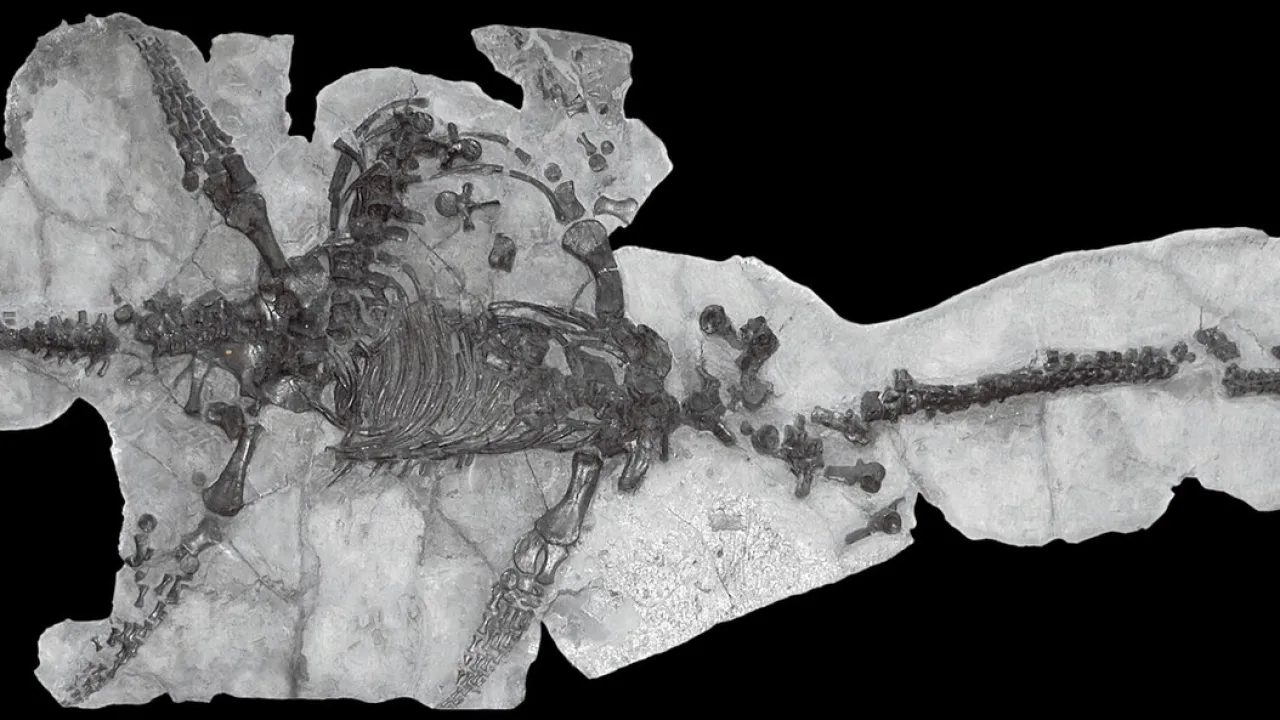
In December 1823, twenty-four-year-old fossil hunter Mary Anning uncovered a ten-foot skeleton in the crumbly seaside cliffs of Lyme Regis, England. With a tiny skull, thirty-eight neck bones, a broad belly, and four long flippers, Plesiosaurus looked unlike any animal on Earth!
2
Passing the Test in Paris
When drawings reached French anatomist Georges Cuvier, he first suspected someone had attached a snake's neck onto another sea reptile! After studying detailed sketches, Cuvier gladly admitted he was wrong and praised Mary Anning's extraordinary discovery.
3
Sneaking Up on Fish
Swimming through Early Jurassic seas 190 million years ago, Plesiosaurus slipped its small head into fish schools before its wider body scared them away!
1. Why couldn't Plesiosaurus hold its neck high out of the ocean like a swan in old drawings?
2. Who discovered the first nearly complete Plesiosaurus skeleton in 1823?
🤯 Mind-Blowing Fact • Grade 3
Water-tank tests with robotic flippers proved Plesiosaurus's back flippers surfed the swirling water wakes created by its front flippers, boosting speed and saving energy!
✨ Word Sparks (Grade 3 Glossary)
Tap 🔊 to hear
Vortex
Swirling ring of water giving extra push
Hydrofoil
Wing-shaped blade generating lift underwater
Thrust
Forward pushing force through water or air
🪝
How did swimming robots help modern engineers solve the two-hundred-year mystery of Plesiosaurus's four flippers?
1
Unique Four-Wing Design
No living animal today swims with four matching wings! Sea turtles and penguins flap only their front flippers while steering with small back feet. Yet 190 million years ago in Early Jurassic seas, eleven-to-fifteen-foot Plesiosaurus dolichodeirus glided on two huge front flippers AND two equally huge back flippers!
2
Testing With Robot Flippers
For generations, scientists puzzled over how front and back flippers avoided bumping into each other's swirling water wakes. In 2015 and 2019, engineers and paleontologists built robotic four-flippered swimmers inside water tanks! They discovered that when the back flippers timed their beats slightly behind the front flippers, they caught swirling vortices to boost by up to forty percent!
3
Cone Teeth for Soft Prey
Lining Plesiosaurus's compact skull were slender, slightly curved needle teeth—ideal for snagging fish and soft squid relatives called belemnites.
4
Caring Ocean Mothers
A famous cousin fossil preserved one large single baby inside its mother, suggesting plesiosaurs gave birth to big, well-cared-for calves like modern dolphins!
1. What did robotic water-tank experiments discover about Plesiosaurus's back flippers?
2. What does a fossilized pregnant plesiosaur cousin carrying one large single baby suggest about their family life?
🤯 Mind-Blowing Fact • Grade 4
Each digit inside a Plesiosaurus flipper contained up to ten finger bones in a row—twice as many as a human finger—creating long, wing-like underwater foils!
✨ Word Sparks (Grade 4 Glossary)
Tap 🔊 to hear
Sauropterygian
Clade of flippered Mesozoic marine reptiles
Buoyancy
Upward floating balance inside water
Tandem
Arranged one pair behind another working together
🪝
Why did Plesiosaurus swallow smooth seafloor stones—and what do preserved skin scales tell us about its streamlined body?
1
Near to Lizard in the Blue Lias
Dive beneath warm Early Jurassic waves covering Dorset, England, 190 million years ago. Gliding effortlessly past coiled ammonites is Plesiosaurus dolichodeirus ('long-necked near-lizard'). Named as a genus in 1821 by William Conybeare and Henry De la Beche and made world-famous by Mary Anning's complete 1823 Lyme Regis skeleton, this 3.5-to-4.5-meter marine weighed roughly 450 kilograms.
2
Tandem Hydrofoil Propulsion
Each of Plesiosaurus's four tapering paddles contained elongated finger and toe bones—up to ten phalanges per digit—wrapped inside stiff, asymmetric hydrofoils thicker along the leading edge and paper-thin behind. Fluid-dynamics experiments led by Luke Muscutt and Gabriel Weymouth proved flippers surfing leading-edge vortices generated up to 60 percent more thrust and 40 percent higher efficiency than two flippers alone!
3
Gastroliths: Ballast or Food Grinder?
Paleontologists regularly uncover polished river and beach stones clustered inside plesiosaur ribcages! Scientists debate two clever functions working together: grinding tough fish bones and cephalopod beaks inside a muscular gizzard, while also fine-tuning underwater and roll stability.
4
Smooth Skin Revealed in 2025
Recent microscopic analyses of fossilized plesiosaur soft tissue revealed smooth skin along the torso paired with tiny, stiff protective scales along the flippers—cutting water drag while toughening paddles that brushed rocky seafloors!
1. What two jobs might swallowed stomach stones (gastroliths) have performed inside Plesiosaurus?
2. What did fossilized soft-tissue studies reveal about plesiosaur skin?
🤯 Mind-Blowing Fact • Grade 5
Modern ocean engineers build four-flippered underwater exploration robots modeled directly on Plesiosaurus because its tandem wings hover and turn more smoothly in tight coral canyons than noisy propellers!
✨ Word Sparks (Grade 5 Glossary)
Tap 🔊 to hear
Biomimetic
Engineering machines inspired by living nature
K-Selected
Raising very few large, well-cared-for offspring
Epidermis
Outer protective layer of animal skin
🪝
How did Plesiosaurus dolichodeirus anchor two centuries of marine reptile science—from Regency England cliffs to biomimetic underwater robotics?
1
Foundational Discovery of Sauropterygia
Eroding from Sinemurian-stage (~195–190 MYA) Lower Lias shales at Lyme Regis, Dorset, England, Plesiosaurus ('near to lizard') stood beside Ichthyosaurus at the dawn of vertebrate paleontology. First named from fragmentary remains by William Conybeare and Henry De la Beche in 1821, its bizarre body plan shocked scientific Europe in December 1823 when Mary Anning excavated the nearly complete holotype of Plesiosaurus dolichodeirus (NHMUK 22656)—winning Georges Cuvier's endorsement at the French Academy of Sciences.
2
Taxonomic Clarity and Anatomy
Although 19th-century authors assigned over a hundred species to Plesiosaurus, modern revision by Glenn Storrs (1997) restricted the genus strictly to its Early Jurassic type species, P. dolichodeirus! Reaching 3.5 to 4.5 meters long, it possessed 38 to 42 amphicoelous cervical vertebrae with tall neural spines and long cervical ribs that restricted sharp vertical swan-bends while permitting smooth lateral sweeps. Its small, triangular cranium housed slender, striated procumbent teeth specialized for seizing teleost fish and soft coleoid cephalopods.
3
Hydrodynamics of Tandem Flipper Flight
Reinforced pectoral and pelvic ventral plates anchored massive adductor and abductor musculature driving four subequal, high-aspect-ratio hydrofoils shaped by extreme hyperphalangy. Experimental robotics and computational fluid dynamics by Muscutt et al. (2017) resolved the classic tandem-flipper paradox: modulating phase lag allowed the hind flippers to harvest constructive lift from the fore flippers' trailing vortex street, boosting thrust by up to 60 percent during ambush surges and agile turns.
4
Viviparity, Endothermy, and Integument
Isotopic paleothermometry indicates sauropterygians maintained elevated ~35°C body temperatures, while the landmark 2011 discovery of a gravid polycotylid plesiosaur carrying a single large fetus demonstrated viviparity analogous to modern odontocete whales. Furthermore, 2025 histological imaging of Jurassic plesiosaur soft tissue confirmed sleek, scaleless torso paired with keratinized micro-scales stiffening the flipper trailing edges.
5
Living Inspiration
Today, naval engineers model four-finned autonomous underwater vehicles directly on Plesiosaurus's maneuverable tandem propulsion!