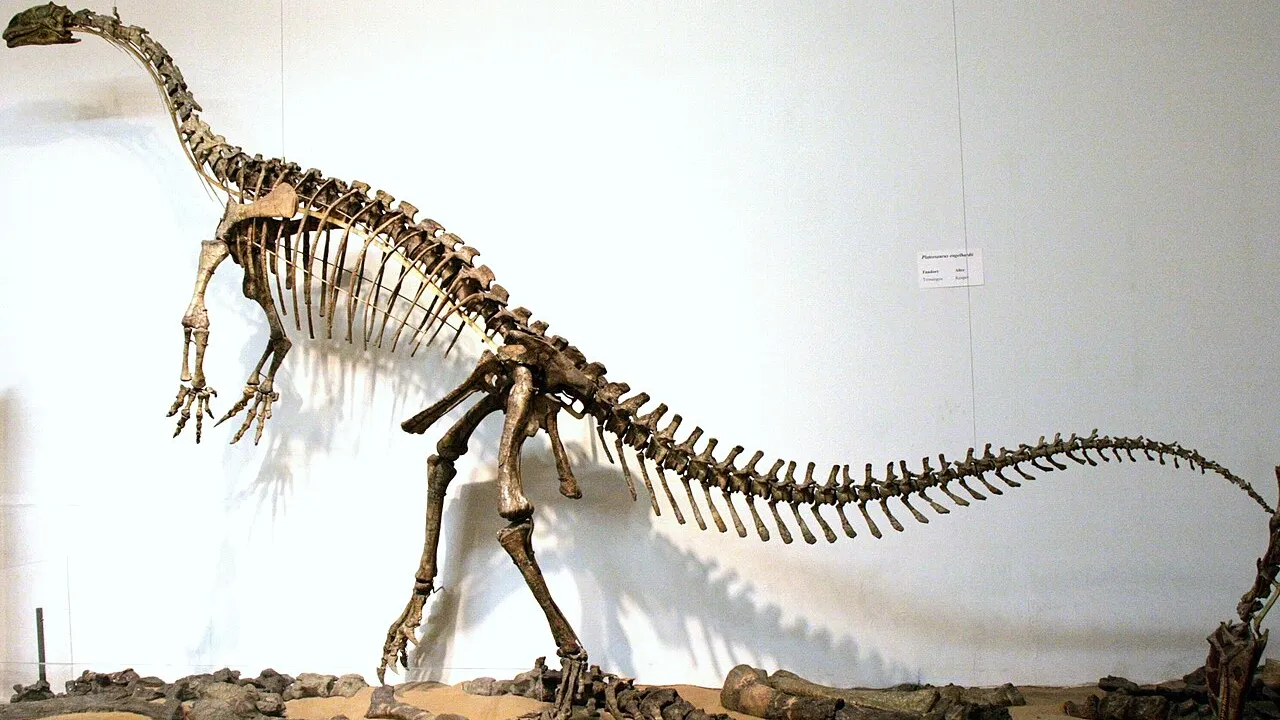
2. What did Plateosaurus use its big curved thumb claws to do?
🤯 Mind-Blowing Fact • Grade 2
Plateosaurus was named in 1837—five full years before scientists even invented the word 'dinosaur' in 1842!
✨ Word Sparks (Grade 2 Glossary)
Tap 🔊 to hear
wrist
the joint connecting an arm and hand
plentiful
available in big, generous amounts
Triassic
the earliest time period when dinosaurs lived
🪝
How could two grown-up Plateosaurus dinosaurs be completely different sizes?
1
Discovered Before the Word 'Dinosaur'!
When German scientist Hermann von Meyer named Plateosaurus in 1837, the word 'dinosaur' hadn't even been invented yet! Dozens of skeletons later turned up in Germany and Switzerland where ancient mud holes trapped heavy walkers.
2
Clapping Hands, Not Walking Feet
Old books drew Plateosaurus strolling on four legs. However, 3D bone checks proved its could not twist downward! Instead, it ran on two legs and grabbed pine branches with both hands.
3
Surprise Growth Sizes!
Unlike dogs or people, adult Plateosaurus came in many sizes—from sixteen feet in dry years up to thirty-three feet when food was !
1. Why couldn't Plateosaurus walk comfortably on all four legs?
2. Why were some adult Plateosaurus twice as long as other adults?
🤯 Mind-Blowing Fact • Grade 3
More than 100 Plateosaurus skeletons have been unearthed across Europe and Greenland, making it one of science's best-understood Triassic dinosaurs!
✨ Word Sparks (Grade 3 Glossary)
Tap 🔊 to hear
Pangaea
ancient supercontinent joining almost all Earth's land
serrated
lined with tiny saw-like notches along edges
growth rings
yearly layers inside bone showing age and speed
🪝
Why did dozens of heavy Plateosaurus get stuck upright in Triassic mud traps while tiny dinosaurs walked right past?
1
Earth's First High-Browsing Giants
Travel back 210 million years to Late Triassic Europe, when all continents were joined in the supercontinent ! Towering above crocodile-like reptiles stood Plateosaurus, one of Earth's very first large plant-eating dinosaurs to reach twenty to thirty feet long.
2
Trapped in Sticky Clay
Over one hundred Plateosaurus skeletons have been dug from clay quarries in Trossingen, Germany, and Frick, Switzerland. Heavy adults weighed up to four tons, sinking chest-deep into slick watering-hole mud while lighter, cat-sized dinosaurs scampered safely across the crust!
3
Leaf-Shaped Teeth and Grasping Thumbs
With a long, flexible neck and small skull packed with coarsely , leaf-shaped teeth, Plateosaurus snipped tough ferns, cycads, and conifers after pulling branches close with powerful three-clawed hands.
4
Flexible Growth Superpower
Counting annual inside leg bones showed something unheard of in earlier dinosaur studies: one fully grown twelve-year-old might measure sixteen feet, while a well-fed neighbor grew past thirty feet!
1. Why are almost all skeletons in the Trossingen and Frick mud traps big Plateosaurus rather than small animals?
2. What kind of teeth lined the jaws of Plateosaurus?
🤯 Mind-Blowing Fact • Grade 4
Two fully mature adult Plateosaurus could differ in weight by more than six times—600 kilograms versus 4,000 kilograms—simply depending on how rich their childhood habitat was!
✨ Word Sparks (Grade 4 Glossary)
Tap 🔊 to hear
biped
an animal that walks upright on two legs
plasticity
ability to mold growth to match changing environments
monsoon
seasonal wind bringing intense rainy and dry spells
🪝
How did digital crash-test models and microscopic bone rings overturn a century of myths about Plateosaurus?
1
Blueprint for Future Giants
Long before eighty-ton titanosaurs shook the Cretaceous, their Late Triassic forerunners—early sauropodomorphs like Plateosaurus trossingensis—pioneered the elongated neck, small head, and barrel gut that made giant herbivory possible across -swept Pangaea 210 million years ago.
2
3D Bone Scans Banish Four-Legged Poses
For decades, museum mounts posed Plateosaurus switching casually between two legs and four. In 2010, paleontologist Heinrich Mallison laser-scanned a virtually uncrushed skeleton and tested every joint digitally. Whenever he tried rotating the radius and ulna forearm bones to place the palms flat on the ground, the bones collided or dislocated! Plateosaurus was an obligate whose inward-facing hands and trenchant thumb claws functioned purely for grasping branches and raking predators.
In 2005, Martin Sander and Nicole Klein sliced dozens of Plateosaurus femora to study bone histology. Rapidly deposited fibrolamellar tissue proved fast, warm-blooded-style growth rates—yet individual growth plateaued anywhere between 5 meters (600 kilograms) and 10 meters (4,000 kilograms)! Called developmental , this flexible growth let Plateosaurus adjust adult body size to match boom-or-bust Triassic .
4
Scleral Rings Hint at Flexible Hours
Delicate rings of tiny eye bones preserved inside Plateosaurus sockets suggest keen vision suited to foraging during both bright daylight and cooler twilight hours.
1. What happened in Heinrich Mallison's 3D computer model when he tried to twist Plateosaurus's wrists palm-down for four-legged walking?
2. How did 'developmental plasticity' help Plateosaurus thrive across Pangaea?
🤯 Mind-Blowing Fact • Grade 5
In 2019, international naming authorities officially switched Plateosaurus's reference species to Plateosaurus trossingensis so science could anchor this famous genus on crystal-clear, complete skeletons from Trossingen!
✨ Word Sparks (Grade 5 Glossary)
Tap 🔊 to hear
pronate
twist forearm bones so palms face downward
LAGs
annual pause rings inside bone marking seasonal slowdowns
manus
anatomical scientific word for the front hand
🪝
Why did Plateosaurus—named five years before 'Dinosauria' itself—reshape how biologists view dinosaur evolution from cold-blooded reptiles to warm-blooded giants?
1
Pre-Owen Discovery and Nomenclature Reform
Collected near Nuremberg by physician Johann Friedrich Engelhardt and named by Hermann von Meyer in 1837—five years before Richard Owen coined Dinosauria—Plateosaurus stood among science's earliest recognized Mesozoic reptiles. Because the fragmentary 1837 holotype lacked diagnostic traits, paleontologists petitioned the International Commission on Zoological Nomenclature, which in 2019 conserved the genus around complete Norian skeletons from Trossingen, Germany, as the new type species Plateosaurus trossingensis.
2
Taphonomy of the 'Swabian Lindwurm' Mire Traps
Excavations at Trossingen (led famously by Eberhard Fraas and Friedrich von Huene) and Frick, Switzerland, have yielded over a hundred articulated individuals from Norian (~214–204 MYA) playa-mudstone beds. Sedimentological analysis overturned older 'desert drought herd-death' tales: solitary heavy subadults and adults exerted high plantar pressures that punched deep into liquefied clay holes, trapping hindlimbs vertically while sparing lightweight coelophysoid theropods.
3
Kinematic Proof of Obligate Bipedalism
Digital range-of-motion modeling by Heinrich Mallison (2010) demonstrated that the radius could not rotate around the ulna at the elbow to the . Instead, supinated five-digit hands faced medially, wielding hyper-extendable second fingers and trenchant, strongly curved pollex unguals for pulling gymnosperm foliage and slashing attackers.
4
Developmental Plasticity in Fibrolamellar Bone
In a landmark 2005 Science paper, Martin Sander and Nicole Klein revealed a mosaic physiology unseen in modern mammals or birds: Plateosaurus deposited vascularized fibrolamellar bone indicative of elevated tachymetabolic rates, yet lines of arrested growth () showed final adult length varied unpredictably between 4.8 and 10 meters (0.6 to 4 metric tons) in response to local resource availability.
5
Avian-Style Lung Hints on the Road to Sauropoda
Subtle rib-facet geometry and incipient vertebral fossae suggest Plateosaurus already possessed rigid, flow-through lung mechanics—laying the physiological foundation from which quadrupedal Jurassic sauropods soon conquered the skies.