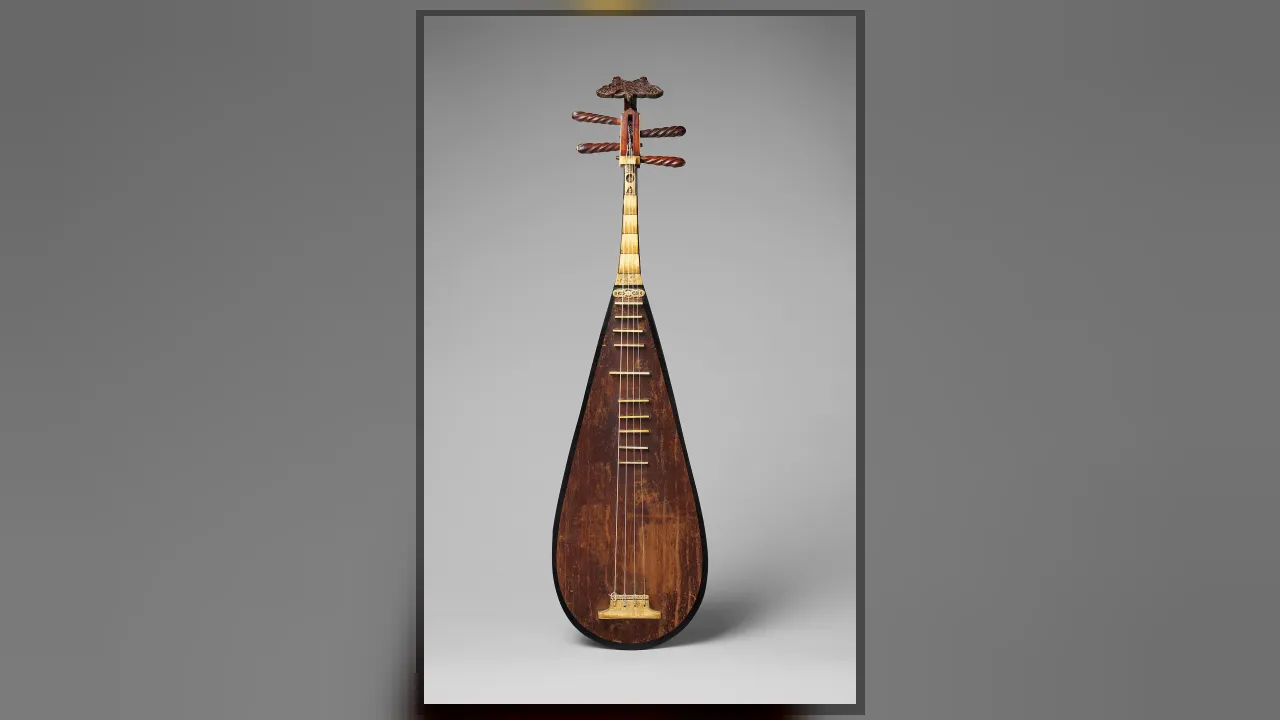
In ancient Tang Dynasty paintings, musicians held the pipa sideways like a guitar and struck it with a big wooden pick before switching to upright finger playing!
✨ Word Sparks (Grade 2 Glossary)
Tap 🔊 to hear
Silk Road
Ancient trade routes linking China with Central Asia.
jade
A smooth, hard green stone prized in China.
ledge
A thick wooden block acting as an upper fret.
🪝
Why does this lute flicker all five fingers outward like an opening flower?
1
Pearls Falling on a Jade Plate
Pitter-patter-ring! Ancient Chinese poets wrote that the pipa sounds like big and small pearls tumbling onto a plate! Shaped like a graceful wooden pear, this four-stringed lute has delighted listeners along the for two thousand years.
2
Thirty Tall Wooden Steps
Resting upright on the musician's lap, its flat wooden belly carries six thick wedge at the top and twenty-four tall bamboo frets below. Because those frets stand up high like tiny stairs, pushing a string sideways bends the note cleanly!
3
The Five-Finger Wheel
Instead of pinching strings inward like a guitarist, a pipa player tapes picks onto all five right-hand fingers and flicks them outward. Spinning all five fingers one after another creates a smooth, purring roll!
1. In which direction do a pipa player's five picked fingers usually strike the strings?
2. What did a famous Tang Dynasty poet compare the crisp sound of the pipa to?
🤯 Mind-Blowing Fact • Grade 3
Unlike guitars or violins, a pipa has zero open soundholes cut into its front soundboard—its crisp vibrations radiate right through the thin paulownia wood itself!
✨ Word Sparks (Grade 3 Glossary)
Tap 🔊 to hear
lunzhi
Five-finger rolling tremolo unique to pipa playing.
chromatic
Moving step-by-step through all twelve half-step notes.
harmonic
A bell-like high note made by lightly touching strings.
🪝
How can one pear-shaped lute paint both peaceful river moonlight and a ten-thousand-soldier battle?
1
Two Faces: Gentle Poetry and Fierce Battle
Whisper—shimmer—CRACK! One moment, delicate float like spring moonlight over a misty river; the next, crossed strings snap together like clashing cavalry spears! For two millennia, China's pipa repertoire has divided into two thrilling styles: lyrical civil pieces called wen and dramatic martial pieces called wu.
2
Silk Road Travelers
During the Han and Tang dynasties, pear-shaped lutes from Central Asia traveled east along the Silk Road and merged with Chinese plucked instruments. Artisans carved a shallow hardwood bowl from dense rosewood and sealed it with a flat paulownia soundboard.
3
Wedge Ledges and Bamboo Frets
Modern pipas carry thirty frets—six tall wedge-shaped ledges called xiang near the sculpted pegbox, plus twenty-four bamboo strips called pin running far down the belly. Tall frets lift the four nylon-wound steel strings high off the wood so sideways finger pushes bend pitches by whole steps!
4
Lunzhi: The Spinning Five-Finger Roll
With picks taped to every right-hand finger, players uncurl pinky, ring, middle, index, and thumb in a continuous outward wheel called , creating a shimmering stream of uninterrupted melody.
1. What surprising detail do you notice if you search the front soundboard of a pipa for big round soundholes?
2. What are the two classic storytelling categories in traditional pipa music?
🤯 Mind-Blowing Fact • Grade 4
Carved right at the top of many traditional pipas sits an ornate finial shaped like a bat's head—because the Chinese word for bat, 'fu,' sounds identical to the word for good fortune!
✨ Word Sparks (Grade 4 Glossary)
Tap 🔊 to hear
barbat
Ancient Central Asian lute ancestor of the pipa.
finial
A decorative carved ornament topping an instrument's pegbox.
percussive
Crisp, rhythmic, and drum-like in attack.
🪝
Why does a lute with zero front soundholes and sky-high frets project like acoustic fireworks?
1
Ambush from Ten Sides
What would happen if a single musician walked onstage and recreated bugle calls, galloping warhorses, whistling arrows, and clashing armour using four strings? In the famous martial showpiece 'Ambush from Ten Sides,' a pipa virtuoso twists adjacent strings together until they rattle like snare drums and snaps bass cords against bamboo frets—turning a pear-shaped lute into an entire battlefield.
2
Silk Road Synthesis and Vertical Posture
Over two thousand years ago, Chinese chroniclers used 'pipa' for several plucked lutes before Silk Road caravans introduced the four-stringed, bent-neck Central Asian —also ancestor to the Middle Eastern oud and European lute. During the Tang Dynasty, court artists played it horizontally with a large wooden plectrum; by the Song and Ming eras, performers stood the instrument upright and adopted intricate five-finger plucking.
3
Shallow Hardwood Bowl and Tall Frets
Unlike deep-bellied European lutes, a pipa pairs a heavy, shallow carved rosewood or mahogany back with an unpierced paulownia top plate. Without a large air-cavity soundhole, bass boom stays tight while crisp high frequencies leap forward with immediacy. Thirty chromatic frets—six sculpted horn or wood xiang wedges plus twenty-four bamboo pin—span over three and a half octaves from A2 to E6.
4
Sixty Finger Techniques
Historical manuals catalog more than sixty left- and right-hand techniques! Because strings hover high above the wood atop tall frets, pushing a string laterally across a fret crown stretches tension smoothly up a minor third, while outward five-finger lunzhi rolls sustain melodies effortlessly.
1. Which other world instruments share an ancient Central Asian 'barbat' ancestor with the Chinese pipa?
2. Why do pipa builders carve a bat symbol onto the top pegbox?
🤯 Mind-Blowing Fact • Grade 5
Tang Dynasty murals in the Mogao Caves of Dunhuang even show celestial musicians spinning pipas behind their backs mid-dance—a dazzling acrobatic feat recreated onstage today!
✨ Word Sparks (Grade 5 Glossary)
Tap 🔊 to hear
onomatopoeic
A word formed by imitating a real sound.
polyphony
Combining multiple independent musical lines at once.
biwa
Japanese pear-shaped lute cousin of Tang-era pipas.
🪝
How do a sealed shallow-cavity soundboard, high-relief frets, and outward five-digit mechanics make the pipa one of Earth's most agile lutes?
1
Acoustic Pyrotechnics from Whisper to Battlefield
Few plucked chordophones rival the sheer kinetic range of the Chinese pipa. Balanced nearly vertically on the performer's thigh at roughly one hundred centimetres tall, its four nylon-wound steel strings tuned to A2–D3–E3–A3 command more than three and a half chromatic octaves up to E6—shifting instantaneously from gossamer bell harmonics to explosive, drum-like string snaps.
2
Trans-Eurasian Organology Along the Silk Road
Classified under Hornbostel-Sachs 321.322 as a short-necked fretted bowl lute, the modern pipa crystallizes two millennia of cultural exchange. While Han-dynasty texts applied the syllables pi (outward strike) and pa (inward pluck) to native round-bodied lutes, fourth- to sixth-century Silk Road trade introduced the four-stringed, bent-pegbox Kuchean barbat. Tang-dynasty frescoes at Dunhuang depict dancers wielding horizontal pipas struck with large wooden plectra—a form preserved in Japan's —before Song-era musicians rotated the pipa upright for bare-nail and plectrum-taped .
3
Impedance Mismatch and Soundboard Radiation
Structurally, the pipa pairs a dense, massive carved rosewood or zitan shallow shell with a thin, unpierced Paulownia tomentosa soundboard braced internally by transverse wooden ribs and stabilized at the base by a glued fushou string-anchor bridge. Because the heavy hardwood back reflects energy rather than flexing and no open rosette vents Helmholtz cavity air resonance, string vibrations radiate directly from bending modes in the lightweight wutong plate, producing razor-sharp transients and sparkling upper partials.
4
Chromatic Fret Architecture and Lateral Pitch Modulation
Modern twentieth-century reforms expanded historical fourteen- and sixteen-fret layouts to thirty twelve-tone equal-tempered frets: six sculpted horn or hardwood wedge ledges (xiang) along the neck followed by twenty-four tall bamboo strips (pin) descending across the soundboard. Elevated fret crowns suspend strings well clear of the wood, enabling lateral left-hand string deflection (tui and la) that bends sustained notes smoothly across intervals up to a perfect fourth.
5
Outward Digital Biomechanics: Tan-Tiao and Lunzhi
Inverting classical guitar mechanics, pipa performers tape curved polymer or tortoise-shell picks onto all five right-hand digits and propel strokes outward via rapid extensor flicks: tan (index outward) paired with tiao (thumb outward) drives blistering runs, saofu rakes percussive chords, and lunzhi unfurls all five fingers in seamless melodic sustain.