Why are houses in northern Alaska built up on stilts instead of sitting flat on the ground?
1
A Giant Underground Freezer
Imagine digging a hole in northern Alaska or Canada in midsummer—CLINK! Just a couple of feet down, your shovel hits dirt as hard as concrete. That permanently frozen layer of soil, gravel, and ice is permafrost.
2
The Muddy Active Layer
Every summer, warm sunshine melts the top foot or two of soil, called the . Because melted snow cannot drain down through solid permafrost below, the dots with thousands of shallow ponds! Tall trees cannot sink deep roots here, so low shrubs and mosses cover the land.
3
Building Houses on Stilts
If a warm house sat right on permafrost, its heat would melt the icy ground and make the building tilt and sink! Engineers raise Arctic buildings on so cold air blows underneath.
1. Why are so many ponds scattered across Arctic tundra in summer?
2. Why do builders lift homes onto stilts in permafrost towns?
🤯 Mind-Blowing Fact • Grade 3
Russian scientists sprouted healthy white campion flowers from ancient seeds buried by an Ice Age ground squirrel in Siberian permafrost 32,000 years ago!
Why does Arctic permafrost ground crack into giant honeycomb shapes seen from airplanes?
1
Defined by Temperature, Not Just Ice
Believe it or not, dry solid bedrock with zero ice can still count as permafrost! Scientists define permafrost strictly by temperature: any soil, sediment, or rock that stays at or below zero degrees Celsius (thirty-two degrees Fahrenheit) for at least two years.
2
Polygon Ground and Ice Wedges
Fly low over Alaska's North Slope, and the tundra looks tiled like a giant honeycomb or turtle shell! Bitter winter cold shrinks the frozen ground until narrow cracks pop open. Spring meltwater trickles into those cracks and freezes into V-shaped that widen year after year, pushing soil into neat polygons.
3
Nature's Time Capsule
Because freezing temperatures stop bacteria and fungi from rotting dead plants and animals, permafrost works like a time machine. Scientists have uncovered Ice Age bison, cave lion cubs, and thirty-thousand-year-old seeds that sprouted into living flowers in a lab!
4
High Mountain Permafrost Too
Permafrost does not exist only near the poles; high permafrost locks peaks together in the Rocky Mountains, Alps, Andes, and Himalayas.
1. Can completely dry solid rock with no ice inside still be classified as permafrost?
2. How do giant honeycomb-shaped polygons form across flat Arctic tundra?
🤯 Mind-Blowing Fact • Grade 4
Tuktoyaktuk in northern Canada sits surrounded by more than 1,350 pingos—giant dome-shaped hills with solid cores of pure underground ice!
✨ Word Sparks (Grade 4 Glossary)
Tap 🔊 to hear
Pingo
Dirt-covered Arctic hill pushed up by growing ice
Thermokarst
Sunken bumpy land formed when underground ice melts
Continuous
Forming an unbroken layer across an entire region
🪝
What is a 'drunken forest,' and why are Arctic trees leaning in wild directions as permafrost warms?
1
Quarter of the Northern Hemisphere
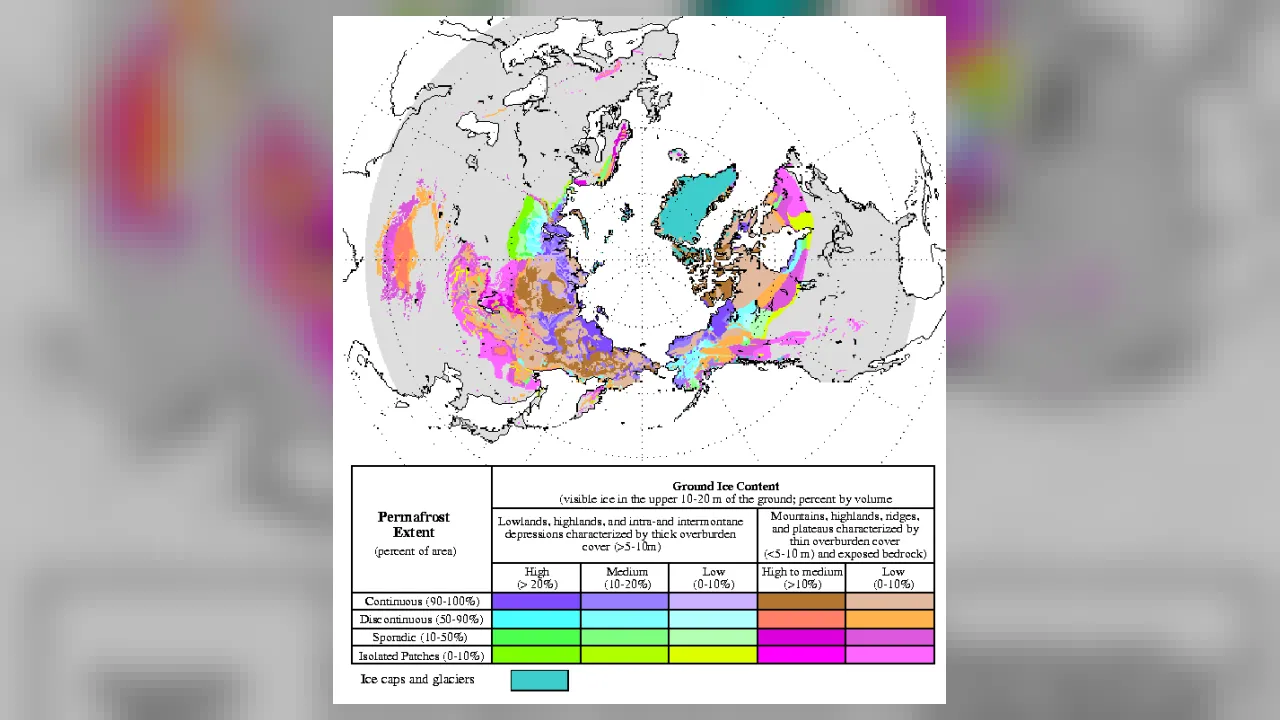
Look at a map of the Northern Hemisphere's landmass—across Alaska, Canada, Greenland, Scandinavia, Russia, and Tibet—and nearly one-quarter of all exposed northern land sits atop permafrost! Near the coldest Arctic coasts, permafrost forms an unbroken frozen shield hundreds of meters thick. Farther south in boreal spruce forests, discontinuous and sporadic permafrost appears in cold, shaded patches.
2
Pingos and Thermokarst Collapse
Underground ice shapes strange landforms across the north. Pressurized groundwater freezing upward pushes earth-covered ice hills called up to seventy meters high! Conversely, when buried ice wedges melt, the ground collapses unevenly into bumpy pits, sinkholes, and slump lakes known as . In subarctic forests, thawing ground tilts black spruce trees at crazy angles—creating what locals call 'drunken forests.'
3
Clever Cold-Region Engineering
When engineers built the 800-mile Trans-Alaska Pipeline, carrying warm oil underground would have thawed permafrost and snapped the pipe. Instead, they elevated over half the pipeline on special vertical supports fitted with heat-radiating pipes that keep the permafrost frozen without electricity!
4
Why Scientists Watch Frozen Carbon
Thousands of years of undecayed roots and peat remain locked inside permafrost. When permafrost thaws, microbes wake up and digest that ancient plant matter, releasing carbon dioxide and methane gases that warm Earth's atmosphere further.
1. What causes spruce trees in a subarctic 'drunken forest' to lean in every direction?
2. Why does thawing permafrost concern climate scientists around the world?
🤯 Mind-Blowing Fact • Grade 5
NASA's Phoenix Mars Lander photographed unmistakable Arctic-style polygon ground on Mars and scraped away a few centimeters of rusty soil to reveal bright white water-ice permafrost!
✨ Word Sparks (Grade 5 Glossary)
Tap 🔊 to hear
Talik
Pocket of unfrozen ground inside a permafrost zone
Cryoturbation
Churning and sorting of soil by freeze-thaw cycles
Feedback Loop
Cycle where warming causes changes that add more warming
🪝
How can frozen ground beneath the Arctic Ocean and Siberian plains hold twice as much carbon as our entire sky?
1
Thermal Physics of the Cryotic Subsurface
Lower temperature sensors down a borehole in Yakutia, Siberia—specifically the Markha River basin—and rock stays frozen down to an astonishing 1,500 meters (4,900 feet) below the surface! Geocryologists define permafrost strictly by thermal state: earth material remaining cryotic (at or below 0°C) for two or more consecutive years. Its thickness reflects a delicate balance between cold mean annual air temperatures above and geothermal heat rising steadily from Earth's interior below.
2
Continuous Zones, Taliks, and Subsea Relics
Across roughly 23 million square kilometers of the Northern Hemisphere, permafrost grades southward from continuous (>90 percent aerial coverage) to discontinuous (50–90 percent), sporadic (10–50 percent), and isolated patches. Even inside continuous permafrost, deep lakes and major rivers radiate enough warmth to maintain unfrozen pockets called . Remarkably, subsea permafrost also lies beneath shallow Arctic continental shelves—flooded when sea levels rose over frozen tundra after the Last Glacial Maximum!
3
Cryoturbation and Periglacial Landforms
Repeated seasonal freeze-thaw cycles in the upper active layer churn soil horizons in a mixing process called , sorting stones into striking geometric circles, stripes, and nets. Deeper thermal contraction cracks grow massive syngenetic ice wedges—especially in Siberia and Alaska's Pleistocene 'Yedoma' silt deposits, where ice can account for fifty to eighty percent of total ground volume.
4
The Permafrost Carbon Feedback Loop
Northern permafrost soils store an estimated 1,400 to 1,600 gigatons (billion metric tons) of organic carbon—roughly double the carbon currently suspended in Earth's atmosphere! Because Arctic regions warm three to four times faster than the global average (Arctic amplification), deepening active layers and abrupt thermokarst landslides expose ancient peat to aerobic bacteria (releasing CO₂) and waterlogged anaerobic archaea (releasing potent methane, CH₄), creating a self-reinforcing climate feedback.
5
Alpine Slope Stability and Martian Permafrost
In high mountain chains like the European Alps, interstitial permafrost acts as icy cement holding fractured rock peaks together; warming triggers high-elevation rockfalls. Beyond Earth, NASA's Phoenix lander dug directly into polygon-patterned Martian permafrost just centimeters below Mars's northern polar plain!