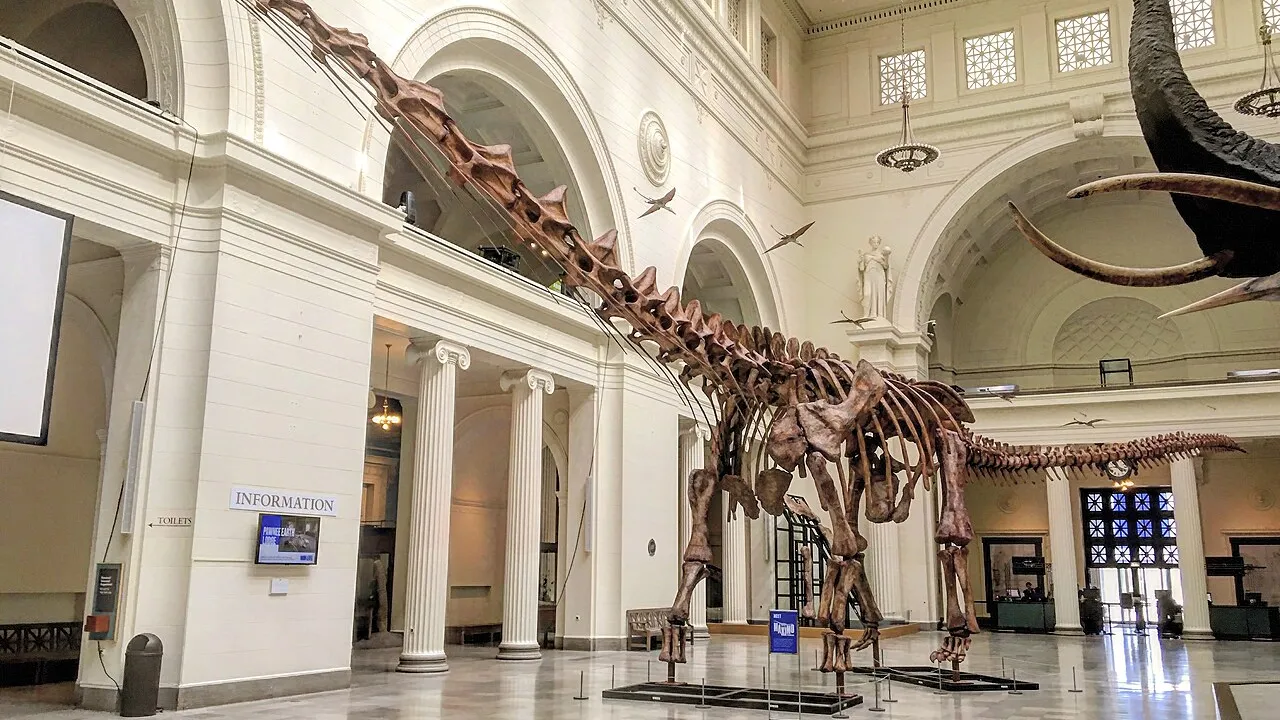
1. How tall is just one thigh bone of Patagotitan?
2. Why does Patagotitan's head poke out into a museum hallway?
🤯 Mind-Blowing Fact • Grade 2
Scientists had to build a special dirt road into the desert with bulldozers just to haul out Patagotitan's eight-foot leg bones!
✨ Word Sparks (Grade 2 Glossary)
Tap 🔊 to hear
ranch
a large farm where animals graze outdoors
excavate
to dig something carefully out of the ground
bloom
when a plant opens up colorful flowers
🪝
How did one sharp-eyed farm worker uncover six super-giant dinosaurs in the desert?
1
A Desert Surprise on La Flecha Ranch
While checking sheep on a dusty in Argentina, worker Aurelio Hernández spotted a huge rock shaped like a bone. When scientists started digging, they didn't find just one giant—they uncovered over one hundred fifty bones from at least six young adults!
2
Meet the Giant From Patagonia
Scientists named the new dinosaur Patagotitan mayorum to honor Patagonia and the friendly Mayo family who welcomed them onto their . Stretching 121 feet long, it weighed as much as ten African elephants!
3
Munching Early Flowers and Pines
One hundred one million years ago, the very first flowering plants were blooming alongside tall pine trees. Patagotitan swept its long neck across lush river valleys to feast all day.
1. Who does the second part of the name Patagotitan mayorum honor?
2. How many Patagotitan individuals were found buried at the ranch dig site?
🤯 Mind-Blowing Fact • Grade 3
The longest complete femur ever measured on Earth belongs to Patagotitan, stretching 7 feet 10 inches (2.38 meters) from hip joint to knee!
✨ Word Sparks (Grade 3 Glossary)
Tap 🔊 to hear
femur
the big upper leg bone between hip and knee
drought
a long dry spell with very little rain
cast
an exact lightweight copy molded from a fossil
🪝
Why did six seventy-ton dinosaurs gather at the exact same spot across different years?
1
Three Layers of Giants
Imagine excavating a desert quarry where every shovel strike hits another monstrous bone! Beginning in 2013 in Chubut Province, Argentina, paleontologists José Luis Carballido and Diego Pol unearthed more than 150 giant bones stacked across three separate floodplain layers.
2
Record-Breaking Thigh Bone
One excavated —the upper leg bone—measured 7 feet 10 inches (2.38 meters) from end to end, making it the longest complete thigh bone ever measured from any land animal! Lying beside it on a couch, a grown paleontologist looked miniature.
3
Returning to a Favorite Watering Hole
Why did at least six young-adult Patagotitan die in the same place at three slightly different times? Scientists suspect seasonal drew herds to a shrinking floodplain lake, and later floods gently covered their bones in protective mud.
4
Famous Museum Stars
Because six overlapping skeletons filled in missing parts for one another, museums in New York, Chicago, and London now display towering life-size —including Chicago's famous mount nicknamed 'Máximo.'
1. How did having six Patagotitan skeletons in one quarry help museum builders?
2. What record does Patagotitan's 7-foot-10-inch femur hold?
🤯 Mind-Blowing Fact • Grade 4
Diggers uncovered 57 shed, steak-knife-like teeth from giant meat-eating dinosaurs mixed right in among the Patagotitan bones, left behind when scavengers fed on the fallen titans!
Could the worldwide explosion of flowering plants have fueled the rise of Earth's biggest land giants?
1
Dawn of the Mega-Titanosaurs
One hundred one million years ago during the late Early Cretaceous, Patagonia's river plains witnessed an evolutionary leap in sheer scale. Earlier sauropods were already huge, yet Patagotitan mayorum and its close lognkosaurian relatives suddenly pushed body lengths to 37 meters (121 feet) and weights around 60 to 70 tons.
2
A Global Botanical Buffet
What sparked this burst of gigantism? Paleobotanists point to two planetary changes happening right around the same time: warm greenhouse climates and the rapid spread of —Earth's first fast-growing flowering plants—alongside towering araucarian conifers and ferns. Lush, fast-recovering floodplain forests offered endless calories for herds of giant browsers.
3
Clues From a Multi-Individual Graveyard
At the La Flecha quarry, three thin mudstone separated by brief spans of time preserved over 150 unweathered bones from at least six young adults whose growth was just beginning to slow. Notably, fifty-seven shed serrated teeth from the giant predator Tyrannotitan littered the quarry, proving carnivores scavenged the carcasses before gentle river silt sealed them away.
4
Built With Air-Lightened Strength
Extra bracing ridges called crisscrossed Patagotitan's towering back vertebrae like steel girders on a suspension bridge, giving maximum structural strength with minimum bone weight as herds marched across Patagonia.
1. What environmental change around 101 million years ago may have helped fuel mega-titanosaurs like Patagotitan?
2. What did the 57 shed predator teeth found among the Patagotitan bones indicate?
🤯 Mind-Blowing Fact • Grade 5
Volcanic ash crystals locked inside the Patagotitan rock layers acted like tiny atomic clocks, pinpointing the exact age of the six giants to 101.6 million years ago!
✨ Word Sparks (Grade 5 Glossary)
Tap 🔊 to hear
taphonomy
how organisms decay, get buried, and become fossils
clade
an evolutionary group sharing one common ancestor
zircons
tiny durable crystals used to date ancient rocks
🪝
How did six overlapping skeletons from one Patagonian ranch allow paleontologists to unify the family tree of Earth's super-titanosaurs?
1
An Extraordinary Taphonomic Window
Discovered in 2010 by ranch hand Aurelio Hernández and excavated between 2013 and 2015 by a team from the Museo Paleontológico Egidio Feruglio led by José Luis Carballido and Diego Pol, the La Flecha bonebed in Argentina's Cerro Barcino Formation reshaped everything science knew about extreme sauropod gigantism. Dated via volcanic ash to roughly 101.6 million years ago (late Albian), the quarry preserved more than 150 disarticulated yet pristine bones representing at least six young-adult individuals across three closely spaced low-energy flood events.
2
Unifying the Lognkosauria Clade
Named Patagotitan mayorum in 2017, this treasure trove bridged critical anatomical gaps. Previously, fragmentary giants like Argentinosaurus (known mostly from vertebrae) and Puertasaurus could barely be compared bone-for-bone. Because Patagotitan preserved neck, dorsal, and caudal vertebrae alongside complete humeri and a monumental 2.38-meter femur, phylogenetic analysis united Patagotitan, Argentinosaurus, and Puertasaurus within a single South American of colossal titanosaurs called Lognkosauria.
3
Cross-Checking Body Mass Methods
Carballido and Pol tested two independent mass-estimation techniques on the same dataset: limb-shaft circumference scaling of the femur and humerus yielded roughly 69 metric tons (with a ±17-ton margin), while 3D volumetric laser-scan reconstructions placed live body mass between 50 and 57 metric tons—confirming Patagotitan stood squarely in the same elite weight class as Argentinosaurus.
4
Histology of Young-Adult Giants
Thin-section osteohistology of six different femora revealed vascularized fibrolamellar cortex transitioning toward slower outer growth zones without a completed external fundamental system, showing all six perished as young adults whose steepest growth spurt had ended but who still added modest mass each year.
5
Social Aggregation and Scavenger Traces
Repeated burial of similarly aged adults on one floodplain—accompanied by 57 shed carcharodontosaurid teeth attributed to Tyrannotitan—points to recurring congregation around seasonal water sources and highlights how a single fallen Patagotitan delivered tens of millions of calories to its Cretaceous ecosystem.