🧬 HUMAN BODY
🧬 Pancreas • Digestive & Endocrine Systems
VA Science & Health SOL 1.1, 3.1, 4.2, 5.1 (Cells, Organs & Body Systems)
Pancreas
Double-Duty Master of Digestion and Blood Sugar
Grade 1 • Early Reader • 76 words
🩺 Body System & LocationUpper Abdomen • Tucked Horizontally Behind the Stomach
🔬 Size / Cell Count6 in (15 cm) long • ~3 oz (85 g) leaf-shaped gland
⚙️ Core JobSecretes enzyme-rich digestive juice into the gut and insulin into blood
⚡ Body SuperpowerWorks in two body systems at once with 1 million tiny hormone islands
🤯 Mind-Blowing Fact • Grade 1
Your pancreas belongs to two different body teams at the exact same time—the digestion team and the hormone team!
✨ Word Sparks (Grade 1 Glossary)
Tap 🔊 to hear
Gland
An organ that makes helpful body liquids
Insulin
Hormone key that lets sugar enter cells
Energy
Power your body uses to move and grow
🪝
What shy organ hides behind your tummy and wears two helper hats at once?
1
Hiding Behind Your Stomach
Tucked cozy and warm behind your stomach sits a bumpy yellow . It is shaped like a flat pear or a little fish! Meet your hardworking pancreas.
2
Job One: Super Food Chopper
When lunch leaves your stomach, your pancreas squirts special juice into your gut. That juice chops carbs, fats, and proteins into tiny bits your body can use.
3
Job Two: Sugar Key Maker
Your pancreas also makes tiny keys called . Insulin unlocks your cells so food sugar can step inside and give you !
1. Where does your pancreas sit inside your belly?
2. How does insulin act like a tiny helpful key?
🤯 Mind-Blowing Fact • Grade 2
Every single day, a six-inch pancreas makes more than a quart of digestive juice mixed with natural baking soda!
✨ Word Sparks (Grade 2 Glossary)
Tap 🔊 to hear
Hormone
Chemical messenger traveling through your bloodstream
Neutralize
Calm down strong acid until it is gentle
Starch
Carbohydrate energy found in bread, rice, and potatoes
🪝
Why doesn't stinging stomach acid burn your small intestine when food moves down?
1
Cooling the Acid Splash
Picture super-sour lemon juice getting calmed down by baking soda! Food leaving your stomach is soaked in strong acid. Right away, your six-inch pancreas squirts gentle baking-soda fluid into the small intestine to calm that acid down.
2
Three Kinds of Food Scissors
Inside that same pancreatic juice ride three teams of enzyme scissors. One team snips from bread, another snips proteins from beans or meat, and the third snips fats from cheese!
3
Tiny Hormone Islands
Dotted across the pancreas are a million microscopic cell clusters that look like tiny islands. They send insulin and glucagon into your blood to keep your blood sugar steady all day.
1. How does pancreatic juice protect your small intestine from strong stomach acid?
2. How many major nutrient groups can pancreatic enzymes snip apart?
🤯 Mind-Blowing Fact • Grade 3
The pancreas packs its protein-digesting enzymes with built-in safety switches so they stay fast asleep until they enter your small intestine!
✨ Word Sparks (Grade 3 Glossary)
Tap 🔊 to hear
Exocrine
Sending helpful fluids out through tiny ducts
Endocrine
Releasing messenger hormones straight into the blood
Glucagon
Hormone telling the liver to release sugar
🪝
How does your pancreas make powerful protein-digesting enzymes without accidentally digesting itself?
1
One Organ, Two Systems
Imagine a factory where 98 percent of the building ships packages down a pipeline, while hundreds of tiny rooftop towers broadcast radio signals everywhere! That is how your pancreas works. Its part sends digestive juice through a duct into the duodenum, while its part releases hormones straight into passing blood vessels.
2
Safety Locks on Enzymes
Pancreatic juice carries amylase for carbohydrates, lipase for fats, and proteases for proteins. Because active proteases could chew up the pancreas's own cells, the pancreas builds them with tiny molecular safety caps! Only after they safely reach the small intestine do those caps pop off.
3
Islets of Langerhans
Scattered across the gland sit roughly one million tiny cell clusters called the islets of Langerhans. Beta cells release insulin after meals to move glucose into cells, while alpha cells release between meals to tell the liver to share stored sugar.
4
Helping Hands From Medical Science
In type 1 diabetes, beta cells stop making insulin, so kids use smart insulin pumps and sensors invented by medical scientists to thrive every day!
1. Why doesn't the pancreas digest its own cells with its strong protein-chopping enzymes?
2. How do insulin and glucagon work together like a seesaw?
🤯 Mind-Blowing Fact • Grade 4
Even though the hormone-making islets of Langerhans make up less than two percent of the pancreas's weight, they receive nearly fifteen percent of its blood flow!
✨ Word Sparks (Grade 4 Glossary)
Tap 🔊 to hear
Acini
Berry-shaped cell clusters making digestive enzymes
Zymogens
Safely inactive forms of powerful digestive enzymes
Bicarbonate
Alkaline compound that neutralizes strong stomach acid
🪝
How did a twenty-one-year-old medical student spot a million hidden 'islands' inside the pancreas that later saved millions of lives?
1
Acini and Ducts: The Exocrine Powerhouse
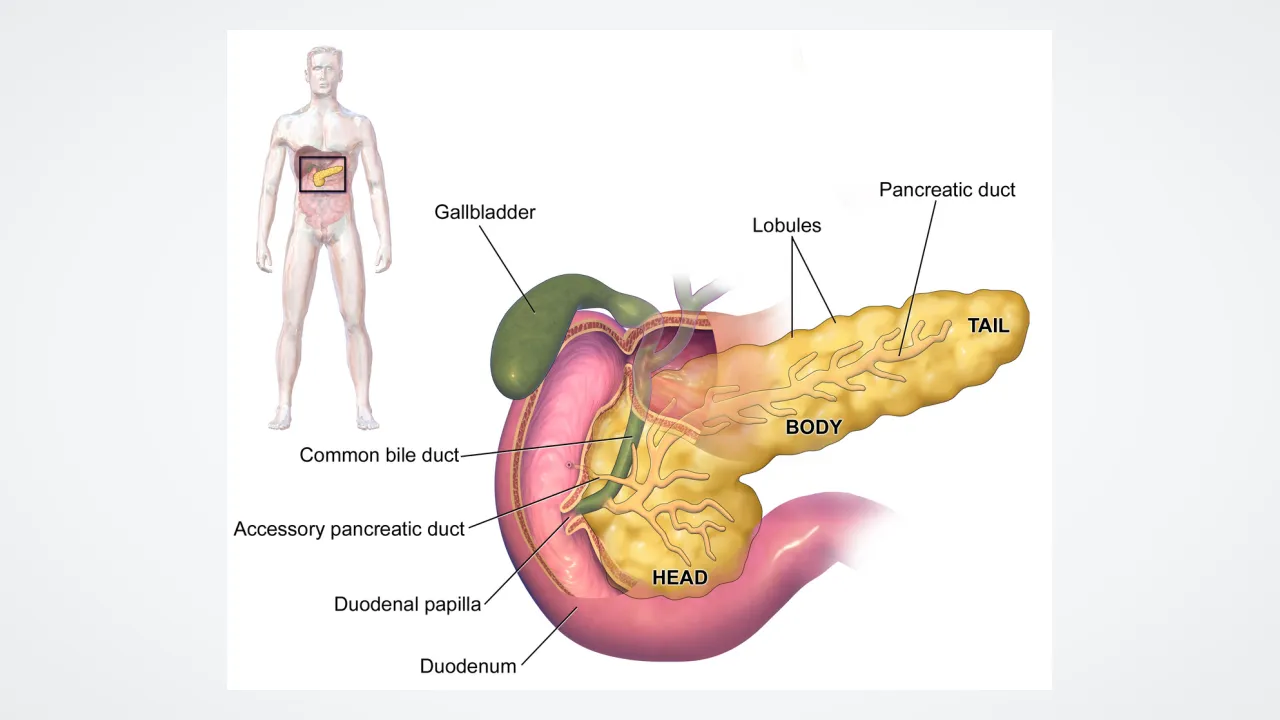
Stretch a six-inch, tadpole-shaped pancreas across your palm in an anatomy model: its rounded head nestles inside the C-shaped curve of the duodenum, its body crosses behind the stomach, and its narrow tail touches the spleen. Nearly 98 percent of its mass consists of berry-like clusters called . Acinar cells synthesize amylase, pancreatic lipase, nucleases, and inactive protein-splitting such as trypsinogen. Meanwhile, cells lining the pancreatic ducts pump sodium into the fluid, raising its pH to neutralize acidic chyme.
2
Unlocking Zymogens Safely
Once pancreatic juice flows through the main pancreatic duct into the duodenum, an enzyme anchored exclusively to the intestinal brush border—enteropeptidase—snips a tiny peptide cap off trypsinogen. Instantly, active trypsin awakens and switches on the remaining protein enzymes right where lunch is waiting!
3
Paul Langerhans's Microscopic Islands
In 1869, German medical student Paul Langerhans stained pancreatic tissue under his microscope and noticed pale, richly vascularized clusters floating amid dark acinar berries. Though these 'islets of Langerhans' occupy barely 1 to 2 percent of pancreatic weight, they receive up to 15 percent of the organ's blood supply so alpha, beta, and delta cells can sample blood glucose second by second.
4
The 1921 Breakthrough of Insulin
Fifty-two years later in Toronto, Frederick Banting, Charles Best, John Macleod, and biochemist James Collip purified islet insulin—turning once-fatal type 1 diabetes into a manageable condition overnight!
1. Which intestinal brush-border enzyme acts as the master switch to activate trypsinogen?
2. Why do the tiny islets of Langerhans receive such a huge share of the pancreas's blood flow?
🤯 Mind-Blowing Fact • Grade 5
In 1902, scientists studying how the pancreas responds to stomach acid discovered secretin—giving science the word 'hormone' for the very first time in history!
✨ Word Sparks (Grade 5 Glossary)
Tap 🔊 to hear
Secretin
First discovered hormone; triggers pancreatic bicarbonate flow
Homeostasis
Keeping internal body conditions steady and balanced
Parenchymal
Relating to an organ's main functional cells
🪝
How do two duodenal hormones and a million microscopic endocrine islets orchestrate both chemical digestion and whole-body glucose homeostasis?
1
Retroperitoneal Dual-Gland Architecture
Positioned transversely in the retroperitoneal space behind the stomach, the adult human pancreas measures roughly 15 centimeters (6 inches) long and weighs 70 to 100 grams. Its Greek name—from pan ('all') and kreas ('flesh')—was coined by ancient anatomist Herophilus because the pale, lobulated organ contains neither bone nor cartilage. Histologically, it operates as two interwoven glands: an exocrine acinar-ductal network comprising ~98 percent of volume, and ~1 to 2 million endocrine islets of Langerhans.
2
Secretin, CCK, and the Zymogen Cascade
In 1902, British physiologists William Bayliss and Ernest Starling discovered the very first hormone in medical history——while studying how duodenal acid triggers pancreatic juice! When acidic, lipid-rich chyme enters the duodenum, S-cells release secretin, prompting pancreatic ductal cells to secrete 1.2 to 1.5 liters daily of alkaline bicarbonate fluid (pH ~8.0). Simultaneously, cholecystokinin (CCK) stimulates acinar cells to release pancreatic amylase, lipase-colipase, ribonuclease, and inactive zymogens (trypsinogen, chymotrypsinogen, procarboxypeptidase) via the duct of Wirsung into the ampulla of Vater, where brush-border enteropeptidase triggers activation.
3
Cellular Symphony Inside Each Islet
Each vascularized islet houses distinct endocrine cell types working in negative-feedback loops: beta cells (~60–70%) secrete insulin when blood glucose rises above ~90 mg/dL, signaling skeletal muscle and adipose cells to insert GLUT4 glucose transporters into their membranes; alpha cells (~20–30%) secrete glucagon during fasting or exercise to stimulate hepatic glycogenolysis and gluconeogenesis; delta cells (~5%) secrete somatostatin to fine-tune both neighbors; and PP cells regulate exocrine output.
4
From Banting and Best to Bioengineering
Before Banting, Best, Collip, and Macleod isolated insulin in 1921–1922, autoimmune loss of beta cells in type 1 diabetes left cells starving amid high blood sugar.
5
Modern Closed-Loop Care
Today, recombinant human insulin, continuous glucose monitors, and automated 'bionic pancreas' algorithms emulate islet precision around the clock.