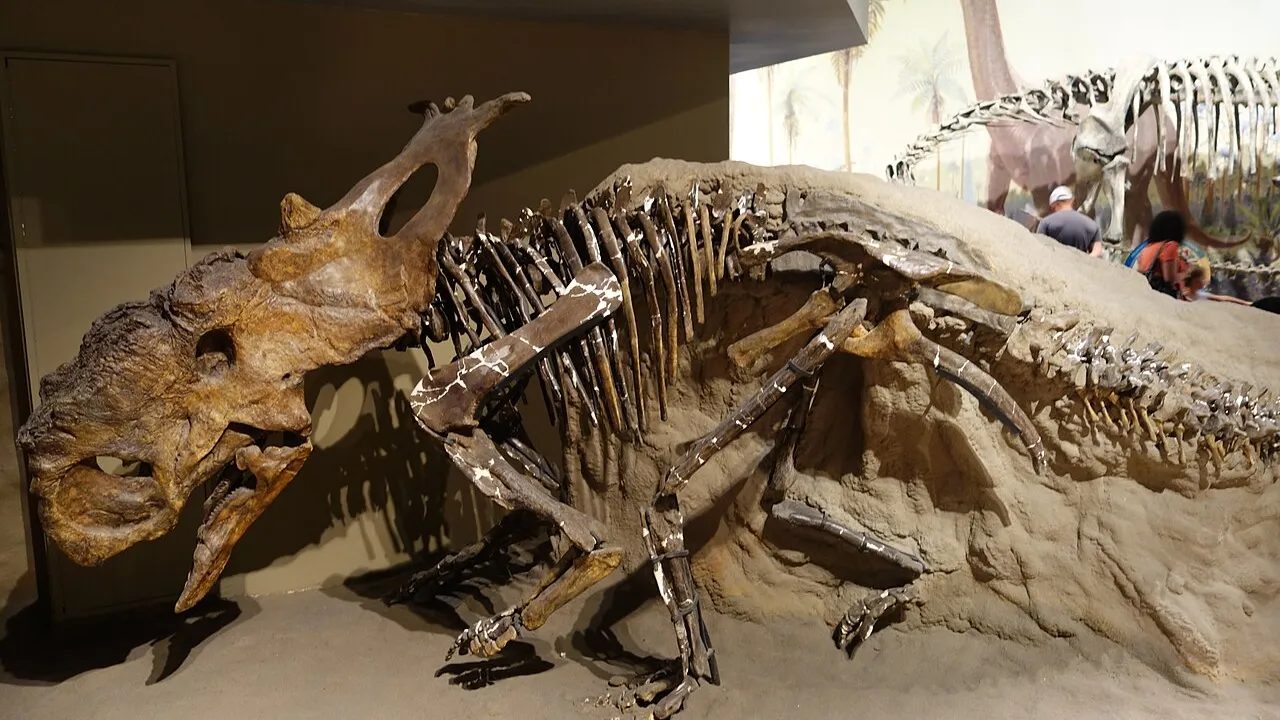
1. What grew on top of an adult Pachyrhinosaurus's snout instead of a sharp horn?
2. Where did northern herds of Pachyrhinosaurus live?
🤯 Mind-Blowing Fact • Grade 2
Along Pipestone Creek in Alberta, a single hillside holds bones from thousands of Pachyrhinosaurus that traveled together in a mega-herd!
✨ Word Sparks (Grade 2 Glossary)
Tap 🔊 to hear
Arctic
Far northern region around the North Pole
Mega-herd
A giant group of thousands of animals
Gnarled
Bumpy, rough, and covered in deep grooves
🪝
How did a four-ton horned dinosaur thrive through dark, snowy Arctic winters?
1
Tough Northern Giant
Cold wind whistles through ancient dawn-redwood trees in Alaska 70 million years ago. Pushing aside frosted branches steps a four-ton Pachyrhinosaurus! Measuring 25 feet long, this sturdy plant-eater thrived from southern Canada all the way above the Circle.
2
Battering-Ram Snout
Youngsters started out with a small curved bump on their nose. As they grew into adults, that bone widened into a thick, grooved pad called a nasal boss—plus smaller bony pads right above their eyes!
3
Unicorn Frill Spikes
Curved horns sprouted from the top of its neck frill, and one species even grew a sharp unicorn-style spike right between its eyes!
2. What did scientists find at Pipestone Creek in Alberta?
🤯 Mind-Blowing Fact • Grade 3
Growth rings inside Alaskan Pachyrhinosaurus bones show their growth slowed down each dark Arctic winter and sped right back up every sunny spring!
✨ Word Sparks (Grade 3 Glossary)
Tap 🔊 to hear
Keratin
Tough horn covering over a bony core
Muskox
Shaggy Arctic mammal with thick head bosses
Migrate
To travel long distances together between seasons
🪝
Why did Pachyrhinosaurus trade a sharp nose spear for a giant bony bumper?
1
Rumble in the Northern Woods
Listen! Heavy hooves churn chilly mud along a river in Late Cretaceous Alberta as a massive herd of Pachyrhinosaurus marches past. Stretching up to 26 feet long and weighing as much as a hippo, these hardy centrosaurines conquered cool northern forests from Alberta to polar Alaska.
2
Built Like Muskoxen
Instead of risking broken horn tips in head-to-head contests, adult Pachyrhinosaurus grew a flattened, deeply grooved nasal boss covered in a thick pad of tough —very much like modern muskoxen! Smaller bosses sat over its eyes, built for shoving matches with rivals or flank-butting predators.
3
Three Stylish Species
Paleontologists know three distinct species: canadensis from southern Alberta, lakustai with a surprise unicorn spike behind its nose boss, and perotorum from snowy Arctic Alaska!
4
River of Death Bonebed
When high school teacher Al Lakusta found thousands of bones packed up to 300 per square yard at Pipestone Creek in 1972, scientists realized a flash flood had caught an entire migrating herd crossing a swollen river.
1. Which modern Arctic animal has thick head bosses similar to Pachyrhinosaurus?
2. Who discovered the famous Pipestone Creek bonebed in 1972 and had a species named after him?
🤯 Mind-Blowing Fact • Grade 4
Fossils of tiny baby Pachyrhinosaurus above the Arctic Circle proved beyond doubt that horned dinosaurs lived through dark polar winters instead of walking south!
✨ Word Sparks (Grade 4 Glossary)
Tap 🔊 to hear
Latitude
Distance north or south from Earth's equator
Orbital
Positioned right around the bony eye socket
Adolescence
Teenage growth stage before reaching full adulthood
🪝
What secrets do polar fossils on Alaska's North Slope reveal about warm-blooded dinosaur endurance?
1
Pushing Toward the North Pole
Between 73.5 and 69 million years ago, while global climates were warmer than today, northern Alaska sat even closer to the geographic North Pole—around 80 degrees north ! Every autumn, the sun dipped below the horizon for four straight months of polar twilight and freezing snowfalls. Yet inside the Prince Creek Formation along Alaska's Colville River, paleontologists Anthony Fiorillo and Ronald Tykoski unearthed Pachyrhinosaurus perotorum thriving year-round alongside polar tyrannosaurs like Nanuqsaurus.
2
Ontogeny of the Nasal Boss
Thanks to hundreds of skulls from babies to elders at Alberta's Pipestone Creek bonebed (Pachyrhinosaurus lakustai), scientists traced how that bizarre snout formed. Juveniles actually grew a low, blade-like horn core first; during , bone expanded sideways, folded inward, and fused into a deeply pitted, saddle-shaped boss anchored to thick shock-absorbing keratin.
3
Ornate Frill Weaponry
Far from plain, its short centrosaurine frill sprouted sweeping devil-like lateral horns from the upper corners, while lakustai added a spiky comb right between its bosses for dramatic species recognition.
4
Surviving Polar Winters
Tiny baby Pachyrhinosaurus fossils found right in Arctic Alaska prove herds nested there rather than migrating thousands of miles south! Bone growth rings confirm they endured lean winters by stripping bark, woody twigs, and hardy roots until spring sunlight returned.
1. How did paleontologists prove Alaskan Pachyrhinosaurus stayed in the Arctic year-round rather than migrating south for winter?
2. How did a juvenile Pachyrhinosaurus's nose change as it grew into an adult?
🤯 Mind-Blowing Fact • Grade 5
At Pipestone Creek in northern Alberta, paleontologists calculated up to 100 fossilized Pachyrhinosaurus bones packed into every single square meter of hillside rock!
✨ Word Sparks (Grade 5 Glossary)
Tap 🔊 to hear
Morphogenesis
Biological process shaping organs or bones during growth
Perinatal
Right around the time of hatching or birth
Fibrolamellar
Fast-growing bone tissue typical of warm-blooded animals
🪝
How did bone histology, taphonomy, and polar paleobotany overturn old myths of sluggish cold-blooded dinosaurs through Pachyrhinosaurus?
1
Three Species Across High-Latitude Laramidia
Spanning 73.5 to 69 million years ago across the late Campanian and early Maastrichtian stages, the centrosaurine clade Pachyrhinosaurs dominated northern Laramidia through three chronologically and geographically distinct species: Pachyrhinosaurus lakustai from Alberta's Wapiti Formation, the robust 7.6-meter (25-foot), four-ton type species P. canadensis described by Charles M. Sternberg in 1950 from the Horseshoe Canyon Formation, and the high-Arctic P. perotorum named in 2012 from Alaska's Prince Creek Formation.
2
Morphogenesis of Cranial Bosses
Replacing the acute conical nasal horn of ancestral centrosaurines like Centrosaurus, adult Pachyrhinosaurus developed a massive, rugose nasofrontal boss flanked by paired supraorbital bosses. Ontogenetic series of over 3,500 elements from Alberta's Pipestone Creek monodominant bonebed—where floodwaters entombed up to 100 bones per square meter—demonstrated that young individuals possessed compressed, posteriorly recurved nasal horn cores that inflated laterally and coalesced during subadulthood. Deep vascular grooves indicate a dense, shock-dissipating keratinous pad ideal for intraspecific head-shoving and flank-butting.
3
Life at Eighty Degrees North
Along the steep bluffs of Alaska's Colville River, P. perotorum inhabited deciduous taxodiaceous conifer woodlands situated at paleolatitudes of 80° to 85° North! Although polar ice sheets were absent, paleoclimate reconstructions confirm mean winter temperatures plunged below freezing alongside 120 consecutive days of polar darkness and periodic snowfalls.
4
Year-Round Polar Residency
For years, researchers debated whether Arctic ceratopsids migrated 2,500 kilometers south each autumn. In 2021, Patrick Druckenmiller, Gregory Erickson, and colleagues documented (hatchling-sized) ceratopsid elements inside the Prince Creek Formation, proving herds reproduced locally and lacked the biomechanical stride efficiency to trek south before winter arrived.
5
Physiological Resilience Written in Bone
Osteohistological cross-sections of Alaskan Pachyrhinosaurus limbs reveal rapid, warm-season growth punctuated by closely spaced winter lines of arrested growth (LAGs), confirming active endothermic-grade physiology sustained on woody twigs, horsetail rhizomes, and decaying leaf litter through the long polar night.