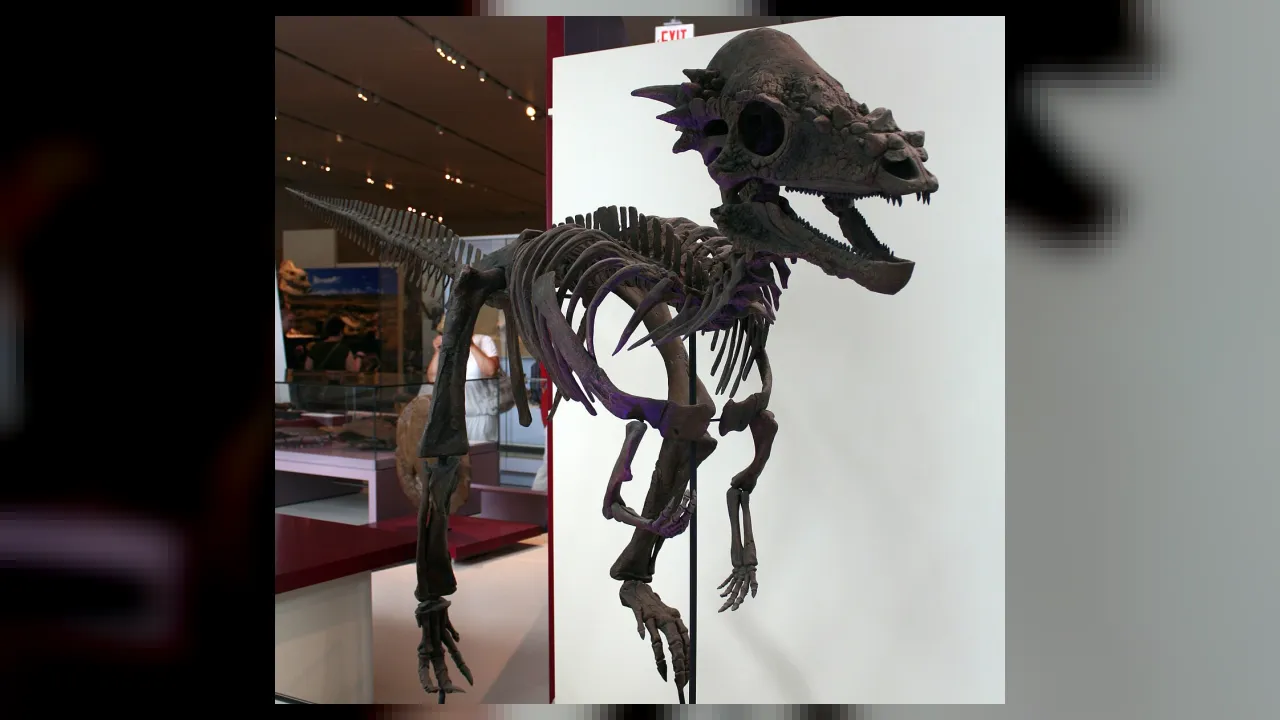
⚡ Survival SuperpowerSolid ten-inch-thick bony skull dome ringed by spiky snout and neck knobs
🤯 Mind-Blowing Fact • Grade 1
The solid bone dome on top of a Pachycephalosaurus head was twenty-five times thicker than a human skull!
✨ Word Sparks (Grade 1 Glossary)
Tap 🔊 to hear
Dome
Smooth rounded cap on top of a skull
Helmet
Hard protective cover shielding the head
Snout
Pointed front nose and mouth of an animal
🪝
What dinosaur walked around wearing a built-in ten-inch bowling ball helmet?
1
Built-In Crash Helmet!
Bonk, tap! Through sunny ferns trots a lively two-legged dinosaur. Right on top of its head sits a smooth, round of solid bone! Say hello to Pachycephalosaurus.
2
Ten Inches Thick
Your own skull bone is thinner than a cracker. This dinosaur's skull roof grew ten inches thick—like a bowling ball!
3
Spiky Nose Crown
Blunt bony bumps ringed the back of its head and dotted its pointed while it snacked on berries, seeds, and leaves.
1. How thick was the solid bone dome on top of Pachycephalosaurus?
2. How many legs did Pachycephalosaurus walk and run on?
🤯 Mind-Blowing Fact • Grade 2
Because its ten-inch skull dome was as hard as a boulder, flowing rivers rolled fossilized domes for miles without breaking them while the rest of the skeleton washed away!
✨ Word Sparks (Grade 2 Glossary)
Tap 🔊 to hear
Omnivore
Animal eating both plants and small animals or bugs
Biped
Creature that walks upright on two hind legs
Scars
Marks left where injured bone healed back strong
🪝
Did Pachycephalosaurus really butt heads like bighorn sheep?
1
Thick-Headed Neighbor of T. rex
Imagine a fifteen-foot dinosaur weighing nearly a thousand pounds trotting briskly through Montana woods sixty-seven million years ago! Pachycephalosaurus means thick-headed lizard—and for years, only its tough bowling-ball skull domes were ever found because thin body bones washed away in rivers.
2
Head-Butting Mystery
When scientists scanned dozens of fossil domes, about one in five showed healed dents and pitted right on top! Like modern bighorn rams or muskoxen, rivals likely shoved heads or tapped flanks to win contests.
3
Mystery Menu
Tiny ridged leaves of teeth up front and sharper pointed teeth near the beak suggest it ate tender leaves, fruits, seeds, and maybe crunchy insects too!
1. Why did paleontologists find dozens of Pachycephalosaurus skull domes long before finding full skeletons?
2. What clue on fossil domes shows Pachycephalosaurus actually used its thick head in shoving or sparring matches?
🤯 Mind-Blowing Fact • Grade 3
Microscopic bone studies suggest spiky-headed 'Dracorex' and 'Stygimoloch' might actually be kids and teenagers growing up into adult Pachycephalosaurus!
✨ Word Sparks (Grade 3 Glossary)
Tap 🔊 to hear
Radiate
Spread outward from the center like wheel spokes
Lesion
Spot on bone damaged by injury and healing
Growth Stage
Body shape at baby, teen, or adult age
🪝
Were flat-headed Dracorex and spiky Stygimoloch actually baby and teenage Pachycephalosaurus?
1
Three Dinosaurs—or One Growing Up?
In the exact same sixty-six-million-year-old Hell Creek rock beds live three famous relatives: flat-headed, spiky Dracorex; medium-domed, long-spiked Stygimoloch; and big-domed, blunt-knobbed Pachycephalosaurus! Paleontologist Jack Horner sliced into their skull bones and discovered juvenile spongy growing bone in the first two, proposing they were actually kid, teen, and adult stages of one species!
2
Shock-Absorbing Bone Fibers
Inside a growing Pachycephalosaurus dome, microscopic columns of spongy bone radiated outward like bicycle spokes, cushioning impacts before hardening solid in older adults.
3
Woven Basket Tail
Near the end of its tail, ossified tendons crisscrossed in a neat woven basket pattern that stiffened the tail for rapid balance.
4
Mixed Front and Cheek Teeth
Pointed, serrated front premaxillary teeth paired with leaf-shaped cheek teeth let it nip fruit, nuts, ferns, and small lizards, making this dome-headed runner one of the most adaptable dinosaurs in the forest.
1. What evidence led paleontologists to propose Dracorex and Stygimoloch were young Pachycephalosaurus?
2. What unusual pattern stiffened the tail of Pachycephalosaurus?
🤯 Mind-Blowing Fact • Grade 4
3D crash-test simulations showed a Pachycephalosaurus skull protected its brain during head-butts even better than the skulls of modern bighorn sheep!
✨ Word Sparks (Grade 4 Glossary)
Tap 🔊 to hear
Frontoparietal
Fused forehead and roof bones forming the dome
Heterodont
Having differently shaped teeth for varied food jobs
Concussion
Jarring injury to the brain from sudden impact
🪝
How could Pachycephalosaurus butt heads without hurting its brain when modern woodpeckers and bighorn sheep do?
1
Cushioning the Brain Under Ten Inches of Bone
Skeptics once doubted two nine-hundred-pound Pachycephalosaurus could clash rounded domes at speed without sliding sideways or suffering brain . Then in 2011, biomechanical researcher Eric Snively ran 3D finite-element crash tests comparing Pachycephalosaurus skulls directly against bighorn sheep, muskoxen, and duikers! Covered in a flat-topped keratin pad, the twenty-five-centimeter dome transmitted lower strain to the tiny braincase underneath than modern head-butting mammals experience!
2
Kangaroo-Like Spine Alignment
In 2023, examination of one of the most complete Pachycephalosaurus skeletons ever found—nicknamed 'Sandy'—revealed S-curved neck and back vertebrae with interlocking tongue-in-groove joints that could line up straight behind the thick skull to brace heavy impacts without buckling the neck.
3
Heterodont Teeth and Omnivory
Most plant-eating dinosaurs had uniform rows of identical teeth, yet Pachycephalosaurus carried jaws: curved, blade-like front teeth resembling small theropod teeth ahead of triangular leaf-shredding cheek teeth! That versatile toolkit suggests seasonal omnivory on fruits, seeds, shoots, insects, and small vertebrates.
4
Wide Hips and Ribcage
Broad pelvic bones protected internal organs against flank-butting shoves while housing a spacious digestive tract capable of extracting energy from fibrous woodland ferns, fallen ginkgo seeds, and seasonal berries.
1. What did Eric Snively's 3D crash-test computer models reveal about the Pachycephalosaurus dome?
2. Why do paleontologists think Pachycephalosaurus may have been an omnivore rather than a strict leaf-eater?
🤯 Mind-Blowing Fact • Grade 5
Detailed rock-layer mapping in Montana revealed that spiky-horned skulls cluster in younger upper Hell Creek rocks, showing pachycephalosaurs were actively evolving new horn styles right before the asteroid hit!
✨ Word Sparks (Grade 5 Glossary)
Tap 🔊 to hear
Marginocephalia
Dinosaur clade uniting horned ceratopsians and domed pachycephalosaurs
Osteomyelitis
Bone inflammation and healing remodeling after deep injury
Agonistic
Relating to ritualized sparring contests between rival animals
🪝
How do cranial bone histology and stratigraphic rock layers refine the Stygimoloch–Pachycephalosaurus debate?
1
Taxonomic History from Tylosteus to Wyomingensis
Fragments of bumpy pachycephalosaur skull armor found by Ferdinand Hayden along the Missouri River in the 1850s were initially mistaken by Joseph Leidy for armored reptile scales (`Tylosteus`). Only when Charles Whitney Gilmore described a domed Lance Formation cranium from Wyoming in 1931—elevated to the new genus Pachycephalosaurus by Barnum Brown and Erich Schlaikjer in 1943—did paleontologists grasp that united horned ceratopsians with dome-skulled bipeds!
2
Histological Ontogeny vs. Stratigraphic Evolution
In 2009, Jack Horner and Mark Goodwin used synchrotron and CT histology on twenty-one skulls to show spongy, vascularized radially fibrolamellar bone in flat-headed `Dracorex` and long-horned `Stygimoloch`, contrasting with dense, remodeled acellular bone in adult `Pachycephalosaurus`. Subsequent stratigraphic surveys added an evolutionary twist: long-spiked `Stygimoloch` skulls cluster specifically in the upper third of the Hell Creek Formation rather than evenly bottom-to-top, suggesting `Pachycephalosaurus spinifer` evolved slightly later as a descendant species whose juveniles still resembled `Dracorex`!
3
Osteomyelitis Pathology From Agonistic Combat
Systematic surveys by Joseph Peterson of over one hundred pachycephalosaurid domes documented a twenty-two-percent frequency of depressed fractures and secondary bone infections () concentrated on the dorsal dome—matching modern caprid rams that clash head-on during territorial contests.
4
Caudal Myrmekite Basketwork
Crisscrossing ossified caudal tendons—historically mistaken for armored fish scales when found isolated—formed a semi-rigid tapered cylinder stabilizing agile bipedal sprints through forested uplands.
5
Upland Forest Generalist
Measuring 4.5 meters (15 feet) and 430 kilograms, Pachycephalosaurus occupied mid-tier browser-omnivore niches across western North America's coastal plains and wooded foothills right until the K-Pg extinction boundary sixty-six million years ago.