⚡ Survival SuperpowerParrot-strong toothless beak and protective nest-brooding care
🤯 Mind-Blowing Fact • Grade 1
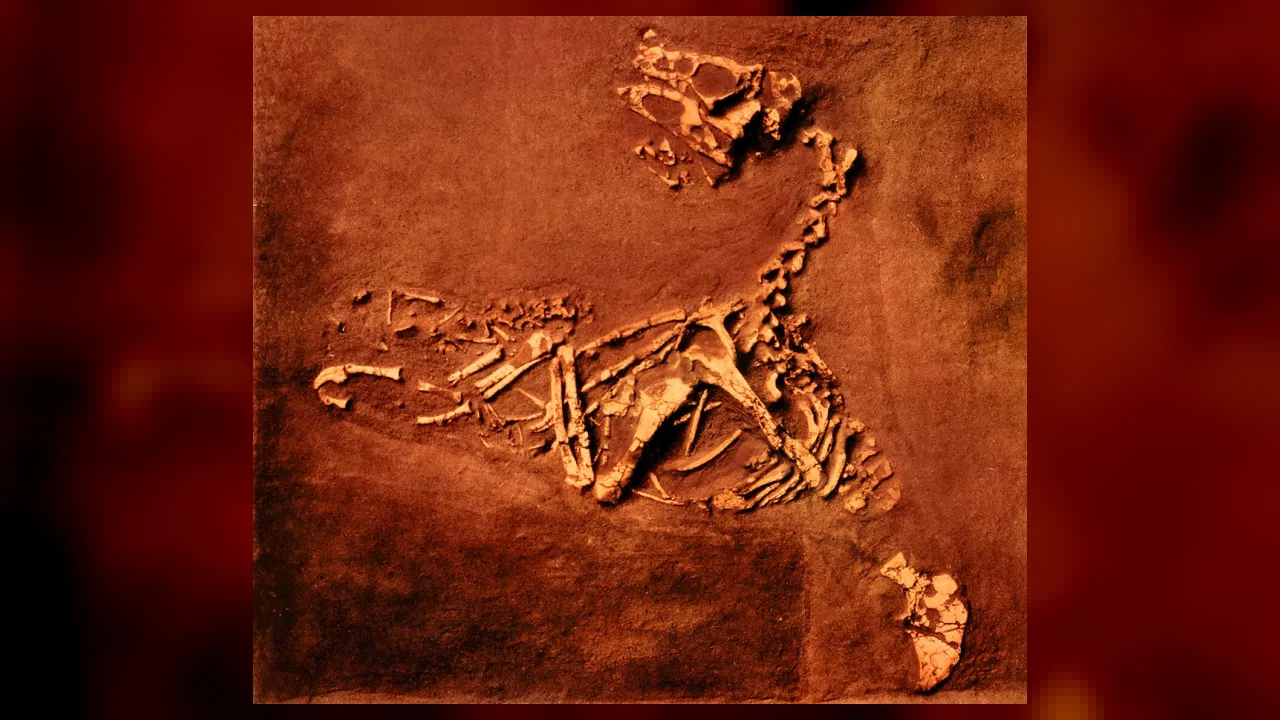
Scientists found a fossilized lizard skeleton inside the very first Oviraptor's tummy, showing it ate lizards as well as tough plants!
✨ Word Sparks (Grade 1 Glossary)
Tap 🔊 to hear
beak
Hard, toothless mouth covering like a bird's
brood
To sit on eggs to keep them warm
thief
Someone accused of taking what isn't theirs
🪝
Why did scientists accidentally call this caring dinosaur parent an egg thief?
1
Oops! Wrong Name!
Hiss, rustle! Sand blows across a warm desert nest in ancient Mongolia. A feathered dinosaur crouches over fifteen long eggs! In 1924, scientists named it Oviraptor, which means egg .
2
A Loving Parent
Years later, tiny baby bones inside matching eggs told the truth! Oviraptor was not stealing eggs—it was keeping its very own babies safe!
3
Strong Parrot Beak
It had zero teeth! Instead, a hard, curved cracked tough seeds, nuts, and lizards.
1. Why did Oviraptor get stuck with the unfair name 'egg thief'?
2. What kind of mouth did Oviraptor have?
🤯 Mind-Blowing Fact • Grade 2
Under science naming rules, even when a dinosaur's name turns out to be a mistake, its original first scientific name—Oviraptor—stays official forever!
✨ Word Sparks (Grade 2 Glossary)
Tap 🔊 to hear
omnivore
An animal that eats both plants and animals
sandstorm
Strong desert wind blowing thick clouds of sand
unhatched
Still growing safely inside an eggshell
🪝
How did a seventy-year-old fossil mystery prove Oviraptor was a hero parent instead of a villain?
1
Found on a Desert Nest
Imagine digging into red sandstone at Mongolia's famous Flaming Cliffs in 1923 and uncovering a dinosaur skeleton lying right on top of a ring of fossil eggs! Because many horned Protoceratops lived nearby, scientist Henry Fairfield Osborn guessed the newcomer died while robbing their nest and named it Oviraptor—'egg seizer.'
2
Clearing Oviraptor's Good Name
Seventy years later in the 1990s, paleontologists peered inside an identical fossil egg from Mongolia and found a tiny oviraptorid baby! Oviraptor and its close cousins hadn't raided nests—they died protecting their own eggs during desert .
3
Built-In Nutcracker
Two sharp bony points on the roof of its toothless beak helped Oviraptor crush hard seeds, roots, shellfish, and small lizards.
1. What discovery in the 1990s cleared Oviraptor's reputation after seventy years?
2. What sat on the roof of Oviraptor's mouth inside its toothless beak?
🤯 Mind-Blowing Fact • Grade 3
Oviraptor arranged its elongated eggs in neat, paired circles pointing outward like bicycle spokes so the parent could crouch safely in the middle!
✨ Word Sparks (Grade 3 Glossary)
Tap 🔊 to hear
embryo
Developing baby animal inside an egg before hatching
clutch
A whole group of eggs laid in one nest
erosion
Natural wearing away of rock by wind or water
🪝
Why did Oviraptor have a deep parrot beak, feathered arms, and a fan on its tail?
1
Red Cliffs of the Gobi
Golden sunset light sets the red sandstone cliffs of Bayanzag, Mongolia, ablaze—just as it did 75 million years ago when Oviraptor philoceratops trotted across dry sand dunes and desert oases. About six feet long and weighing eighty pounds, this nimble, bird-like theropod sported wing-like arm feathers and a stiff tail fan.
2
Paleontology's Greatest Case of Mistaken Identity
During explorer Roy Chapman Andrews's 1923 Gobi expedition, technician George Olsen found the first Oviraptor fossilized only inches above fifteen oblong eggs. Assuming the eggs belonged to abundant Protoceratops, Henry Fairfield Osborn named it Oviraptor philoceratops—'egg thief fond of ceratopsians'! Not until 1993 did paleontologist Mark Norell's team discover an embryonic oviraptorid curled inside that exact egg type, proving Oviraptor died faithfully guarding its .
3
Crushing Beak and Head Crest
Though wind crushed the original skull slightly, recent reconstructions show Oviraptor carried a rounded, air-filled head crest above a deep, toothless beak reinforced by keratin.
4
Desert Menu
Whether snapping tough desert plants and seeds or catching swift lizards—like the skeleton preserved inside the original fossil's rib cage—Oviraptor thrived in harsh desert scrub.
1. What does the species name 'philoceratops' in Oviraptor philoceratops mean?
2. How were eggs arranged inside an Oviraptor nest?
🤯 Mind-Blowing Fact • Grade 4
Remarkably, when Henry Fairfield Osborn coined the name Oviraptor in 1924, he wrote in his own scientific paper that the name might 'entirely mislead us as to its feeding habits'—and seventy years later, he was proven right!
✨ Word Sparks (Grade 4 Glossary)
Tap 🔊 to hear
vindication
Clear proof clearing someone of unfair blame
xerophytic
Tough plants specially adapted to dry desert climates
mandible
Lower jawbone supporting a beak or bottom teeth
🪝
How did a sandstorm 75 million years ago create paleontology's most famous courtroom reversal?
1
Discovery at the Flaming Cliffs
Imagine accompanying the 1923 Central Asiatic Expeditions into Mongolia's Djadokhta Formation, where rust-orange sandstones preserve an ancient dune sea from the Campanian stage (~75 MYA). When fossil preparator George Olsen uncovered specimen AMNH 6517—a toothless, three-fingered theropod positioned directly atop a clutch of elongated, ridged eggs—paleontologist Henry Fairfield Osborn published Oviraptor philoceratops in 1924, warning readers himself that the name 'egg seizer' might someday mislead them if the nest proved its own!
2
Vindication Through Embryos
Osborn's quiet caution proved prophetic seventy years later. In 1993 at nearby Ukhaa Tolgod, American and Mongolian paleontologists discovered a fossilized Elongatoolithidae egg containing an embryonic skeleton (IGM 100/971) with the unmistakable toothless, deep lower jaw of an oviraptorid, while actual Protoceratops eggs turned out to be smaller and smooth-shelled. Rather than plundering neighbors, Oviraptor perished while shielding its own brood from a suffocating dune collapse or sandstorm.
3
Biomechanics of a Shearing-Crushing Jaw
Despite lacking teeth, Oviraptor evolved an extraordinarily deep with wide openings and a high coronoid process anchoring stout jaw muscles. As its lower beak closed against twin tooth-like bony projections on the maxillae and vomer, it generated high concentrated pressures capable of cracking hard seeds, tubers, mollusks, and small vertebrates.
4
Separating Oviraptor From Citipati
For decades, artists drew Oviraptor using taller-crested skeletons that were later recognized in 2001 as its larger cousin Citipati, whereas true Oviraptor had a longer snout and lower, rounded cranial crest.
1. Why do many older dinosaur books show Oviraptor with a tall, flat-topped cassowary crest?
2. What direct fossil evidence proves Oviraptor wasn't purely vegetarian despite its parrot-like beak?
🤯 Mind-Blowing Fact • Grade 5
Tiny wrist bones in Oviraptor shaped like half-moons (semilunate carpals) let it fold its feathered arms neatly sideways against its flanks—the exact same joint birds use today to tuck their wings!
✨ Word Sparks (Grade 5 Glossary)
Tap 🔊 to hear
edentulous
Naturally lacking teeth inside the upper and lower jaws
rhamphotheca
Hard keratin outer sheath covering a bony bird-like beak
durophagy
Feeding behavior specialized for cracking hard shells or seeds
🪝
How did Oviraptor philoceratops transform from paleontology's most maligned 'egg thief' into cornerstone proof of avian reproductive behavior in dinosaurs?
1
Icon of the 1923 Central Asiatic Expeditions
In July 1923, at the crimson Campanian eolian sandstones of Bayanzag ('Flaming Cliffs') in Mongolia's Gobi Desert (~75 MYA), collector George Olsen unearthed the first recognized dinosaur egg nest—crowned just ten centimeters above by the partial skeleton of an enigmatic, toothless maniraptoran (AMNH 6517). Describing the find in 1924, Henry Fairfield Osborn named Oviraptor philoceratops ('ceratopsian-loving egg seizer') under the assumption that the clutch belonged to abundant Protoceratops andrewsi, though Osborn presciently noted the proximity might prove deceptive.
2
Embryological Exoneration at Ukhaa Tolgod
For seven decades, museum murals depicted Oviraptor skulking into nests by night. In 1993, joint American Museum of Natural History–Mongolian Academy expeditions recovered an identical elongatoolithid egg (IGM 100/971) housing an articulated pre-hatching oviraptorid embryo alongside brooding adult skeletons of closely related Citipati. Re-examination of AMNH 6517's original matrix confirmed Oviraptor perished atop its own paired-ring clutch during an acute sandflow or dust-storm burial.
3
Craniodental Durophagy and Herbivory-Omnivory
Measuring roughly 1.6 to 2 meters long and weighing thirty-three to forty kilograms, Oviraptor possessed a heavily pneumatized cranium with fused, premaxillae sheathed in a thick (keratinous beak). Paired ventral prongs from the maxillae and vomer projected into the oral roof opposite an arched, deep dentary driven by tall coronoid musculature—combining durophagous crushing of tough desert seeds and mollusks with opportunistic predation, corroborated by a squamate lizard skeleton inside the holotype's thoracic cavity.
4
Taxonomic Clarification in 2001
Because AMNH 6517 suffered post-mortem cranial compression, twentieth-century reconstructions borrowed complete tall-crested skulls later assigned by James Clark, Mark Norell, and Rinchen Barsbold (2001) to Citipati osmolskae; true Oviraptor displays a relatively longer snout and lower naso-premaxillary crest.
5
Maniraptoran Plumage and Avian Kinship
Equipped with a fused furcula, semilunate wrist bones allowing wing-folding motion, and a shortened muscular tail supporting a pygostyle-like feather fan, Oviraptor showcases how deeply avian traits and parental care evolved among non-flying theropods.