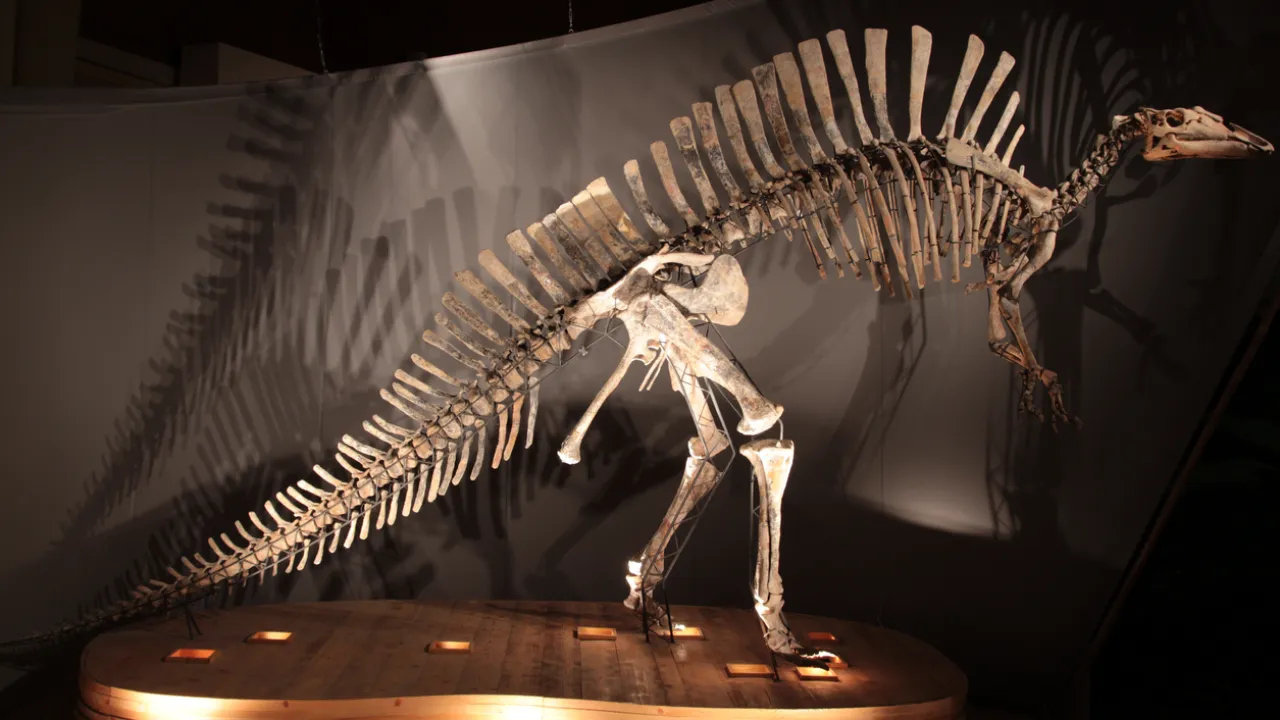
⚡ Survival SuperpowerTwo-foot neural spine ridge forming a dramatic back sail or energy hump, paired with bony thumb spikes
🤯 Mind-Blowing Fact • Grade 1
Today its fossils lie in the hot, dry Sahara Desert, which used to be lush and green with giant rivers!
✨ Word Sparks (Grade 1 Glossary)
Tap 🔊 to hear
ridge
a long, raised strip along a back
spike
a stiff, pointed piece for protection
lush
full of thick, green growing plants
🪝
What plant-eating dinosaur wore a tall sail down its back AND sharp spikes on its thumbs?
1
Sail or Hump?
Look at that tall rising along its back! Ouranosaurus lived beside warm rivers in Africa long ago. Tall bones held up either a bright skin sail or a thick hump.
2
Flat Duck Snout
Its long face ended in a wide, flat beak. Swipe, munch! It scooped up soft river weeds, ferns, and low leaves.
3
Spiky Thumbs
Look at its hands! Each thumb had a pointy bone cone to poke away hungry predators or crack tough fruit.
Each hand of Ouranosaurus acted like a multi-tool, with hooves for walking, spikes for defense, and bendy pinkies for grasping leaves!
✨ Word Sparks (Grade 2 Glossary)
Tap 🔊 to hear
spine
a tall bony prong rising from backbones
bison
a large shaggy mammal with shoulder muscles
grasp
to wrap fingers around and hold tightly
🪝
Why did several different dinosaurs in ancient Africa all grow tall sails along their backs?
1
Green Rivers of Ancient Africa
Splash through a wide, sunny river in North Africa 115 million years ago! Long before sand dunes covered the Sahara, tall conifers and fern meadows lined deep waterways. Here walked Ouranosaurus, a twenty-five-foot plant-eater whose name means brave monitor lizard.
2
Mystery of the Tall Back Bones
Bony two feet tall stood straight up from its neck all the way down its tail! Some scientists picture a colorful skin sail for showing off and cooling down. Others think the bones supported a muscular hump like an American .
3
Clever Hands
Each hand had a spiky thumb, three middle hooves for walking, and a bendy pinky finger for grabbing leafy branches!
1. What could the flexible fifth finger of Ouranosaurus do?
2. What two ideas do scientists have about the tall back bones of Ouranosaurus?
🤯 Mind-Blowing Fact • Grade 3
Two other dinosaurs living in the very same African river system—Suchomimus and Nigersaurus—also evolved unusual back ridges or specialized necks for thriving in hot floodplains!
✨ Word Sparks (Grade 3 Glossary)
Tap 🔊 to hear
drought
a long dry spell with little rain
excavation
careful scientific digging to uncover buried fossils
crocodile
a large semi-aquatic reptile with long jaws
🪝
What happened when French paleontologist Philippe Taquet explored a remote African fossil bed called Gadoufaoua?
1
Brave Lizard of the Desert
Imagine standing under blazing desert sun in Niger while sand blows off two almost complete dinosaur skeletons! Between 1965 and 1972, paleontologist Philippe Taquet excavated a remarkable plant-eater from the Elrhaz Formation and named it Ouranosaurus nigeriensis, honoring a local Tuareg word meaning brave desert monitor.
2
Half Iguanodon, Half Duck-Bill
At first glance, Ouranosaurus looks like two dinosaurs blended together. Its body and spiky thumbs resemble older iguanodontians, yet its long, flat snout flares wide like later duck-billed dinosaurs! Two small bumps between its eyes and nostrils added extra flair.
3
Living Among River Giants
Ancient Gadoufaoua teemed with giant neighbors, including the -snouted predator Suchomimus and the forty-foot crocodilian Sarcosuchus. Staying alert along muddy riverbanks was essential!
4
Beating Seasonal Droughts
If its tall neural spines supported a camel- or bison-like hump, stored fat and muscle could have fueled long marches whenever dry seasons withered riverside plants.
1. Why does the head of Ouranosaurus surprise people who see its thumb spikes?
2. Which giant river predator shared ancient Niger with Ouranosaurus?
🤯 Mind-Blowing Fact • Grade 4
In the Tuareg language, Gadoufaoua—where Ouranosaurus was found—means 'the place where camels fear to go' because fossils litter the harsh desert floor!
✨ Word Sparks (Grade 4 Glossary)
Tap 🔊 to hear
diastema
a toothless gap between beak and cheek teeth
prehensile
able to bend around and grasp objects
neural
relating to the arch atop a backbone
🪝
Why do paleontologists think the famous back spines of Ouranosaurus looked closer to an American bison than a thin lizard fin?
1
Oasis of the Early Cretaceous
Travel back 115 million years to Gadoufaoua in central Niger—a Tuareg name meaning the place where camels fear to tread. Today wind-sculpted sandstone stretches to every horizon, yet during the Aptian stage of the Early Cretaceous, braided rivers watered lush floodplains. Across those sunlit flats strode Ouranosaurus nigeriensis, an eight-meter hadrosauriform ornithopod weighing up to three and a half tons.
2
Sail Versus Muscular Hump
Rising up to sixty centimeters above its vertebrae, a continuous wall of thick, flattened spines ran from the base of its neck onto its tail, peaking right above the forelimbs. In 1997, paleontologist Jack Bailey noted that these stout, tendon-scarred spines resemble the shoulder spines of Ice Age bison far more closely than the slender rods of sail-backed reptiles, suggesting a muscular or fat-storing hump that sustained Ouranosaurus through dry seasons.
3
Specialized Low-Browsing Skull
Its elongated skull featured a broad, toothless keratinous beak separated from cheek tooth rows by a wide gap called a . Paired with hinged upper jaws and fleshy cheeks, this arrangement let Ouranosaurus strip horsetails and ferns efficiently near ground level.
4
Multi-Purpose Forelimbs
Walking comfortably on either four legs or two, Ouranosaurus retained classic iguanodontian hands: a conical thumb spike, three hoofed central digits, and a fifth finger.
1. Why did paleontologist Jack Bailey compare Ouranosaurus back spines to an American bison?
2. What was the diastema in the mouth of Ouranosaurus?
🤯 Mind-Blowing Fact • Grade 5
Bone-slice studies of Ouranosaurus reveal distinct seasonal growth rings, reflecting annual wet and dry cycles across North Africa 115 million years ago!
✨ Word Sparks (Grade 5 Glossary)
Tap 🔊 to hear
spatulate
broad and flat with a rounded tip
pollex
the innermost first digit or thumb
adipose
body tissue specialized for storing energy fat
🪝
How does Ouranosaurus bridge the evolutionary gap between thumb-spiked iguanodontians and true duck-billed dinosaurs?
1
Unearthing Gadoufaoua's Ornate Herbivore
Between 1965 and 1972, French paleontologist Philippe Taquet led grueling expeditions into the Tenere Desert of Niger, excavating Aptian-age sandstones of the Elrhaz Formation at Gadoufaoua. Two exceptionally complete skeletons revealed an extraordinary Early Cretaceous herbivore formally named Ouranosaurus nigeriensis in 1976. Measuring roughly 7.3 to 8.3 meters in length and three metric tons in mass, the species quickly became a centerpiece for understanding Gondwanan ornithopod diversity.
2
Mosaic Anatomy in Hadrosauriformes
Ouranosaurus displays a textbook evolutionary mosaic within basal Hadrosauriformes. Postcranially, its forelimbs preserve ancestral iguanodontian hallmarks: a fused wrist block, weight-bearing hooves on digits two through four, a flexible grasping fifth digit, and a shortened conical spike on each thumb. Cranially, however, its elongated rostrum flares into a , duck-like bill separated by a long diastema from interlocking cheek teeth—foreshadowing Late Cretaceous hadrosaurids.
3
Biomechanics of the Dorsal Axial Sail
Its defining anatomical trait is an unbroken series of hypertrophied neural spines extending across the dorsal, sacral, and anterior caudal vertebrae, reaching heights over half a meter above the centrum. Ossified tendons bound these broad blades together, stiffening the trunk during quadrupedal and bipedal strides while supporting either a vascularized display sail for visual signaling and thermoregulation or an -muscular hump analogous to modern bison, storing energy reserves across seasonal monsoonal droughts.
4
Cranial Bumps and Slow-Paced Growth
Paired nasal prominences rose just ahead of the orbits, likely sheathed in keratin for intraspecific display. Recent bone-histology analyses indicate steady, seasonally modulated growth suited to fluctuating semi-arid floodplains.
5
Sharing Niger's Megafaunal Waterways
Browsing alongside the lawnmower-mouthed sauropod Nigersaurus while evading the spinosaurid Suchomimus, the carcharodontosaurid Eocarcharia, and giant pholidosaurid crocodylomorph Sarcosuchus, Ouranosaurus thrived as a resilient keystone browser of Early Cretaceous Africa.