🦴 PREHISTORIC
🦴 Ornithomimus velox • Ornithomimidae
VA Science SOL 2.5, 3.4, 3.5, 5.8 (Fossils, Adaptations & Earth History)
Ornithomimus
Feathered Ostrich-Speed Sprinter of the Cretaceous
Grade 1 • Early Reader • 59 words
🌋 Geologic Period & RegionLate Cretaceous (76–66 MYA) • Western North America
📏 Size & Weight12 ft (3.7 m) long • 350 lbs (160 kg)
🦴 Diet & FossilsOmnivore & Herbivore • Dinosaur Park & Hell Creek Formations
⚡ Survival SuperpowerForty-mile-per-hour ostrich sprint speed and adult feathered arm fans
🤯 Mind-Blowing Fact • Grade 1
Ornithomimus could sprint nearly 40 miles per hour—making it one of the very fastest dinosaurs that ever lived!
✨ Word Sparks (Grade 1 Glossary)
Tap 🔊 to hear
ostrich
Tall, super-fast flightless bird from Africa
balance
Staying steady without tipping or falling over
outsmart
To escape or win by being quick and clever
🪝
Which dinosaur could race as fast as a car on a neighborhood street?
1
Zoom Like an Ostrich!
Whoosh! Dust flies across a sunny plain as a long-legged runner zooms past! Ornithomimus means bird mimic. It looked remarkably like a modern with a long balancing tail!
2
Fluffy Coat, Fancy Wings
Fluffy feathers covered its body. Grown-up Ornithomimus also grew long, showy wing feathers on their arms!
3
Fastest Feet Around
Racing up to forty miles per hour, it outran big hunters like T. rex!
2. How did Ornithomimus stay safe from big predators like T. rex?
🤯 Mind-Blowing Fact • Grade 2
Fossil skin from Alberta showed Ornithomimus had bare, unfeathered lower legs just like modern ostriches so it wouldn't overheat during long sprints!
✨ Word Sparks (Grade 2 Glossary)
Tap 🔊 to hear
quill
Hollow main shaft of a large stiff feather
overheat
To become too hot during hard exercise
bound
To leap forward in long, springy strides
🪝
Why did baby Ornithomimus wear fuzzy coats while grown-ups grew fancy arm wings?
1
Ostrich of the Dinosaur Age
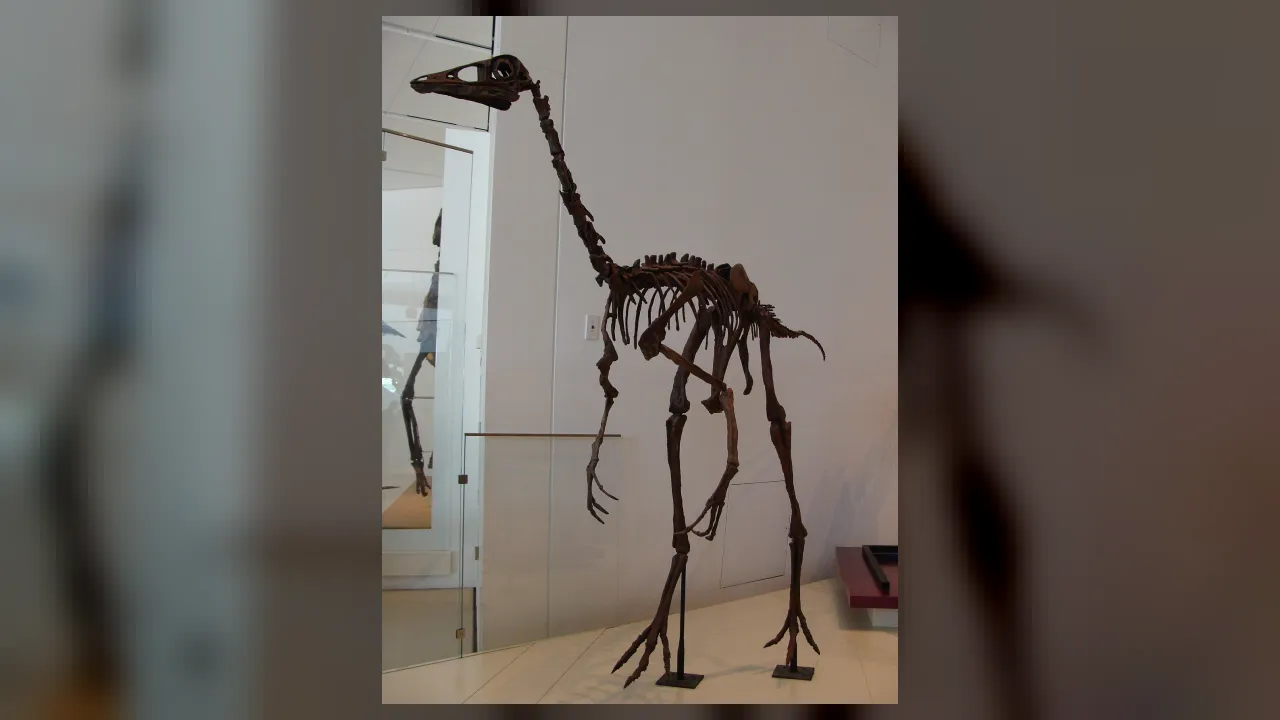
Imagine watching a herd of graceful, twelve-foot dinosaurs bounding across ancient Alberta and Montana 70 million years ago! Named Ornithomimus velox—meaning 'swift bird mimic'—in 1890, this 350-pound runner had huge eyes, a slender neck, a toothless beak, and super-long shins and feet.
2
Growing Into Adult Wing Fans
In 2012, Canadian fossils preserved black feather marks right on Ornithomimus skeletons! Cute youngsters wore short, fuzzy down all over, while only adults grew long feathers along their arms to wave at mates or shade nests.
3
Three Equal Fingers
Unusual among dinosaurs, all three fingers on each hand grew the exact same length, forming a neat hook for pulling leafy branches close!
1. Why did only adult Ornithomimus grow long quill feathers on their arms?
2. What was special about the three fingers on Ornithomimus's hands?
🤯 Mind-Blowing Fact • Grade 3
Ornithomimus fossils unearthed in Alberta in 2012 became the very first feathered non-bird dinosaurs ever discovered anywhere in North or South America!
✨ Word Sparks (Grade 3 Glossary)
Tap 🔊 to hear
quill knob
Small bump or scar on arm bone anchoring flight-style feathers
gizzard stone
Smooth swallowed pebble helping a toothless stomach grind plants
crustacean
Shelled water animal such as crayfish or shrimp
🪝
Why were North America's fastest ostrich-dinosaurs covered in feathers on top but bare-legged below?
1
Built for Blazing Speed
Tall grasses hadn't spread across meadows yet 70 million years ago, so fern plains and riverbanks stretched wide across Alberta and Colorado. Racing effortlessly at forty miles per hour comes Ornithomimus velox, named by paleontologist Othniel Charles Marsh in 1890. Every bone in its 160-kilogram frame screamed speed: hollow vertebrae, high hip muscles, shins twenty percent longer than its thighs, and shock-absorbing pinched foot bones!
2
Alberta's Feathered Breakthrough
Before 2012, almost all feathered dinosaurs came from fine lake mud in China. Then paleontologist Darla Zelenitsky's team unveiled three Ornithomimus skeletons from sandstone in Alberta—the first feathered dinosaurs ever discovered in the Western Hemisphere! Juveniles wore fluffy filaments, whereas adults developed dark along their forearms anchoring showy wing fans called pennibrachia.
3
Built-In Ostrich Cooling System
Another incredible fossil in 2015 preserved skin and tail plumes, revealing bare, scaly skin from mid-thigh downward—shedding excess sprint heat exactly like living ostriches!
4
Comb-Like Beak and Gizzard Stones
Fine vertical ridges inside its keratin beak snipped leaves, seeds, insects, and pond , ground smooth by swallowed .
1. Why were the 2012 Ornithomimus fossils from Alberta a landmark discovery?
2. How did bare skin on its lower thighs and shins help Ornithomimus?
🤯 Mind-Blowing Fact • Grade 4
Ornithomimus shared the EXACT same pinched middle-foot-bone shock absorber (arctometatarsus) as T. rex—evolving independently in predator and prey for high-speed chases!
✨ Word Sparks (Grade 4 Glossary)
Tap 🔊 to hear
pennibrachia
Wing-like feathered dinosaur arms too small for flying
lamellae
Tiny comb-like ridges lining a duck's or ornithomimid's beak
thermal window
Unfeathered skin patch radiating extra body heat away
🪝
What does it mean when a dinosaur grows big feathered wings ONLY after it becomes a teenager?
1
Fleet-Footed Survivor of Laramidia
Picture the lush river deltas of Late Cretaceous Alberta and Montana from 76 to 66 million years ago, shared with horned ceratopsids and prowling Albertosaurus and Tyrannosaurus. Gliding swiftly across open sandbars in alert flocks is Ornithomimus, a 3.7-meter ornithomimid whose big scleral-ringed eyes scanned horizons both day and dusk while its stiffened tail balanced hairpin turns at speeds topping sixty kilometers per hour.
2
Delayed Wing Development Proves Display
In 2012, Darla Zelenitsky, François Therrien, and colleagues published a game-changing study in Science examining a juvenile and two adult Ornithomimus edmontonicus specimens from Alberta's Dinosaur Park and Horseshoe Canyon formations. While both youngsters and adults wore five-centimeter hair-like body filaments, only adults bore rows of carbonized quill markings along the ulna! Because flying birds grow wing feathers early in youth, delayed adult-only '' proved wings originally evolved in ornithomimosaurs for courtship displays and egg brooding rather than flight!
3
Thermoregulatory Plumage Windows
In 2015, paleontologist Aaron van der Reest described an exquisite specimen preserving curved tail plumes alongside bare, unfeathered skin below the mid-femur and a fleshy skin web behind the knee—matching the exact convective cooling '' of modern African ostriches.
4
Hook-Handed Browser and Strainer
Fossilized keratin beaks preserve fine comb-like along the jaw margins, letting Ornithomimus snip tender horsetails, fruits, and aquatic invertebrates pulled within reach by its equal-length, sloth-like three-fingered hands.
1. Why did finding wing feathers on adult Ornithomimus—but NOT on juveniles—prove those wings evolved for display or brooding rather than flight?
2. Which foot structure evolved independently in both Ornithomimus and tyrannosaurids for sprint speed?
🤯 Mind-Blowing Fact • Grade 5
By proving planar 'wings' evolved first in non-flying ornithomimosaurs exclusively at adulthood, Ornithomimus became textbook proof of 'exaptation'—when evolution builds a trait for display first and repurposes it for flight millions of years later!
✨ Word Sparks (Grade 5 Glossary)
Tap 🔊 to hear
exaptation
Evolution repurposing an existing trait for a brand-new function
fluvial
Deposited by flowing river currents rather than calm lakes
Laramidia
Ancient island continent forming western North America during Late Cretaceous
🪝
How did Canadian sandstone fossils of Ornithomimus rewrite both the taphonomy of plumage preservation and the evolutionary origin of wings?
1
Benchmark of the 'Ostrich Dinosaurs'
First established by Othniel Charles Marsh in 1890 from Maastrichtian foot and hand bones discovered near Denver, Colorado (Ornithomimus velox), and richly represented by Campanian–Maastrichtian skeletons from Alberta's Dinosaur Park and Horseshoe Canyon formations (O. edmontonicus), Ornithomimus defines the hyper-cursorial clade Ornithomimidae. Measuring roughly 3.7 meters long and weighing 150 to 170 kilograms, it survived across right up to the end-Cretaceous extinction 66 million years ago.
2
Breaking the Fluvial Sandstone Barrier
For decades, paleontologists assumed delicate plumage fossilized only inside anoxic, fine-grained lacustrine mudstones like Solnhofen or Liaoning. In October 2012, Darla Zelenitsky, François Therrien, and colleagues shattered that paradigm in Science by documenting carbonized filamentous protofeathers and ulnar quill attachments on three Ornithomimus skeletons preserved in coarse channel sandstones in Alberta—the first feathered non-avian dinosaurs discovered in the Americas.
3
Ontogenetic Pennibrachia and Exaptation
Crucially, while juvenile specimen TMP 2009.110.1 wore simple filamentous body down alone, adult specimen TMP 1995.110.1 exhibited seventy-plus elongate, rigid feather-shaft scars along its ulna forming wing-like 'pennibrachia.' Because ornithomimosaurs branched basal to Maniraptora and could never fly, this adult-onset ontogeny demonstrated that planar forelimb wings originated via socio-sexual display and clutch brooding—later exapted for aerodynamics in paravians!
4
Ratite-Convergent Thermoregulation
In 2015, Aaron van der Reest and colleagues described specimen UALVP 52531 preserving three-dimensional plumulaceous torso coats, sweeping caudal plumes, and completely bare skin below the mid-thigh with a post-femoral skin web—replicating modern Struthio (ostrich) evaporative and convective heat-dumping windows during sixty-kilometer-per-hour sprints.
5
Craniodental Herbivory and Hooked Metacarpals
Equipped with equal-length metacarpals I–III forming a branch-hooking grapple, gastrolith-lined gizzards, and keratinous rhamphothecae ribbed with fine vertical lamellae, Ornithomimus browsed horsetails, fruits, and littoral invertebrates.