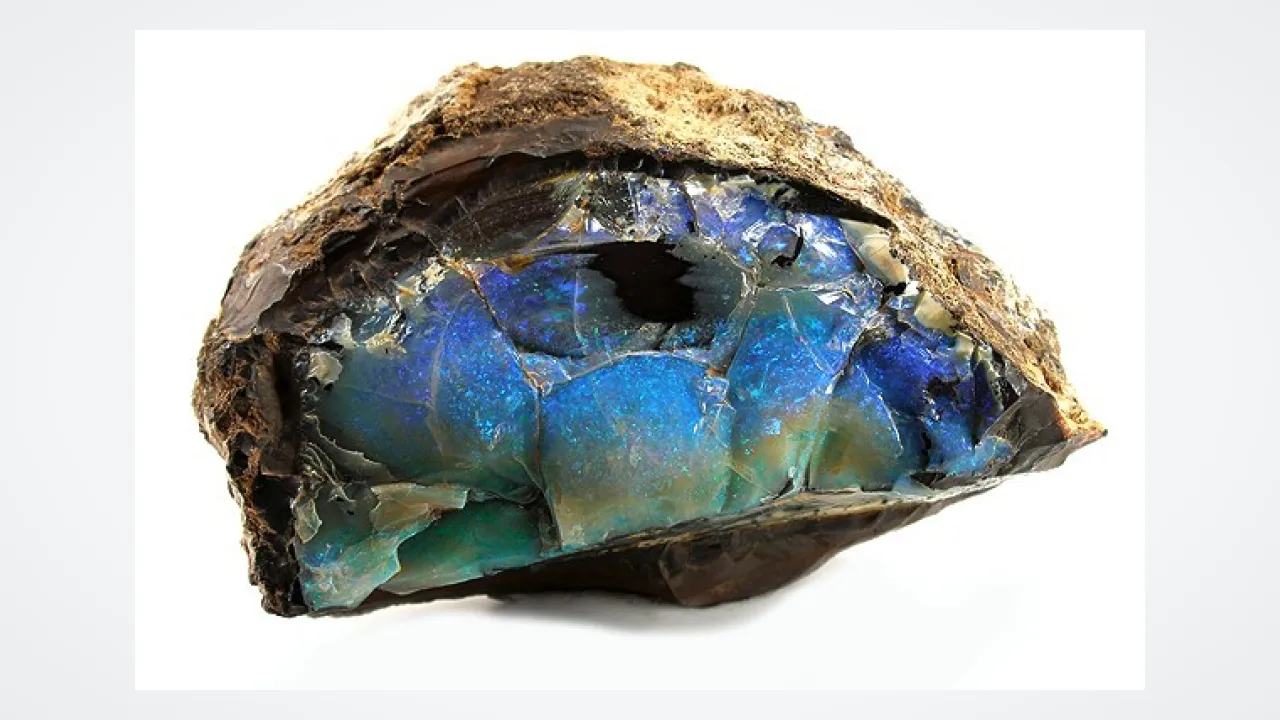
1. What happens when you tilt a precious opal in the light?
2. What surprising liquid is still trapped inside every natural opal?
🤯 Mind-Blowing Fact • Grade 2
In Australia, miners have discovered whole fossil seashells, pinecones, and dinosaur bones turned completely into shimmering rainbow opal!
✨ Word Sparks (Grade 2 Glossary)
Tap 🔊 to hear
sphere
A perfectly round ball shape
fossil
Ancient plant or animal remains turned to stone
mineraloid
A natural rock material without crystal structure
🪝
How can ancient sea creatures in a desert turn into glowing rainbow fossils?
1
Stacked Like Tiny Marbles
Imagine filling a clear jar with millions of neat, identical microscopic glass marbles. Inside a precious opal, tiny of silica stack in tidy rows that split white light into shifting rainbow colors!
2
Australia's Ancient Inland Sea
One hundred million years ago, a cool shallow sea covered central Australia. After the sea dried into red desert Outback, silica-rich groundwater seeped into cracks—and even filled hollow shells and dinosaur bones with rainbow opal!
3
Not Quite a True Crystal
Because opal is built from round mixed with water instead of flat-sided crystals, geologists call it a '.' NASA rovers have even spotted opal on Mars, proving ancient water once flowed there!
1. Why do geologists call opal a 'mineraloid' instead of a true mineral?
2. Why were NASA scientists excited to find opal on the planet Mars?
🤯 Mind-Blowing Fact • Grade 3
Some volcanic opals from Ethiopia are 'hydrophane'—soak one in a cup of water and it turns clear like glass, then gets its rainbow flash back as it dries!
✨ Word Sparks (Grade 3 Glossary)
Tap 🔊 to hear
play-of-color
Shifting rainbow flashes seen as opal tilts
diffraction
Splitting light waves through tiny regular gaps
Outback
The vast dry inland region of Australia
🪝
Why do some opals flash fiery red rainbows while others only flash cool blue and green?
1
Size Controls the Rainbow!
Until electron microscopes zoomed in 40,000 times in the 1960s, nobody knew how opal made its '.' Scientists saw millions of tiny silica spheres stacked like oranges at a grocery store! Small spheres bounce back short blue and violet light waves, while slightly larger spheres bounce back long fiery red and orange waves.
2
Precious Opal Versus Common Opal
If the silica spheres are all different sizes or jumbled messily together, light scatters evenly without rainbow flashes. Geologists call those smooth pastel stones 'common opal' or 'potch.'
3
Australian Black Opal and Ethiopian Hydrophane
Lightning Ridge in Australia produces rare 'black opal,' where dark rock underneath makes rainbow colors pop like neon signs! Meanwhile, volcanic opals from Ethiopia can soak up water like a tiny sponge, turning clear until they dry out again.
4
Handle With Care
With a Mohs hardness of 5.5 to 6.5 and up to ten percent water by weight, opal is softer than quartz dust and prefers steady humidity away from extreme heat.
1. What determines whether a precious opal can flash rare red light instead of only blue light?
2. What happens if an opal's microscopic silica spheres are jumbled in uneven sizes?
🤯 Mind-Blowing Fact • Grade 4
In the Australian opal town of Coober Pedy, more than half the residents live in naturally cool homes carved underground into sandstone hillsides!
✨ Word Sparks (Grade 4 Glossary)
Tap 🔊 to hear
amorphous
Lacking an ordered repeating atomic crystal lattice
nanometer
One billionth of a meter in size
precipitate
To settle out of liquid as solid particles
🪝
How did underground miners beat 120-degree desert heat in Australia's opal capital by building whole towns underground?
1
Diffraction Grids Built by Groundwater
Unlike quartz—even though both are made of silica—opal (SiO2·nH2O) never locks its atoms into a rigid crystal lattice. Instead, seasonal desert rains dissolve silica from weathered sandstone or volcanic ash and carry it downward into clay-lined faults. As groundwater slowly evaporates over hundreds of thousands of years, silica into submicroscopic spheres 150 to 300 wide. Settling by gravity into three-dimensional hexagonal grids, the tiny gaps between spheres diffract white light into shifting spectral colors!
2
Living Underground in Coober Pedy
In South Australia's Coober Pedy—where summer desert temperatures soar past 115 degrees Fahrenheit—opal miners carved cool underground homes called 'dugouts' straight into the pale sandstone hillsides, discovering new opal seams right in their living-room walls!
3
Opalized Marine Reptiles
During the Cretaceous Period, Australia's Eromanga Sea teemed with plesiosaurs, ammonites, and freshwater mussels. When shells and bones decayed in clay sediment, silica gel filled the exact molds, creating priceless rainbow fossils such as 'Eric the Pliosaur.'
4
Why Virginia Classifies Opal Carefully
In Earth science mineral labs, students learn that a true mineral must be naturally occurring, inorganic, solid, have a definite chemical formula, and possess an ordered atomic structure. Because opal's water content varies from 3 to 20 percent and its silica is , it is Earth's most famous gem mineraloid!
1. Which two mineral rules prevent opal from being classified as a true crystalline mineral?
2. How wide are the uniform silica spheres that diffract visible rainbow colors in precious opal?
🤯 Mind-Blowing Fact • Grade 5
Ordinary lawn grass and bamboo armor their leaves with microscopic grains of biogenic opal called phytoliths to make them tougher for hungry insects to chew!
How does precious opal act as a natural photonic crystal—the exact same optical physics seen on morpho butterfly wings?
1
Photonic Crystals and Bragg Diffraction
Shine white light onto a red ruby and chemical chromophores absorb green wavelengths; shine light onto precious opal and zero pigment is required! In 1964, Australian CSIRO scientists John Sanders and PJ Darragh used electron microscopy to reveal that precious opal is a natural three-dimensional composed of uniform amorphous silica spheres (150 to 300 nanometers in diameter) packed in face-centered cubic or hexagonal arrays. Governed by Bragg's Law, light waves reflecting off successive layers of spheres interfere constructively: 150-nanometer spheres diffract only short 400-nanometer violet-blue light, whereas 300-nanometer spheres diffract up to 700-nanometer crimson alongside every shorter color as viewing angle shifts.
2
Opal-A, Opal-CT, and Diagenetic Aging
Mineralogists subdivide opaline silica by X-ray diffraction signatures. Australian sedimentary precious opals are predominantly Opal-A (wholly amorphous spheres), whereas volcanic opals from Ethiopia's Wollo province, Mexico's fire opal veins, and Nevada's Virgin Valley fossil wood beds are typically Opal-CT—containing nanoscale clusters of cristobalite and tridymite blades. Over tens of millions of years of burial, unstable opal gradually dehydrates and recrystallizes into microcrystalline quartz (chert or chalcedony).
3
Acidic Weathering of the Great Artesian Basin
Why does Australia host over 90 percent of Earth's gem-quality black and white opal? During Early Cretaceous regression of the Eromanga Sea, pyrite-rich marine mudstones oxidized near the surface, generating sulfuric acid that weathered feldspar sands into kaolinite clay and liberated vast quantities of dissolved silicic acid above an impermeable claystone barrier.
4
Biogenic Opal on Land and Sea
Living organisms precipitate billions of tons of common Opal-A every year! Microscopic ocean algae called build intricate glassy shells of opaline silica, while prairie grasses pack microscopic opal into their blades to wear down grazing teeth.
5
Martian Paleoclimate Archives
Orbital spectrometers and NASA's Spirit and Curiosity rovers mapped extensive opaline silica halos along fractures in Gusev and Gale craters on Mars—preserving potential biosignatures from Mars's final wet epochs.