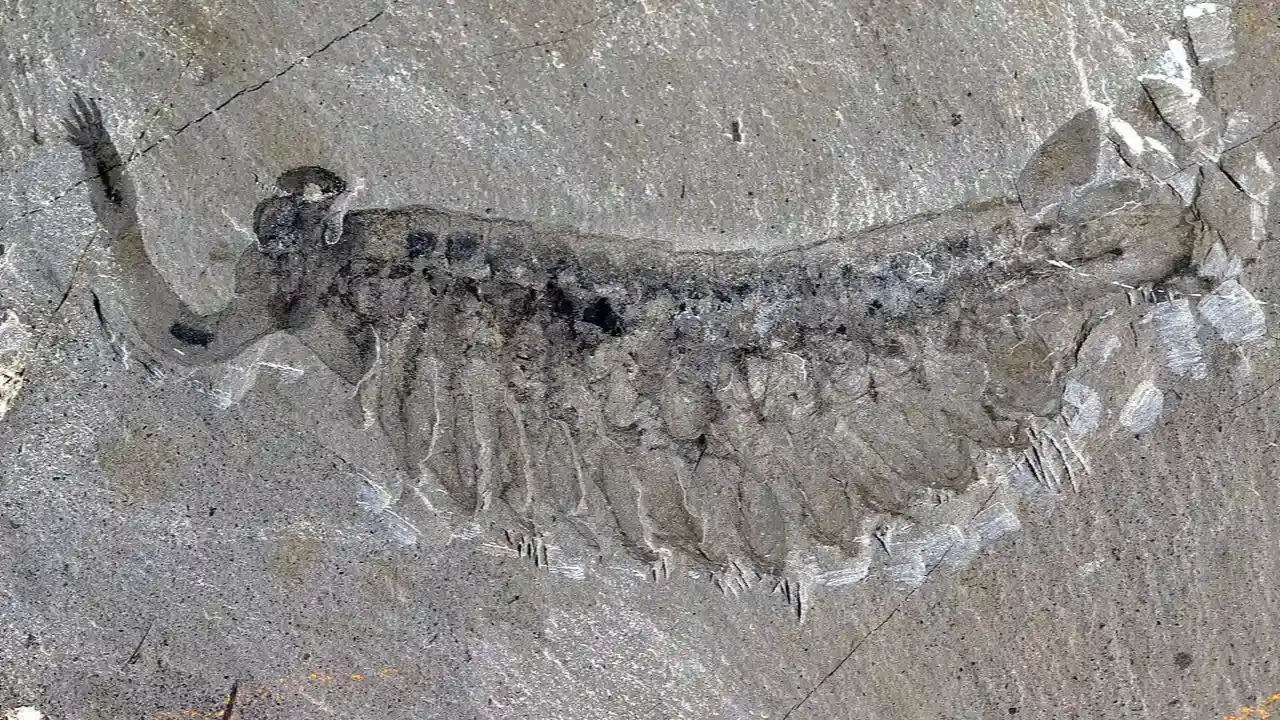
⚡ Survival SuperpowerFive mushroom-shaped compound eyes and a flexible claw-tipped vacuum trunk
🤯 Mind-Blowing Fact • Grade 1
When scientists first showed a drawing of five-eyed Opabinia at a big science meeting in 1972, the whole room burst out laughing because they thought it was a joke!
✨ Word Sparks (Grade 1 Glossary)
Tap 🔊 to hear
bendy
Easy to curve, twist, and flex
trunk
Long flexible nose tube used for grabbing
burrow
Cozy tunnel dug down into soft mud
🪝
What tiny ocean creature looked around with FIVE eyes and a grabber nose?
1
Count Those Eyes!
One, two, three, four, FIVE! Five little eyes popped up on top of its head! Meet Opabinia, a finger-sized sea swimmer.
2
Vacuum-Hose Nose
Look at its long, snout! At the tip sat sharp grabber claws that pinched soft mud worms.
3
Tucked-Under Mouth
Its curled right back under its chin to pass yummy snacks into its mouth!
2. What sat at the very tip of Opabinia's bendy snout?
🤯 Mind-Blowing Fact • Grade 2
Fewer than forty complete Opabinia fossils have ever been found, making it one of the rarest treasures of the Burgess Shale!
✨ Word Sparks (Grade 2 Glossary)
Tap 🔊 to hear
proboscis
A flexible snout or tube-shaped nose
reconstruction
Science model showing how a fossil lived
unveiled
Showed something exciting for the first time
🪝
Why did a roomful of paleontologists giggle when they saw the first accurate drawing of Opabinia?
1
The Fossil That Made Scientists Laugh
Picture an animal the length of your pinky finger with five stalked eyes, side swimming flaps, a fan tail, and a vacuum-cleaner hose growing off its face! When paleontologist Harry Whittington his careful of Opabinia in 1972, scientists laughed out loud—thinking he had invented a cartoon monster!
2
Probing Muddy Burrows
Living 508 million years ago in Canada's Burgess Shale sea, Opabinia glided smoothly just above the seafloor by waving fifteen pairs of side flaps. Its flexible —twice as long as its head—poked into soft mud burrows to pinch hidden worms!
3
Backward-Facing Mouth
Because its mouth sat underneath its head facing backward, that bendy trunk worked like a built-in dinner fork!
1. Why did Opabinia need its flexible proboscis to bend backward underneath its head?
2. About how big was a full-grown Opabinia?
🤯 Mind-Blowing Fact • Grade 3
Opabinia's weird grabber trunk actually formed when a pair of left and right front arms fused together into a single flexible hose!
✨ Word Sparks (Grade 3 Glossary)
Tap 🔊 to hear
crustacean
Shell-wearing arthropod group like shrimp and crabs
fused
Joined together into one single piece
gills
Feathery organs that absorb oxygen underwater
🪝
How did five compound eyes and fifteen pairs of flaps turn Opabinia into a 360-degree hovering hunter?
1
Named After an Alpine Mountain Pass
High in the Canadian Rockies of British Columbia, explorer Charles Doolittle Walcott split open dark shale in 1912 and named a strange fossil Opabinia regalis—meaning 'royal Opabin' after nearby Opabin Pass. For sixty years, textbooks assumed it was just an ordinary gill-breathing .
2
Dissecting Thin Stone Layers
Then Cambridge professor Harry Whittington gently chipped away microscopic flakes of rock using tiny dental needles under a microscope! Layer by layer, he revealed zero hard shell, fifteen pairs of overlapping side lobes fringed with delicate , and three upward-tilted tail blades shaped like airplane stabilizers.
3
Five Eyes Watching Every Angle
Two large eyes on outer stalks scanned left and right, two more peered upward and forward, and a fifth eye sat right in the middle! If giant Anomalocaris swooped down from above, Opabinia spotted the shadow instantly.
4
Two Arms Fused Into One Nozzle!
Scientists realized Opabinia's wrinkly, hollow-muscled proboscis evolved when two front arthropod-like grabber arms together down the middle—leaving twin spiny claws at the very tip!
1. How did scientists figure out where Opabinia's strange single proboscis came from?
2. How did five eyes facing different directions help small Opabinia survive?
🤯 Mind-Blowing Fact • Grade 4
After standing completely alone for 110 years, Opabinia finally got an official five-eyed sibling in 2022 named Utaurora comosa from Utah's Wheeler Shale!
✨ Word Sparks (Grade 4 Glossary)
Tap 🔊 to hear
body plan
Basic structural blueprint of an animal group
cuticle
Protective outer skin layer on invertebrates
stem branch
Extinct early cousins leading toward modern groups
🪝
Why did Opabinia stay completely alone in its family tree for a hundred years—until a fossil hidden in Utah joined it?
1
Whittington's 1975 Paleontological Revolution
Before the 1970s, biologists tried shoehorning every Cambrian fossil into modern animal groups like shrimp or jellyfish. Harry Whittington's painstaking three-dimensional micro-dissection of Opabinia regalis in 1975 shattered that tidy habit forever! Measuring four to seven centimeters long with an unmineralized , five mushroom-stalked compound eyes, a fused claw-tipped proboscis, and fifteen pairs of gill-bearing lateral lobes, Opabinia proved early evolution experimented boldly with !
2
Cousin to Radiodonts and True Arthropods
Wait—was Opabinia an alien dead end with zero relatives? Not at all! Closer inspection revealed tiny triangular lobopod-like walking pads tucked underneath its lateral swimming flaps, plus a V-shaped tail fan remarkably like Anomalocaris! Paleontologists realized Opabinia sat right beside radiodonts on the lower leading toward modern jointed-legged arthropods.
3
No Longer Lonely: Enter Utaurora!
For over a century after 1912, Opabinia regalis was the ONLY confirmed opabiniid fossil on planet Earth! Then in 2022, paleontologist Stephen Pates and colleagues re-examined a puzzling five-eyed, spiky-tailed Cambrian fossil collected in Utah decades earlier. Naming it Utaurora comosa, they finally gave Opabinia a true sister genus millions of years younger!
4
Benthic Vacuum-Claw Foraging
Ringed with circular fluid-filled muscles like an elephant's trunk or squid tentacle, Opabinia's flexible proboscis probed flocculent seafloor sediment, pinching annelid worms with five-spined terminal claws and curling ventrally to feed its rear-facing mouth.
1. How did Harry Whittington's 1975 study of Opabinia change paleontology?
2. What major discovery in 2022 proved Opabinia wasn't the only member of its family?
🤯 Mind-Blowing Fact • Grade 5
Evo-devo scientists studying modern insect embryos found that the tiny 'upper lip' (labrum) of every ant, bee, and crab today may trace back to fused front appendages just like Opabinia's trunk!
✨ Word Sparks (Grade 5 Glossary)
Tap 🔊 to hear
hydrostatic
Supported and moved by internal fluid pressure
homologous
Body parts inherited from a shared ancestor
evo-devo
Science linking embryo growth to animal evolution
🪝
How does Opabinia's fused muscular proboscis illuminate the evolutionary origin of the arthropod labrum and head?
1
Micro-Stratigraphic Dissection of a Burgess Icon
First collected by Charles Doolittle Walcott in 1912 from the Phyllopod Bed of British Columbia's Burgess Shale ( ~508 MYA) and misclassified as an anostracan branchiopod crustacean, Opabinia regalis catalyzed modern Cambrian paleobiology when Harry Whittington published his 1975 monograph. Excavating through sub-millimeter aluminosilicate compression laminae revealed different burial angles (parallel, oblique, and lateral), reconstructing a soft-bodied swimmer whose unorthodox features famously drew laughter at a 1972 Oxford symposium before revolutionizing evolutionary developmental biology ().
2
Hydrostatic Proboscis and Labrum Homology
Extending up to a third of body length from the ventral cephalon, Opabinia's annulated, fluid-filled proboscis terminated in a bifurcated grasping claw armed with paired inward-facing spines. Developmental geneticists and paleontologists recognize this single nozzle as to fused protocerebral frontal appendages—shedding critical light on how ancestral paired limbs fused along the midline to form the upper lip (labrum) of modern euarthropods!
3
Pentameral Visual Array and Locomotor Apparatus
Atop the head sat two pairs of stalked lateral-dorsal compound eyes plus one median sessile compound eye, wired to inspect bright downwelling light for overhead radiodont predators while scanning benthic substrates. Propulsion combined fifteen pairs of overlapping lateral swimming flaps—bordered dorsally by lamellate setal blades functioning as gills and underlain ventrally by tiny clawed lobopod limbs—steered by a three-bladed dorsoposterior caudal fan.
4
Phylogenetic Placement Near Radiodonta
Once hailed by Stephen Jay Gould in Wonderful Life (1989) as an unclassifiable 'weird wonder' phylum unto itself, cladistic matrices compiled by Graham Budd, Allison Daley, and Joanna Wolfe positioned Opabiniidae right alongside Radiodonta at the base of the total-group Euarthropoda ladder—sharing swimming flaps, caudal fans, and stalked compound eyes while retaining soft lobopods.
5
Expanding Opabiniidae With Utaurora
In 2022, phylogenetic Bayesian and parsimony analyses by Stephen Pates, Joanna Wolfe, and colleagues elevated a previously enigmatic Drumian fossil from Utah's Wheeler Formation (~504 MYA) as Utaurora comosa. Sharing five compound eyes, intersegmental furrows, and serrated caudal blades, Utaurora confirmed Opabiniidae formed a persistent Laurentian clade.