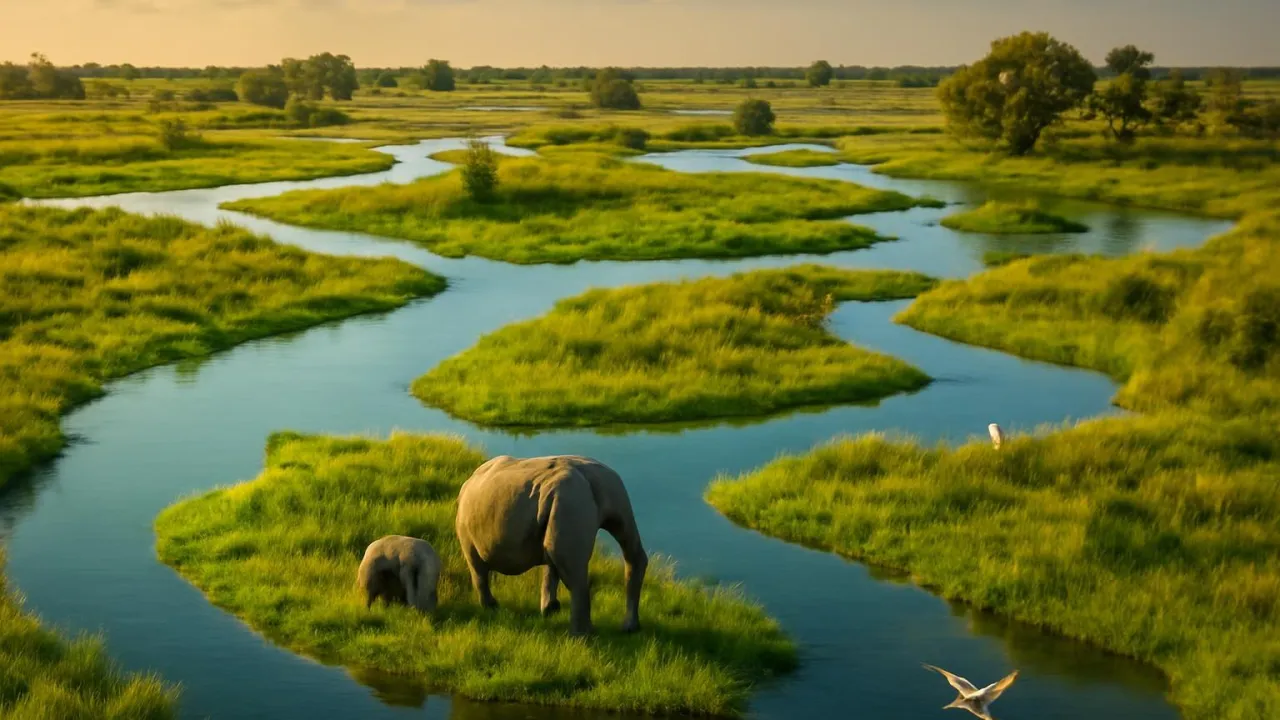
Some islands in the Okavango Delta are made by termites piling up mud!
✨ Word Sparks (Grade 2 Glossary)
Tap 🔊 to hear
wetland
Land covered by water most times
mokoro
A small canoe for the Delta
island
Land with water all around it
🪝
Can you imagine a river turning a desert into a watery home?
1
A River in the Sand
The Okavango River flows into dry land, but it does not reach the sea. Instead, it spreads out and forms the Okavango Delta. This makes a huge in the middle of the Kalahari Desert. The water makes many winding streams and small .
2
Home for Many Animals
The Delta is full of wild animals, like elephants, hippos, and lions. Birds fly over the water and fish swim below. Every year, the flood brings new life to the area. People come from all over to see the animals.
3
Changing with the Seasons
The Delta changes size with the seasons, growing bigger when the river floods. In dry times, the water shrinks and animals move to find water. People ride in special boats called to explore the Delta. It is a place full of adventure and surprises.
The Okavango Delta’s floods travel over 600 miles before reaching the desert!
✨ Word Sparks (Grade 3 Glossary)
Tap 🔊 to hear
ecosystem
A place where plants and animals live together
erosion
When water or wind wears away land
channel
A path water makes through land
🪝
What if a river vanished into sand, but left behind a paradise for animals?
1
A River’s Disappearing Act
The Okavango River travels across Africa and ends in the Kalahari Desert. Instead of reaching the ocean, its water fans out and forms the Okavango Delta. This creates a massive web of , lagoons, and islands. The Delta is a unique inland wetland, not connected to any sea.
2
A Burst of Life in the Desert
Each year, seasonal floods arrive, making the Delta grow larger and deeper. The water brings nutrients that feed tall grasses and trees. Elephants, hippos, and antelope gather to eat and drink. The area is famous for its rich wildlife and birdwatching.
3
How the Delta Changes
The Delta’s size changes with the seasons, expanding during floods and shrinking in dry months. and plant growth shape new islands and each year. Termites even help build islands by piling up mud and grass. People travel in dugout canoes called mokoros to explore the winding waterways.
4
A Natural Wonder of the World
The Okavango Delta is protected as a UNESCO World Heritage site. Scientists study its to learn about water cycles and wildlife. Local people use the Delta’s resources carefully to protect animals and plants. This watery oasis is one of Africa’s greatest natural wonders.
The Okavango Delta is so large it can be seen from space during peak floods!
✨ Word Sparks (Grade 4 Glossary)
Tap 🔊 to hear
biodiversity
Many different living things in one place
evaporate
When water turns into invisible gas
conservation
Protecting nature so it stays healthy
🪝
Have you ever wondered how a desert can suddenly become a lush water world teeming with life?
1
A River That Creates a Living Oasis
Every year, the Okavango River flows from Angola and disappears into Botswana’s Kalahari Desert, never reaching the sea. Instead, its water spreads out to form the Okavango Delta, a vast network of channels, lagoons, and islands. This inland delta is unique because it forms right in the middle of a dry desert. The flooding transforms the area into a living oasis, attracting countless animals and plants.
2
The Science Behind the Floods
The Okavango’s annual floods begin with rainfall far away in the Angolan highlands. The water travels over 600 miles, arriving months later in Botswana. As the river slows, it spreads out and seeps into the sandy ground, creating a giant wetland. This process brings nutrients that support tall grasses, papyrus reeds, and lush trees, making the Delta a hotspot for .
3
A Dynamic Landscape Shaped by Nature
The Okavango Delta is constantly changing due to seasonal flooding, erosion, and plant growth. Termites build large mounds that eventually become islands, while flowing water carves new channels each year. During the dry season, much of the water or sinks into the ground, shrinking the Delta and concentrating animals around remaining pools. This ever-changing landscape supports a rich web of life.
4
A Treasure for People and the Planet
Recognized as a UNESCO World Heritage site, the Okavango Delta is vital for both wildlife and local communities. People use traditional mokoro canoes to travel its winding waterways, fishing and guiding visitors. Scientists study the Delta to understand water cycles and . Protecting this natural wonder helps ensure that its animals, plants, and people can thrive for generations.
1. How does the Okavango Delta get its water each year?
2. Why is the Okavango Delta important to people?
🤯 Mind-Blowing Fact • Grade 5
During peak floods, the Okavango Delta holds over 2.5 trillion gallons (9.5 trillion liters) of water—enough to fill 3.8 million Olympic swimming pools!
✨ Word Sparks (Grade 5 Glossary)
Tap 🔊 to hear
hydrology
The science of how water moves on Earth
sediment
Tiny pieces of soil carried by water
resilience
The ability to recover and stay strong
🪝
Imagine standing in the heart of a desert, hearing the calls of hippos and the rush of water—how did this watery wilderness appear here?
1
A River’s Remarkable Journey
The Okavango Delta is the endpoint of the Okavango River, which originates in the Angolan highlands and travels over 1,000 miles before reaching Botswana’s Kalahari Basin. Unlike most rivers, the Okavango never reaches the sea; instead, it fans out across a tectonic trough, forming the world’s largest inland delta. This sprawling wetland covers an area that can reach up to 8,500 square miles (22,000 square kilometers) during peak floods, transforming arid desert into a vibrant ecosystem.
2
Hydrology and Seasonal Flooding
The Delta’s unique is driven by rainfall patterns in distant Angola, with floodwaters taking up to six months to arrive in Botswana. As the river slows and spreads, water infiltrates the sandy soil, creating a mosaic of permanent channels, seasonal floodplains, and thousands of islands. The annual flood pulse, peaking between June and August, coincides with Botswana’s dry season, providing crucial water and nutrients for plants and animals when they are needed most.
3
Dynamic Ecosystems and Engineering by Nature
Erosion, deposition, and biological activity constantly reshape the Delta’s landscape. Termites play a surprising engineering role by constructing massive mounds that eventually become islands, altering water flow and supporting unique plant communities. The interplay of water, soil, and living organisms creates habitats ranging from papyrus swamps to grassy floodplains, supporting over 1,000 species of plants and hundreds of animal species, including endangered African wild dogs and rare birds.
4
Human Connections and Conservation Challenges
For thousands of years, indigenous peoples such as the Bayei and Hambukushu have relied on the Delta for fishing, farming, and transport using traditional mokoro canoes. Today, eco-tourism provides vital income and incentives to protect the Delta’s biodiversity. However, the region faces threats from climate change, upstream water use, and habitat loss, making conservation efforts and scientific research more important than ever to sustain this fragile ecosystem.
5
A Living Laboratory and Global Treasure
Designated a UNESCO World Heritage site in 2014, the Okavango Delta is recognized for its outstanding ecological and cultural value. Scientists study its hydrological cycles, wildlife migrations, and climate , using the Delta as a model for wetland conservation worldwide. By balancing human needs with environmental stewardship, the Okavango Delta stands as a shining example of how nature and people can thrive together in one of Earth’s most remarkable landscapes.