1. Which modern animal lived a coastal lifestyle most like Nothosaurus?
2. Why did Nothosaurus have long teeth pointing slightly outward?
🤯 Mind-Blowing Fact • Grade 2
Some giant late species like Nothosaurus zhangi in China grew up to twenty-three feet long—nearly twice as big as earlier cousins!
✨ Word Sparks (Grade 2 Glossary)
Tap 🔊 to hear
limestone
Pale rock formed in warm shallow seas
flexible
Able to bend and turn easily
haul
Pull a heavy body forward onto land
🪝
How did Nothosaurus bridge the gap between land lizards and deep-ocean plesiosaurs?
1
Exploring Warm Triassic Lagoons
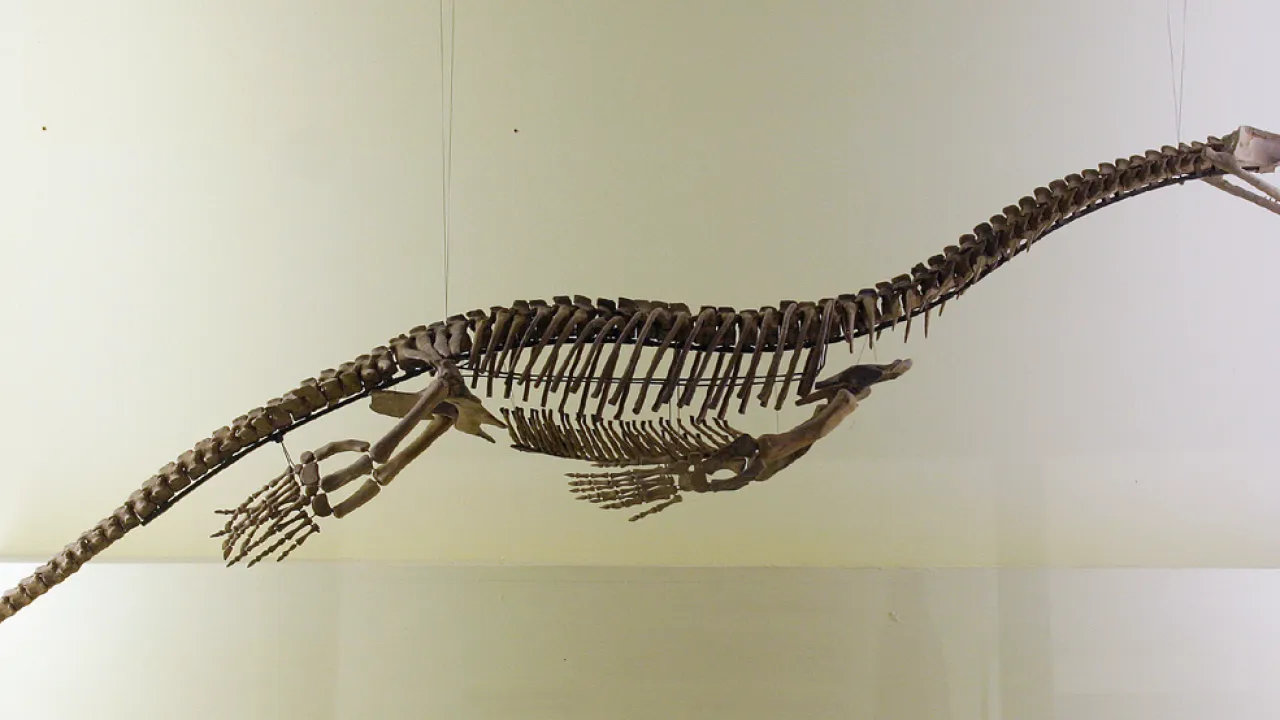
Step onto a tropical beach 240 million years ago along the ancient Tethys Ocean! Sunbathing on warm ledges rests Nothosaurus, a thirteen-foot reptile whose name means 'false lizard.' With a long neck, flat skull, and muscular tail, it felt equally comfortable on land and underwater.
2
Built Like a Cousin to Plesiosaurs
Nothosaurus belonged to the bigger reptile family that later produced famous four-flippered plesiosaurs! Instead of stiff paddles, however, Nothosaurus still kept bending elbows, knees, and webbed toes so it could itself ashore.
3
Sneak Attacks in Shallow Water
Sliding silently beneath rippling waves, Nothosaurus swung its neck sideways into glittering schools of fish, snapping its needle-lined jaws shut in a flash!
1. How were the limbs of Nothosaurus different from later open-ocean plesiosaurs?
2. How did Nothosaurus surprise schools of small fish?
🤯 Mind-Blowing Fact • Grade 3
Heavy, thickened ribs gave Nothosaurus natural ballast underwater without wasting energy kicking downward to stay near the seabed!
✨ Word Sparks (Grade 3 Glossary)
Tap 🔊 to hear
pachyostosis
Extra-thick, heavy bones that help divers sink
ballast
Heavy weight added for underwater balance
mudstone
Smooth rock hardened from ancient soft mud
🪝
How did heavy solid ribs and rowing footprints reveal Nothosaurus's underwater hunting tricks?
1
Prowler of the Tethys Coast
During the Middle Triassic Period, a warm tropical sea called the Tethys Ocean curved across what is now Germany, Italy, Israel, and southern China. Cruising its shallow reefs and salty lagoons was Nothosaurus mirabilis, a sleek semi-aquatic reptile about ten to thirteen feet long.
2
Built-In Diving Weights
Air-filled lungs naturally make an animal bob up like a cork. To stay effortlessly submerged while stalking seafloor prey, Nothosaurus evolved extra-dense, heavy ribs and belly bones—a clever adaptation scientists call that worked just like a scuba diver's weight belt!
3
Footprints on the Seafloor
In Yunnan, China, paleontologists discovered twin rows of curved scoop marks preserved in 245-million-year-old . Nothosaurus had punted along the muddy bottom by rowing both muscular front limbs in unison, stirring up hidden shrimp and fish!
4
Needle-Tooth Fish Trap
Long, grooved fangs projected outward from its spoon-shaped snout, meshing seamlessly between upper and lower jaws so slippery squid and fish had zero chance to wriggle loose.
1. What helpful job did extra-dense, heavy ribs perform for Nothosaurus?
2. What did paired scoop tracks in Chinese mudstone prove about Nothosaurus?
🤯 Mind-Blowing Fact • Grade 4
Nothosaurus nostrils sat high on top of its snout rather than at the very tip, letting it sneak a breath while keeping 99 percent of its body hidden underwater!
✨ Word Sparks (Grade 4 Glossary)
Tap 🔊 to hear
sauropterygians
Flipper-swimming marine reptiles including nothosaurs and plesiosaurs
procumbent
Teeth slanting forward and outward from jaws
amphibious
Adapted for living both in water and ashore
🪝
What can a flattened skull packed with muscle openings tell us about how Nothosaurus ambushed Triassic prey?
1
Sauropterygian Pioneers After Extinction
After the Great Dying wiped out ninety percent of marine species 252 million years ago, coastal reptiles rushed to claim empty ocean habitats. Among these pioneers were ('lizard flippers'), the evolutionary clan containing both semi-aquatic nothosaurs and later open-ocean plesiosaurs. Reaching three to four meters in length across Europe's Muschelkalk Sea and China's Guanling lagoons, Nothosaurus perfected an pinniped-like lifestyle.
2
Skull Mechanics of a Snap-Feeder
View a Nothosaurus skull from above and you'll notice a narrow, constricted waist behind the eye sockets followed by two enormous elongated openings—temporal fenestrae—spanning the rear of the cranium. Long jaw-closing muscles anchored inside those chambers allowed rapid, snapping closures underwater despite strong hydrodynamic resistance, while (outward-angled) conical fangs locked around agile fishes.
3
Dual-Mode Locomotion
Unlike obligate pelagic plesiosaurs whose limbs transformed into rigid paddles unable to support weight ashore, Nothosaurus retained five distinct digits connected by broad webbing, sturdy pectoral and pelvic girdles, and a laterally flattened tail crested by tall neural spines. It combined undulating tail strokes with synchronous forelimb rowing—verified in 2014 by fossilized seabed trackways in Luoping, China—while retaining enough limb mobility to haul onto sunny coastal islands.
4
Live Birth on the Threshold of Ocean Life
Fossils of closely related Triassic such as Lariosaurus and Keichousaurus preserve unborn embryos curled safely inside the mother's body rather than hard-shelled eggs, strongly suggesting that semi-aquatic nothosaurs were already transitioning toward aquatic live birth along Tethyan shores!
1. Why did Nothosaurus have two huge elongated openings at the back of its flat skull?
2. How did top-mounted nostrils help Nothosaurus stay stealthy?
🤯 Mind-Blowing Fact • Grade 5
When Georg Graf zu Münster named Nothosaurus ('false lizard') in 1834, dinosaurs hadn't even been named yet—making it one of the earliest prehistoric reptiles ever studied!
✨ Word Sparks (Grade 5 Glossary)
Tap 🔊 to hear
osteosclerosis
Increased inner bone density replacing hollow marrow space
gastralia
Basket of slender belly ribs protecting the underside
paraxial
Swimming primarily using paired limbs instead of spine
🪝
How does Nothosaurus illuminate the biomechanical transition from undulating coastal reptiles to wing-propelled plesiosaurs?
1
Triassic Radiation Across the Tethys Realm
First described by German paleontologist Georg Graf zu Münster in 1834 from Bavarian Muschelkalk limestone—initially dubbed 'false lizard' because its mosaic of terrestrial and marine traits puzzled early anatomists—Nothosaurus thrived for thirty-five million years across the circum-Tethyan archipelago. Spanning nimble one-meter coastal fish-hunters in Europe and Israel up to the formidable seven-meter apex carnivore Nothosaurus zhangi excavated from Middle Triassic strata in Yunnan, China, the genus exemplifies rapid marine food-web recovery following the End-Permian mass extinction.
2
Evolutionary Bridge to Paraxial Swimming
Biomechanical analyses position Nothosaurus at a pivotal evolutionary crossroads within Eosauropterygia. Whereas terrestrial reptiles propel themselves via lateral body undulation, later Jurassic and Cretaceous plesiosaurs relied exclusively on four-wing underwater flight. Remarkable ichnofossil trackways preserved in 245-million-year-old Anisian micritic carbonates of Luoping, China—displaying dozens of paired crescentic bilateral forelimb scoop impressions—prove Nothosaurus already practiced figure-eight synchronous forelimb rowing alongside muscular caudal undulation to punt across muddy seabeds.
3
Osteosclerosis and Buoyancy Control
Microanatomical bone cross-sections reveal pronounced pachyostosis and —thickened cortical bone walls and mineralized marrow cavities across dorsal ribs and ventral (belly ribs). This natural skeletal ballast countered positive lung buoyancy in shallow epicontinental lagoons, minimizing the metabolic energy wasted fighting upward drift while hovering silently over benthic crustaceans, cephalopods, and bottom-dwelling fishes.
4
Cranial Architecture and Apex Species
A dorsoventrally flattened, streamlined rostrum minimized lateral hydrodynamic drag when sweeping sideways into shimmering schools of fish. Behind the orbits, enormous supratemporal fenestrae housed elongated jaw-adductor musculature optimized for high-velocity underwater closure, driving interlocking procumbent premaxillary and mandibular fangs into slippery actinopterygian fishes, ammonoids, and even smaller pachypleurosaur reptiles.
5
Extinction Before the Jurassic Dawn
As Late Triassic sea-level regressions drained shallow carbonate platforms around 210 million years ago during the Norian stage, coastal specialists like Nothosaurus vanished completely, leaving their deeper-water pistosaurid cousins to carry the sauropterygian lineage onward as iconic four-flippered Jurassic plesiosaurs.