1. What household machine did the wide, flat mouth of Nigersaurus look like?
2. How often did Nigersaurus grow a brand-new replacement in each tooth spot?
🤯 Mind-Blowing Fact • Grade 2
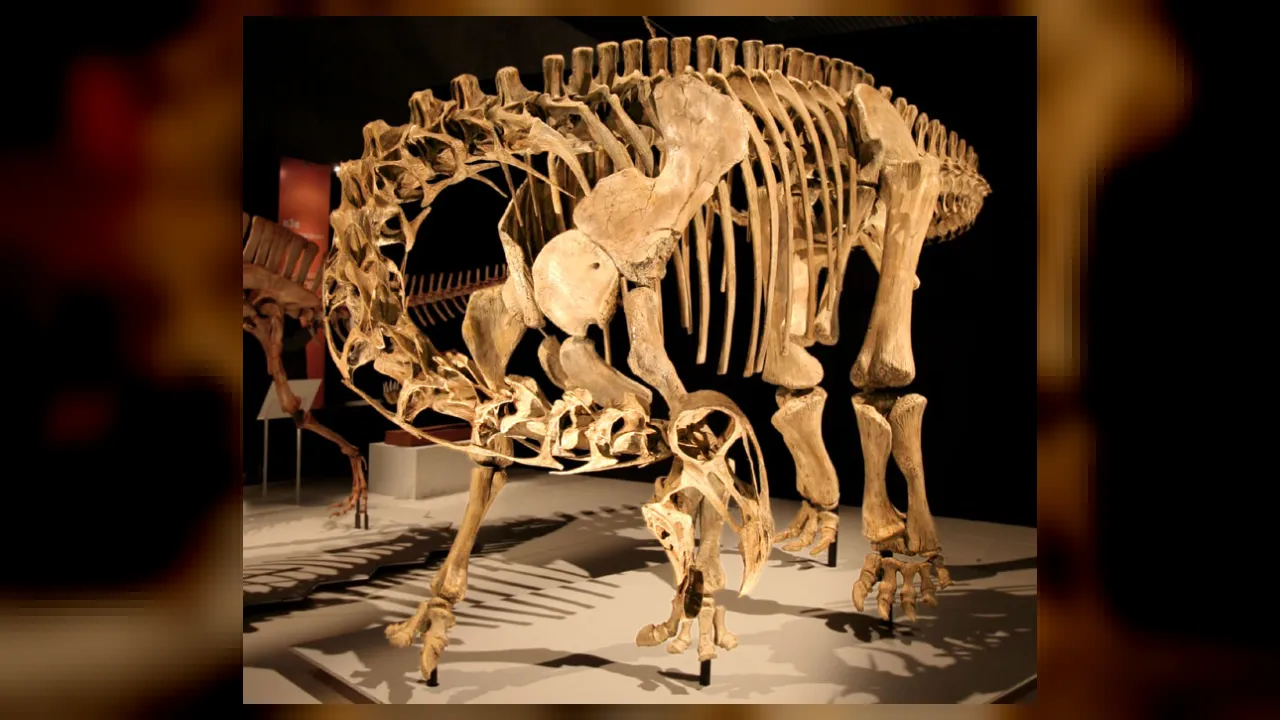
Many bones in Nigersaurus's skull were thinner than two millimeters—so delicate that you can shine a beam of light right through them!
✨ Word Sparks (Grade 2 Glossary)
Tap 🔊 to hear
meadow
open field covered in low green plants
spare
an extra piece kept ready as backup
delicate
very thin, light, and easy to break
🪝
Why did an elephant-sized long-necked dinosaur have five hundred teeth stacked like mechanical pencil leads?
1
Green Rivers Where Sahara Sand Sits Today
Today the Republic of Niger in Africa is covered by golden Sahara sand dunes. Yet 110 million years ago, lush rivers wound through fern where thirty-foot, elephant-sized Nigersaurus grazed head-down all day!
2
Stacked Like Pencil Leads
Cropping sandy horsetails near the dirt ground down teeth quickly. Behind each working front tooth waited a column of nine teeth—pushing a sharp replacement forward every two weeks!
3
See-Through Skull Bones
Even stranger, its skull and backbones were so paper-thin that bright flashlight beams can shine straight through the fossil bone!
1. How did Nigersaurus keep from running out of teeth while eating gritty plants near the dirt?
2. What was the Sahara Desert in Niger like when Nigersaurus lived there 110 million years ago?
🤯 Mind-Blowing Fact • Grade 3
Nigersaurus is the only known animal whose front jaw edge was wider than the back of its own skull, turning its face into a living T-square!
✨ Word Sparks (Grade 3 Glossary)
Tap 🔊 to hear
dental battery
tightly packed columns of fast-replacing spare teeth
fragile
delicately built and easily cracked apart
graze
feed continuously on low ground-level plants
🪝
How do scientists reconstruct a thirty-foot dinosaur whose skull bones were thinner than potato chips?
1
Puzzle Pieces in Desert Wind
French paleontologist Philippe Taquet spotted the first puzzling bones in Niger's Gadoufaoua desert in the 1960s, and Paul Sereno's expeditions later collected hundreds of paper-thin skull fragments. Naming it Nigersaurus taqueti in 1999, Sereno's team needed years of 3D digital scanning to piece together its head!
2
The Mesozoic Cow
When the 3D skull popped onto the computer screen in 2007, scientists couldn't believe their eyes! Unlike any other sauropod, Nigersaurus's jaws turned ninety degrees sideways at the front, creating a straight, foot-wide clipping edge nicknamed the 'Mesozoic cow.'
3
Sauropod Dental Batteries
More than sixty slender tooth columns lined the upper jaw and sixty-eight lined the lower jaw—over 500 total teeth! Replacing worn crowns every fourteen days beat even duck-billed dinosaurs.
4
Nose Pointed Straight at Its Toes
Inner-ear balance scans confirmed Nigersaurus naturally held its muzzle pointed nearly seventy degrees downward—keeping its eyes high to spot predators like Suchomimus while grazing!
1. Why did paleontologist Paul Sereno nickname Nigersaurus the 'Mesozoic cow'?
2. How were ALL of Nigersaurus's 500+ teeth arranged inside its mouth?
🤯 Mind-Blowing Fact • Grade 4
Five extra window-like openings hollowed out Nigersaurus's skull until the entire bony frame of its head weighed less than a Chihuahua!
✨ Word Sparks (Grade 4 Glossary)
Tap 🔊 to hear
abrasive
rough and gritty, wearing surfaces down quickly
translucent
thin enough to let light shine through
dentine
hard bone-like tissue beneath a tooth's enamel
🪝
Why did a member of the famous high-reaching sauropod group remodel its entire skull to stare straight down at the dirt?
1
Turning Sauropod Design Upside Down
When most people picture sauropods, they imagine long necks stretching toward the clouds. Yet 110 million years ago along the lush riverbanks of Niger's El Rhaz Formation, elephant-sized Nigersaurus taqueti thrived by evolving in the exact opposite direction—specializing on ferns and horsetails growing less than a meter off the ground!
2
Featherweight Skull With Heavy-Duty Scissors
Reconstructed via micro-CT scans and 3D rapid prototyping by Paul Sereno and Lawrence Witmer in 2007, Nigersaurus's skull was an engineering marvel. Five extra skull openings reduced bone struts to wafers barely one to two millimeters thick, cutting head weight to under four pounds! All its structural strength focused at the squared-off front jaws, where over 500 needle-thin teeth formed self-sharpening upper and lower shear blades.
3
Speed Champion of Tooth Replacement
Grazing right at ground level meant swallowing quartz sand alongside silica-rich horsetails. Microscopic daily growth lines (von Ebner lines) inside Nigersaurus proved a fresh tooth erupted in every column every fourteen days—twice as fast as Triceratops or duck-billed hadrosaurs!
4
Inner-Ear Proof of Ground Grazing
Scanning its braincase revealed semicircular balance canals rotated so that in its natural alert pose, Nigersaurus pointed its vacuum-cleaner snout sixty-seven degrees downward at the turf while high-set eyes scanned 360 degrees for Sarcosuchus and Suchomimus.
1. Why did Nigersaurus need to replace every worn tooth once every fourteen days?
2. How did having eyes perched high near the top of a downward-pointing skull help Nigersaurus?
🤯 Mind-Blowing Fact • Grade 5
Enamel on the outside face of each Nigersaurus tooth was ten times thicker than on the inside face, so chewing gritty plants automatically wore every tooth into a self-sharpening chisel edge!
How did rebbachisaurid evolution produce translucent skull struts, transverse dental batteries, and fourteen-day tooth replacement in Nigersaurus taqueti?
1
Gadoufaoua Discovery and Digital Cranial Assembly
First noticed between 1965 and 1972 by French paleontologist Philippe Taquet in Aptian–Albian sandstones of Niger's Gadoufaoua fossil beds (El Rhaz Formation, ~115–105 MYA), this enigmatic diplodocoid baffled researchers because its disarticulated cranial bones were wafer-thin. Following major Sahara expeditions in 1997 and 2000, Paul Sereno named Nigersaurus taqueti and partnered with Lawrence Witmer in 2007 to CT-scan, mirror, and 3D-print every gossamer element into the first complete rebbachisaurid skull reconstruction.
2
Transverse Jaws and Sauropod Dental Batteries
Unlike every other tetrapod known to science, Nigersaurus rotated its tooth-bearing maxillae and dentaries completely perpendicular to the skull's long axis, creating a straight, shovel-wide anterior biting edge broader than its occiput! Packed exclusively along that margin were ~60 upper and ~68 lower tooth columns, each stacking one active crown above up to nine developing replacements—totaling more than 500 teeth and representing the independent evolution of true dental batteries within Sauropoda.
3
Asymmetric Enamel and Record Crown Turnover
In 2013, Michael D'Emic and colleagues counted daily incremental von Ebner growth lines inside Nigersaurus teeth, documenting an unprecedented 14-day replacement interval per alveolus (compared with ~30–35 days in Diplodocus and ~50–80 days in ornithischians). Furthermore, outer labial enamel was up to ten times thicker than inner lingual enamel, ensuring abrasion automatically ground each crown into a razor-sharp self-honing chisel!
4
Extreme Fenestration and Vestibular Down-Tilt
Five accessory mandibular and cranial reduced skull struts to translucent 1-to-2-millimeter laminae, while presacral vertebrae hollowed out until central cavities left mere shell walls. Endocranial CT mapping of the lateral semicircular canal oriented the resting muzzle 67 degrees below horizontal—locking its wide keratin-rimmed bill right at ground level.
5
Ecological Role on Saharan Floodplains
Measuring 9 meters long and weighing ~4 metric tons, Nigersaurus mowed vast riverside carpets of ferns and silica-rich equisetalean horsetails alongside iguanodontian Lurdusaurus beneath the watchful jaws of Suchomimus and giant crocodylomorph Sarcosuchus.