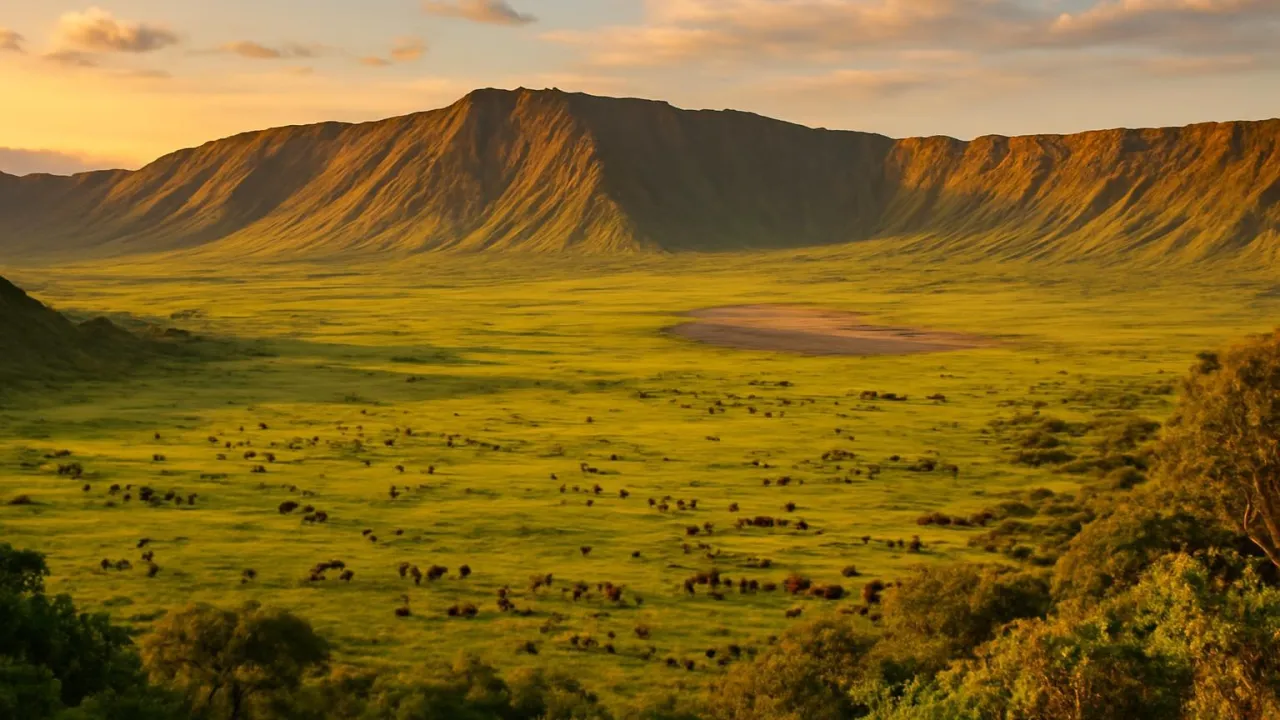
Ngorongoro Crater is home to more than 25,000 large animals!
✨ Word Sparks (Grade 2 Glossary)
Tap 🔊 to hear
volcano
A mountain that can erupt with lava
safari
A trip to see wild animals
tourist
A person who visits new places
🪝
Can you imagine looking down into a land full of wild animals?
1
A Giant Nature Bowl
Ngorongoro Crater looks like a huge green bowl. The walls are very high and steep, making it hard to climb. This special place was made by a long ago.
2
Wildlife in the Crater
Many animals live inside the crater all year. Lions, zebras, and rhinos walk on the grass, while hippos swim in pools. Birds fill the sky with their songs and colors.
3
People Visit to Explore
ride in trucks to spot animals safely. Guides share facts and help everyone see amazing sights. The crater is cool and green, with fresh air and wide views.
Ngorongoro Crater’s caldera is so large it can be seen from space!
✨ Word Sparks (Grade 3 Glossary)
Tap 🔊 to hear
caldera
A huge bowl left by a volcano
ecosystem
All living things in a place
erosion
Slow wearing away of earth
🪝
What would it feel like to stand inside the world’s largest volcanic bowl?
1
The Crater’s Birth
Ngorongoro Crater formed when a massive volcano exploded and collapsed. This created a , a huge bowl-shaped landform with steep walls. Today, the crater’s rim rises high above the grassy floor. The entire crater is about twelve miles across.
2
A Wildlife Paradise
Inside the crater, herds of wildebeest, zebras, and gazelles graze together. Lions, hyenas, and leopards hunt in this natural enclosure. Hippos enjoy the crater’s lakes, while flamingos gather at the water’s edge. The is balanced because the crater walls keep many animals inside.
3
Ecosystem and Erosion
The crater’s thrives due to rich volcanic soil and steady water. Rainwater collects in lakes and rivers, supporting plants and animals year-round. slowly shapes the crater rim, making it less steep over time. Scientists study these changes to learn about volcanic landforms.
4
Visiting the Wonder
Visitors ride in safari vehicles with guides to explore the crater safely. Guides explain animal behavior and volcanic history during the journey. The air is cool and fresh, and the views are breathtaking. Many people call Ngorongoro a living natural museum.
Ngorongoro Crater supports one of the densest populations of large mammals anywhere on Earth!
✨ Word Sparks (Grade 4 Glossary)
Tap 🔊 to hear
predator
An animal that hunts other animals
caldera
A huge bowl from a volcano
conservation
Protecting nature and animals
🪝
Imagine hearing the distant roar of lions echoing across a giant green crater—how did this place form?
1
Volcanic Origins and Structure
Ngorongoro Crater began as a towering volcano in the East African Rift millions of years ago. After a powerful eruption, the volcano’s top collapsed, creating a vast with steep, curved walls. The rim rises over 2,000 feet above the floor, which stretches nearly twelve miles across. This unique structure makes Ngorongoro the largest intact volcanic caldera on Earth.
2
A Thriving Ecosystem
The crater’s rich volcanic soil and steady rainfall create lush grasslands and lakes. These conditions support over 25,000 large animals, including lions, elephants, and endangered black rhinos. The crater’s walls act as a natural enclosure, helping to balance and prey populations. This makes Ngorongoro one of the world’s most stable and diverse wildlife habitats.
3
Erosion, Water, and Change
Rainwater flows down the crater walls, forming rivers and lakes that support plants and animals. Over time, erosion slowly wears down the rim, changing the crater’s shape and allowing some animals to travel in and out. Scientists study these processes to understand how volcanic landforms and ecosystems evolve. The crater is also important for learning about ancient human history in Africa.
4
Human Impact and Conservation
Ngorongoro is protected as a UNESCO World Heritage Site to preserve its unique environment. Local Maasai people graze cattle on the crater’s rim, living in harmony with wildlife. Tourists visit on guided safaris, learning about and the importance of protecting natural wonders. The crater’s beauty and biodiversity inspire people around the world to care for nature.
1. What natural process helps shape the crater over time?
2. Why is Ngorongoro Crater important to scientists?
🤯 Mind-Blowing Fact • Grade 5
Ngorongoro Crater’s ecosystem is so stable that it supports the world’s densest known population of lions!
✨ Word Sparks (Grade 5 Glossary)
Tap 🔊 to hear
stratovolcano
A tall, layered volcano that can erupt powerfully
microclimate
Special weather in a small area
geomorphology
The study of how landforms are shaped
🪝
What secrets would you uncover if you could explore every corner of a 2,000-foot-deep volcanic caldera teeming with life?
1
Geological Origins: The Caldera’s Creation
Ngorongoro Crater formed during the Pleistocene Epoch when a massive , estimated to have been as high as Mount Kilimanjaro, erupted catastrophically and collapsed inward. This collapse created a caldera approximately twelve miles (19 kilometers) wide and over 2,000 feet (610 meters) deep, making it the largest unbroken volcanic caldera on Earth. The steep rim encircles a remarkably flat floor, which is covered in rich volcanic soils. Over time, the caldera’s structure has been shaped by ongoing tectonic activity and gradual erosion.
2
Ecological Marvel: Biodiversity and Food Webs
The crater’s unique topography and support an extraordinary density of wildlife, including more than 25,000 large mammals such as wildebeest, zebras, Cape buffalo, and the endangered black rhinoceros. Its grasslands, swamps, and soda lakes create diverse habitats that sustain complex food webs. Apex predators like lions and spotted hyenas thrive here, while the crater’s walls limit migration, maintaining a delicate balance between predator and prey. Seasonal rains replenish water sources, ensuring year-round life inside the caldera.
3
Hydrology and Erosion: Forces of Change
Rainfall is funneled into the crater, forming seasonal rivers and permanent lakes such as Lake Magadi, which supports flocks of flamingos and hippos. Erosion gradually wears down the rim, while sediment from the slopes enriches the crater floor, influencing plant growth and animal distribution. Scientists use the crater as a living laboratory to study volcanic , hydrologic cycles, and the long-term effects of erosion on caldera landscapes.
4
Human History and Conservation Challenges
Ngorongoro’s fertile lands have attracted humans for thousands of years, from early hominins whose fossils are found nearby to the Maasai people who still graze livestock on the rim. The area became a UNESCO World Heritage Site in 1979 to protect both its biodiversity and archaeological significance. However, balancing conservation with tourism and traditional Maasai practices requires careful management to prevent habitat loss and overuse of resources.
5
Global Significance and Scientific Study
Ngorongoro Crater is not only a wildlife haven but also a key site for understanding human evolution, as nearby Olduvai Gorge contains some of the earliest evidence of hominins using tools. The crater’s intact ecosystem allows ecologists, geologists, and anthropologists to study interactions between geology, climate, animals, and humans. Its preservation serves as a model for global conservation efforts, inspiring scientists and visitors alike to protect Earth’s unique natural wonders.