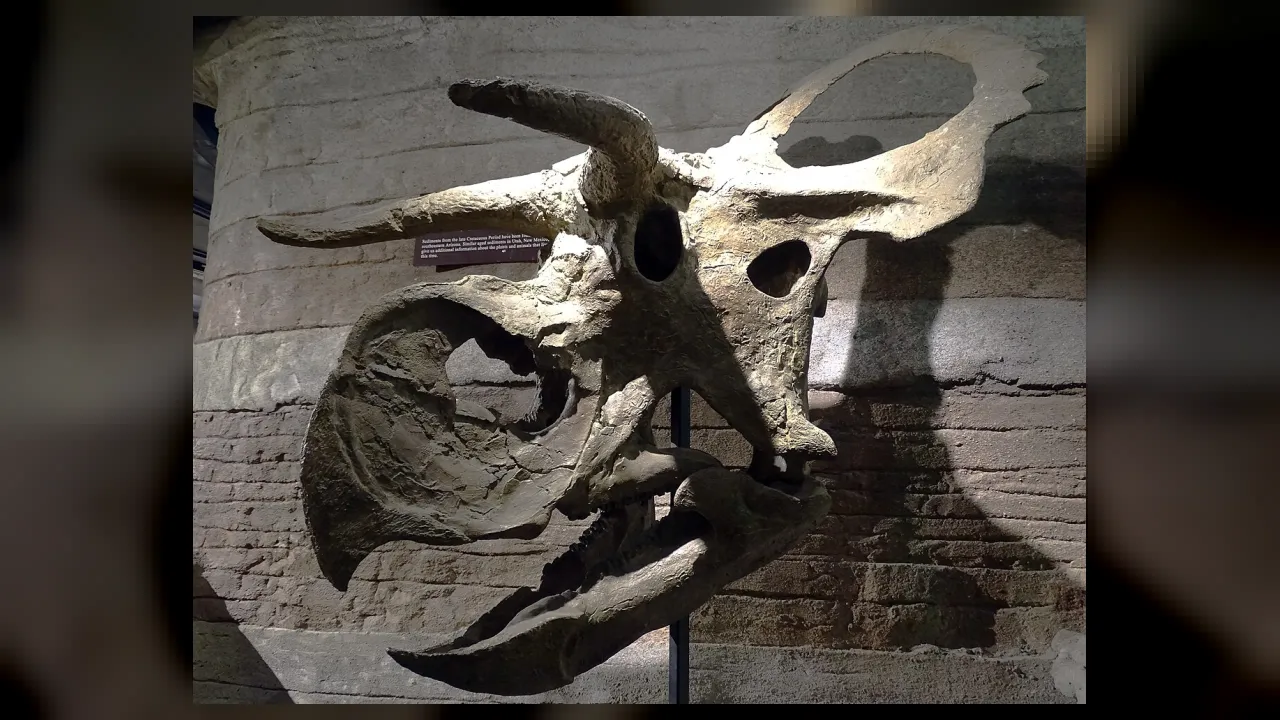
1. What animal do the curved brow horns of Nasutoceratops look like?
2. What does the name Nasutoceratops mean?
🤯 Mind-Blowing Fact • Grade 2
Fossilized skin patches found on Nasutoceratops's front leg showed neat rows of triangle- and hexagon-shaped scales!
✨ Word Sparks (Grade 2 Glossary)
Tap 🔊 to hear
Bayou
Slow, marshy river winding through warm woods
Hollow
Having open air spaces inside solid bone
Dome
A tall, rounded roof-like shape
🪝
Why did a horned dinosaur from Utah grow cow-like horns and a giant balloon nose?
1
Swamp Dweller of Southern Utah
Today, southern Utah's Grand Staircase-Escalante is a dry wonderland of red desert cliffs. Seventy-six million years ago, though, it was a steamy green ! Wading through giant cypress roots came Nasutoceratops, a 15-foot herbivore weighing 1.5 tons.
2
Air Pockets in a Giant Nose
Instead of growing a sharp nose horn like most short-frilled cousins, Nasutoceratops puffed its snout into an enormous ! Air pockets inside kept its jumbo nose surprisingly light.
3
Record Brow Horns
Sweeping forward almost to the tip of its snout, its bull-like brow horns were the longest of any dinosaur in the entire centrosaurine subgroup!
1. Why wasn't Nasutoceratops's huge snout heavy to carry around?
2. What was ancient southern Utah like when Nasutoceratops lived there 76 million years ago?
🤯 Mind-Blowing Fact • Grade 3
Nasutoceratops is the only known horned dinosaur with hollow air pockets hollowed into its nasal bone like bird or sauropod bones!
✨ Word Sparks (Grade 3 Glossary)
Tap 🔊 to hear
Pneumatic
Containing air-filled chambers inside solid bone
Resonate
To echo and boom with deep sound
Monument
Protected public land rich in natural wonders
🪝
Why did Nasutoceratops break almost every fashion rule in its dinosaur subfamily?
1
Rule-Breaker From Escalante
Unearthed in 2006 in Utah's rugged Grand Staircase-Escalante National and named in 2013, Nasutoceratops titusi stunned paleontologists! It belonged to the centrosaurines—the same short-frilled group as Centrosaurus and Styracosaurus—yet it flipped their classic horn style completely upside down.
2
Trading Nose Spikes for Bull Horns
Most centrosaurines grew giant nose horns, tiny brow bumps, and wild frill spikes. Nasutoceratops had almost zero nose horn, a calm scalloped frill rim with smooth half-circles, and huge cattle-like brow horns curving forward nearly to its snout tip!
3
Mystery of the Pneumatic Snout
Huge nasal openings stretched across three-quarters of its snout, backed by unique internal air pockets ( sinuses). Rather than super-smelling—since its smell-brain stayed normal-sized—that hollow nose chamber probably resonated deep, booming honks through thick swamp mist!
4
Shoulder Scales in Stone
Preserved right beside its left forelimb were three patches of skin impressions showing tight mosaics of eight- to eleven-millimeter hexagonal scales.
1. Why do scientists think Nasutoceratops's giant nose was for booming calls or cooling rather than super-smelling?
2. How did Nasutoceratops break the usual rule for centrosaurine dinosaurs?
🤯 Mind-Blowing Fact • Grade 4
While Alberta centrosaurines lost their long brow horns and grew huge nose spikes, Nasutoceratops proved a southern sister lineage kept gigantic brow horns for millions of years!
✨ Word Sparks (Grade 4 Glossary)
Tap 🔊 to hear
Convergent
Unrelated animals evolving remarkably similar body shapes
Endemism
Species living uniquely in one geographic region
Nares
Bony nostril openings inside an animal's skull
🪝
How did southern Utah's isolated swamps produce a dinosaur with pneumatic nose bones and bull horns?
1
Endemism on Southern Laramidia
Seventy-six million years ago, western North America formed the narrow island continent of Laramidia. Intriguingly, dinosaurs living in southern Utah's Kaiparowits Formation looked completely different from cousins living at the exact same moment up in Alberta! Named in 2013 by Eric Lund, Scott Sampson, and colleagues—honoring monument paleontologist Alan Titus—Nasutoceratops titusi revealed an entire lost southern branch of centrosaurine dinosaurs.
2
Convergent Evolution With Cattle
Measuring 4.5 meters long and weighing 1.5 tons, Nasutoceratops sprouted massive supraorbital horncores that swept horizontally outward, curved forward, and twisted inward at their tips. Strikingly with modern bovids, these low-slung horns allowed rival individuals to lock horns safely in pushing contests without stabbing each other's eyes, while deterring local southern tyrannosaurs like Teratophoneus.
3
Unique Pneumatic Nasal Bones
Internally, CT examinations revealed hollowed-out air sacs excavating its fused nasal bones—a feature unseen in any other ceratopsid! Paired with cavernous external occupying 75 percent of the pre-orbital skull length, this lightweight acoustic dome likely amplified low-frequency contact calls across dense cypress swamps while aiding evaporative heat exchange.
4
Forelimb Skin Impressions
Soft wet muds around the holotype skeleton molded crisp forelimb skin casts, capturing arrays of large hexagonal tubercles (up to 11 millimeters wide) bordered by tiny triangular scales.
1. What does 'convergent evolution' between Nasutoceratops and modern cattle mean?
2. Who is honored in the species name Nasutoceratops titusi?
🤯 Mind-Blowing Fact • Grade 5
Radiometric crystal dating proved Nasutoceratops in Utah and Centrosaurus in Alberta lived during the exact same half-million-year window—yet belonged to totally separate evolutionary tribes!
✨ Word Sparks (Grade 5 Glossary)
Tap 🔊 to hear
Autapomorphy
A unique evolutionary trait found in one species
Provincialism
Different regions hosting separate local animal communities
Coeval
Living or forming during the exact same era
🪝
What did Nasutoceratops titusi reveal about dinosaur provincialism and basal centrosaurine evolution across Laramidia?
1
Unearthing Kaiparowits Provincialism
Discovered in 2006 by graduate student Eric Lund inside the 76-to-75.5-million-year-old mudstones of southern Utah's Kaiparowits Formation and formally described in 2013 with Scott Sampson, Mark Loewen, and Andrew Farke, Nasutoceratops titusi reshaped reconstructions of Late Cretaceous biogeography. Despite Laramidia's modest north-south span, radiometrically dinosaur assemblages in Utah shared virtually zero species with Alberta's Dinosaur Park Formation—demonstrating steep latitudinal endemism across coastal wetlands.
2
Defining Tribe Nasutoceratopsini
Phylogenetic analysis recovered Nasutoceratops alongside older relatives like Avaceratops and Crittendenceratops inside a distinct basal centrosaurine clade, Nasutoceratopsini. Whereas derived northern eucentrosaurans (Centrosaurus, Styracosaurus, Pachyrhinosaurus) dramatically reduced supraorbital horns while elaborating nasal weapons and spiked frills, nasutoceratopsins retained and hypertrophied ancestral elongated brow horns alongside an unadorned, sub-circular frill.
3
Pneumatic Nasals and Bovid Horn Mechanics
Measuring 4.5 meters (15 feet) long and weighing roughly 1.5 metric tons, Nasutoceratops possessed hypertrophied external nares spanning three-quarters of its pre-orbital rostrum. Internally, its fused nasals contained unique pneumatic excavations—an unknown in any other ceratopsian—lightening the deep snout while likely acting as a low-frequency vocal resonator in densely vegetated bayous. Above the orbits, sweeping horncores projected anterolaterally and twisted medially toward the snout tip, replicating bovid horn geometry for non-lethal intraspecific wrestling.
4
Scalloped Frill and Forelimb Integument
Framing large kidney-shaped parietal fenestrae, its rounded frill margin bore simple crescentic epoccipitals—including a diagnostic midline epiparietal—while three carbonaceous skin impressions along the left forelimb preserved tightly packed eight-to-eleven-millimeter hexagonal tubercles ringed by minuscule triangular scales.
5
Ecological Richness on an Island Continent
Sharing humid alluvial swamps with ornate chasmosaurines like Kosmoceratops and Utahceratops—plus duck-billed Parasaurolophus and southern tyrannosaurids such as Teratophoneus—Nasutoceratops proved that intense subtropical floral productivity and dietary niche partitioning sustained astonishingly diverse megaherbivore guilds inside compact geographic basins along the Western Interior Seaway.