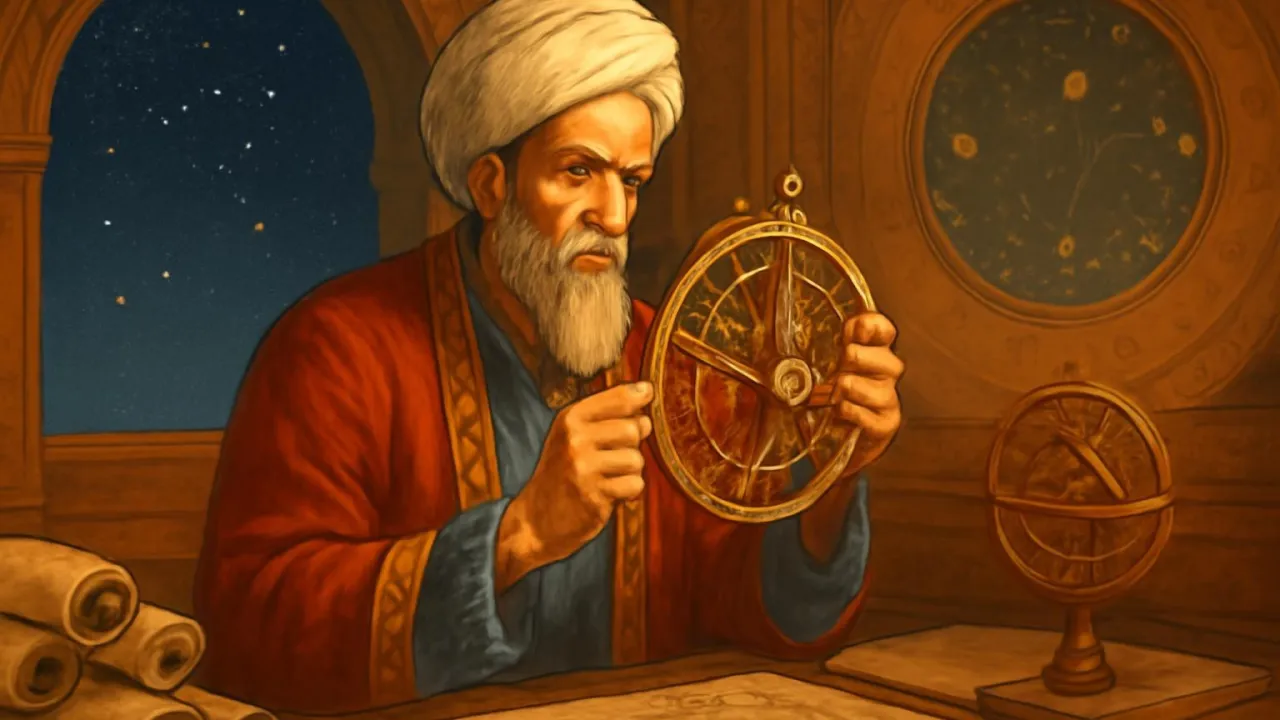
Nasir’s star maps helped other scientists for hundreds of years!
✨ Word Sparks (Grade 2 Glossary)
Tap 🔊 to hear
moon
The bright round shape in the night sky
scientist
A person who studies and learns things
map
A drawing that shows where things are
🪝
Have you ever wondered how people studied stars long ago?
1
Curious About the Sky
Nasir was a curious boy who loved to look at the stars. He asked questions about how the and sun moved. He wanted to know what made the sky work.
2
Learning and Working Hard
Nasir read many books and learned from wise teachers. He practiced using an astrolabe to find where stars were. He worked hard to draw of the night sky.
3
A Big Achievement
Nasir helped build a huge observatory for . People came from far away to learn from him. His work helped everyone understand space better.
Nasir’s Tusi-couple math helped scientists like Copernicus understand how planets move!
✨ Word Sparks (Grade 3 Glossary)
Tap 🔊 to hear
astronomy
The study of stars and planets
orbit
The path a planet travels
philosophy
Thinking about big questions in life
🪝
Imagine building a place just for watching the stars—what might you discover?
1
A Boy with Big Questions
Nasir al-Din al-Tusi spent his childhood gazing up at the night sky. He wondered how the stars moved and why the moon changed shape. These questions made him curious about science and math. He dreamed of solving the mysteries of space.
2
Learning from Books and Teachers
Nasir studied hard, reading every book he could find about and math. He learned to use an astrolabe, a special tool for measuring stars’ positions. His teachers showed him how to draw maps of the sky. He practiced for years to get every detail right.
3
Building the Maragha Observatory
When Nasir grew up, he helped build the Maragha Observatory, one of the world’s first big science centers. Scientists from many countries came to work with him. Together, they watched the stars and wrote down their discoveries. Nasir invented new ways to understand how planets move.
4
Changing the Way We See Space
Nasir created the Tusi-couple, a math idea that helped explain planet . His work made it easier for later scientists to study space. He wrote important books about math, , and . Nasir’s ideas traveled far and inspired people for centuries.
Nasir’s observatory had a giant 13-foot wall quadrant for measuring stars!
✨ Word Sparks (Grade 4 Glossary)
Tap 🔊 to hear
quadrant
A large tool for measuring stars
celestial
Related to the sky or space
Islamic Golden Age
A time of great science and learning
🪝
How did one scientist’s inventions help people all over the world understand the universe?
1
Curiosity Under the Persian Sky
As a young boy in Persia, Nasir al-Din al-Tusi would spend countless nights marveling at the stars. His fascination with the night sky inspired him to ask questions about how the universe worked and why the planets moved the way they did. This curiosity led him to study mathematics, astronomy, and philosophy with great enthusiasm. Even as a child, Nasir dreamed of building a place where people could explore the mysteries of space together.
2
Learning, Teaching, and Inventing
Nasir became a renowned scholar, reading ancient texts and learning from wise teachers across Persia. He mastered the use of the astrolabe, a complex instrument for measuring star positions, and taught others how to draw accurate maps. His dedication to learning helped him become a teacher himself, guiding many students in science and math. Nasir’s inventive mind led him to create new mathematical ideas to solve difficult astronomy problems.
3
The Maragha Observatory: A Center of Discovery
With support from a Mongol ruler, Nasir founded the Maragha Observatory, which became a hub for scientists from many lands. The observatory was filled with advanced tools for observing the sky, and teams of scholars worked together to record and explain what they saw. Nasir invented the Tusi-couple, a mathematical model that made it possible to describe complex planetary motions. His observatory’s discoveries set new standards for scientific research in astronomy.
4
A Lasting Legacy in Science
Nasir al-Din al-Tusi’s books and inventions traveled far beyond Persia, influencing scientists in Europe and Asia. His mathematical ideas helped later thinkers, such as Copernicus, develop new models of the solar system. Nasir’s work in philosophy also encouraged people to ask deep questions about the universe. Today, he is remembered as one of the greatest scientists of the , whose curiosity and inventions changed the world.
The Maragha Observatory’s star catalog listed over 1,000 stars with precise positions!
✨ Word Sparks (Grade 5 Glossary)
Tap 🔊 to hear
astrolabe
An ancient tool for measuring stars and planets
Tusi-couple
A math idea that explains planet motion
heliocentric
A model where planets orbit the sun
🪝
What happens when a brilliant mind dares to chart new paths through the mysteries of the universe?
1
A Childhood of Wonder and Questions
On clear Persian nights, young Nasir al-Din al-Tusi would gaze upward, his mind swirling with questions about the stars, planets, and the endless sky. He was captivated by the changing shapes of the moon and the paths of wandering planets, which inspired him to pursue knowledge in mathematics, astronomy, and philosophy. Nasir’s early education was shaped by reading ancient Greek, Persian, and Arabic texts, and by learning from wise teachers who encouraged his curiosity. Even as a child, he imagined a place where people could work together to unlock the secrets of the cosmos. His determination and thirst for knowledge set him on a path to become one of the most influential scientists of his era.
2
Scholarship, Innovation, and the Art of Measurement
As a scholar, Nasir al-Din al-Tusi became renowned for his mastery of mathematics, geometry, and astronomy, as well as his deep understanding of philosophy and ethics. He learned to use and improve the , a sophisticated tool for measuring the positions of stars and planets, and taught others to create detailed celestial maps. Nasir’s inventive spirit led him to develop the , a revolutionary mathematical device that explained complex planetary motions without relying on the old Ptolemaic system. This innovation became a fundamental concept in later astronomical models and demonstrated his ability to solve problems that had puzzled scientists for centuries.
3
Building the Maragha Observatory: Teamwork and Discovery
With the support of Mongol ruler Hulagu Khan, Nasir established the Maragha Observatory in 1259, which quickly became the most advanced astronomical research center of its time. The observatory featured a massive 13-foot wall quadrant, armillary spheres, and other cutting-edge instruments that allowed precise observations of the heavens. Nasir gathered a diverse team of scholars from many regions, fostering collaboration and the sharing of ideas. Together, they produced star catalogs, improved astronomical tables, and made careful measurements that influenced science for generations. The observatory’s library housed thousands of manuscripts, making it a beacon of knowledge in the medieval world.
4
Legacy: Spreading Knowledge Across Continents
Nasir al-Din al-Tusi’s scientific writings, including his famous 'Book of Astronomy,' traveled far beyond Persia, reaching scholars in Europe, India, and the wider Islamic world. His mathematical innovations, especially the , directly influenced astronomers like Copernicus, who used similar ideas to develop the model of the solar system. Nasir’s philosophical works encouraged critical thinking and ethical reasoning, shaping both scientific and intellectual traditions. Through his teaching, writing, and inventions, Nasir helped lay the foundations for the scientific revolution centuries later.
5
Inspiration for Future Explorers
Nasir al-Din al-Tusi’s life is a powerful example of how curiosity, hard work, and collaboration can change the world. He overcame political upheaval and personal challenges to build a center where people from different cultures could learn together. His legacy reminds us that science is a shared human journey, and that every question we ask can lead to new discoveries. Today, Nasir is celebrated as a pioneer who mapped the skies and inspired generations to keep reaching for the stars.