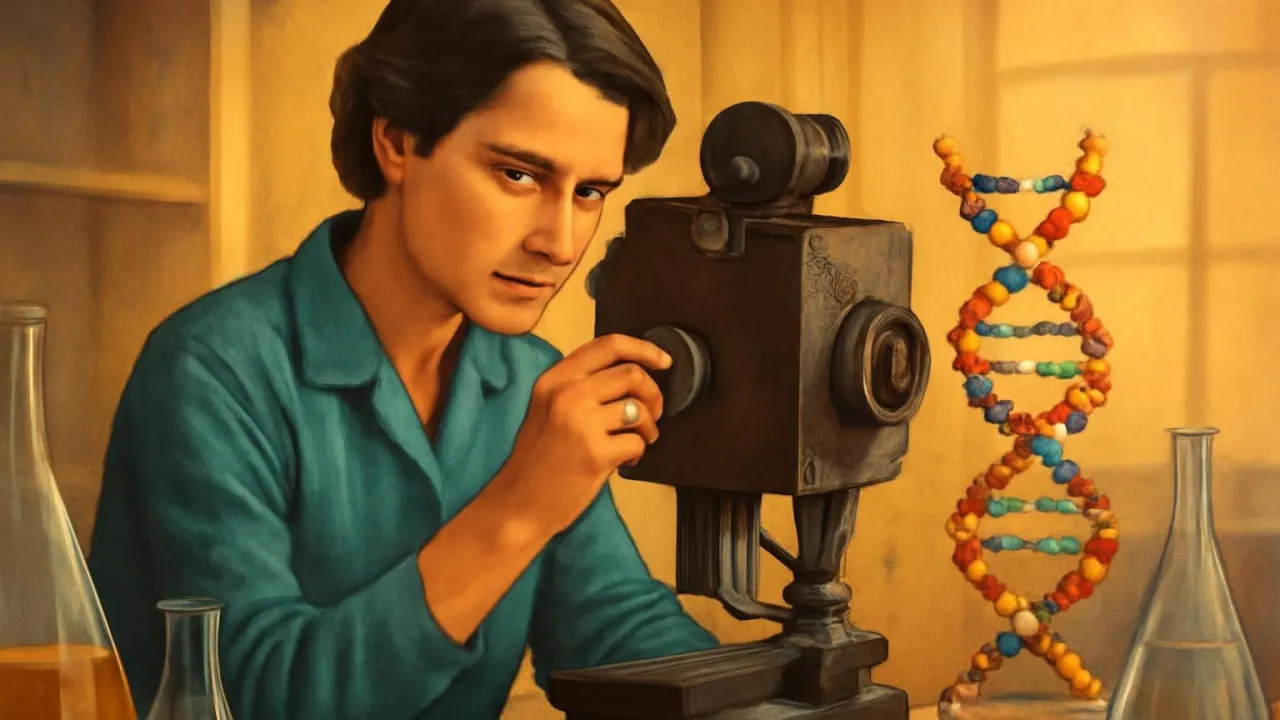
Rosalind always wanted to know how things worked, even as a child. She loved science and spent hours reading and exploring outside. She asked questions about rocks, plants, and tiny things. Her curiosity helped her become a scientist.
2
Hard Work in the Lab
Rosalind worked hard in her , using a strong camera called an machine. She took special pictures of things too small to see, like DNA. She had to be careful and patient every day. Her work took lots of practice and focus.
3
A World-Changing Picture
One day, Rosalind’s photo showed DNA’s twisty, spiral shape. This was a very important for science. Her photo helped everyone understand how living things are built. Rosalind’s work changed the world forever.
Photo 51 helped unlock the secret shape of DNA for the world!
✨ Word Sparks (Grade 3 Glossary)
Tap 🔊 to hear
crystallography
Studying crystals with special pictures
molecule
A tiny building block of matter
perseverance
Never giving up, even when it’s hard
🪝
Can a single photo reveal the secret code of life?
1
A Young Scientist’s Curiosity
As a child, Rosalind Franklin loved exploring nature and solving tricky puzzles. She was fascinated by how things were built, from tiny rocks to living plants. Her curiosity led her to study science at school and later at a university. Rosalind wanted to discover something important about life itself.
2
Learning the Power of X-rays
Rosalind became an expert in X-ray , a technique for taking pictures of things too small to see. She worked in a laboratory, carefully shining X-rays through crystals and capturing the patterns on film. This method helped scientists see the structure of . Rosalind’s careful work made her famous among other scientists.
3
The Mystery of DNA
DNA is a that holds the instructions for all living things. Rosalind used her X-ray skills to take a special photo of DNA, known as Photo 51. This picture showed a spiral, or double helix, shape. Her work helped other scientists understand how DNA works and how traits are passed down.
4
Overcoming Challenges
Rosalind faced many obstacles because she was a woman scientist in the 1950s. She kept working hard, showing and focus every day. Even when others took credit for her discovery, Rosalind’s careful science made a lasting impact. Today, people celebrate her as a true pioneer in biology.
Rosalind’s Photo 51 was the missing piece that revealed DNA’s spiral staircase shape!
✨ Word Sparks (Grade 4 Glossary)
Tap 🔊 to hear
heredity
How traits pass from parents to kids
double helix
A twisty, spiral shape of DNA
pioneer
A person who does something first
🪝
How did a scientist’s sharp eye and steady hands change our view of life forever?
1
A Childhood Full of Questions
Rosalind Franklin grew up in London, surrounded by books, science, and a family that encouraged her curiosity. She loved exploring the outdoors and learning how things worked, which inspired her to study chemistry at university. At a time when few women became scientists, Rosalind was determined to follow her passion. Her early love for discovery set the stage for her groundbreaking work.
2
Mastering X-ray Crystallography
In her laboratory, Rosalind became an expert in X-ray crystallography, a technique that reveals the structures of molecules by analyzing patterns in X-ray images. She spent countless hours preparing samples and adjusting the equipment for perfect results. Her careful attention to detail allowed her to capture incredibly sharp images of DNA. Rosalind’s skills set a new standard for scientific research.
3
Cracking the DNA Code
Rosalind’s most famous achievement was taking Photo 51, the clearest X-ray image of DNA ever made at the time. This photograph revealed the structure, which is the spiral staircase shape of DNA. Although other scientists used her photo to build their own models, Rosalind’s work was the key breakthrough. Her discovery changed how scientists understand genetics, , and life itself.
4
A Lasting Legacy
Rosalind Franklin faced many challenges, including being overlooked because she was a woman in science. Despite this, she continued her research and made important discoveries about viruses, too. Today, Rosalind is celebrated as a whose careful work and determination helped unlock the secrets of life. Her story inspires new generations of scientists around the world.
Rosalind’s Photo 51 was so precise that it allowed scientists to measure the exact distance between DNA’s spiral steps!
✨ Word Sparks (Grade 5 Glossary)
Tap 🔊 to hear
diffraction
When waves bend around things or through gaps
genetics
The science of how traits are inherited
resilience
Staying strong when things are tough
🪝
What does it take to capture the invisible secrets of life and change science forever?
1
A Childhood Spark for Science
Imagine a young girl in 1920s London, endlessly curious about the world around her. Rosalind Franklin’s parents encouraged her love of learning, filling their home with books and lively discussions about science and ideas. Even as a child, Rosalind was determined to understand how things worked, spending hours outdoors collecting rocks and observing plants. Her early fascination with nature and problem-solving set her on a path toward a groundbreaking scientific career. Despite the challenges faced by women in science at the time, Rosalind’s drive and intellect propelled her forward.
2
Mastering the Art of X-ray Crystallography
After excelling in chemistry at Cambridge University, Rosalind became a specialist in X-ray crystallography, a technique that uses X-rays to reveal the structures of molecules. In painstaking experiments, she prepared samples, directed powerful X-ray beams through them, and captured the resulting patterns on photographic film. Her remarkable precision and patience allowed her to produce some of the sharpest molecular images ever seen. Rosalind’s expertise was so advanced that her methods became the gold standard for laboratories worldwide, influencing how scientists study the building blocks of life.
3
Photo 51 and the Double Helix Breakthrough
Rosalind’s most significant achievement was capturing Photo 51 in 1952, an X-ray image that revealed the double helix structure of DNA. This iconic photograph provided crucial measurements and evidence that helped other scientists, like Watson and Crick, build the first accurate model of DNA. Although Rosalind’s contributions were not fully recognized during her lifetime, her meticulous work was the turning point in understanding how genetic information is stored and passed from one generation to the next. The discovery of the double helix revolutionized biology, medicine, and .
4
Facing Barriers and Expanding Science
Rosalind Franklin worked in an era when women scientists were often excluded from recognition and leadership. Despite facing discrimination and sometimes being left out of important discussions, she remained focused on her research. After her DNA work, Rosalind made significant discoveries about the structures of viruses, including the tobacco mosaic virus and the polio virus. Her ability to adapt her scientific skills to new challenges demonstrated her versatility and as a researcher.
5
Legacy and Inspiration for Future Scientists
Today, Rosalind Franklin is celebrated as a pioneer whose work changed the course of science. Her techniques in X-ray crystallography are still used by researchers studying everything from proteins to viruses. Rosalind’s story is a powerful reminder of the importance of perseverance, precision, and curiosity in scientific discovery. She inspires new generations—especially girls—to pursue science, ask bold questions, and look closely at the hidden patterns in our world. Her legacy lives on in every breakthrough that builds upon her work.