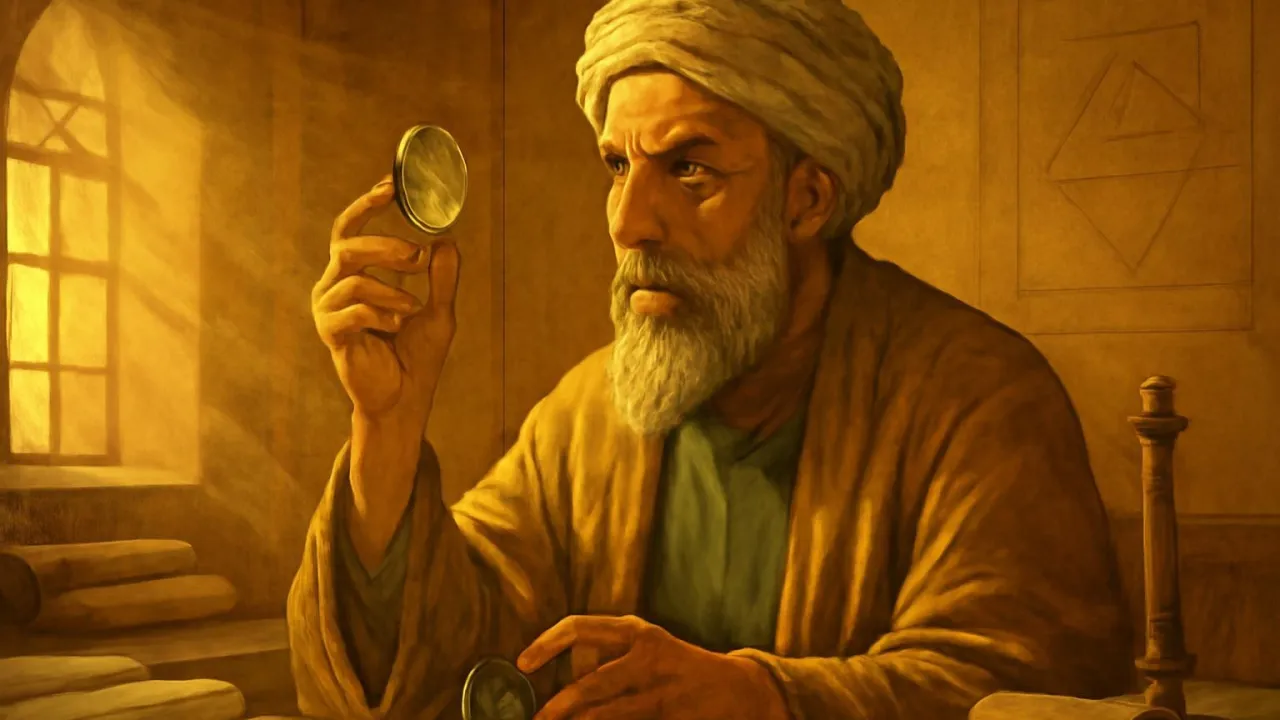
Ibn al-Haytham made the first camera-like dark room, called a camera obscura!
✨ Word Sparks (Grade 2 Glossary)
Tap 🔊 to hear
optics
The science of light and seeing
pattern
A design that repeats
result
What you find out in a test
🪝
Have you ever wondered how your eyes really work?
1
Curious About Light
Ibn al-Haytham watched sunlight make in dark rooms. He wondered how light moved and how people could see. He began to ask questions and look for answers.
2
Testing Ideas
He made experiments with glass, water, and small holes in walls. Ibn used these tools to test how light bends and travels. He wrote down every to remember what he learned.
3
A Big Discovery
Ibn showed that eyes see because light enters them. His book about light and vision helped many people understand science. Today, he is called the father of .
Ibn’s experiments with light led to inventions like eyeglasses and cameras centuries later!
✨ Word Sparks (Grade 3 Glossary)
Tap 🔊 to hear
camera obscura
A dark room that shows outside images
lens
A clear object that bends light
refraction
When light bends as it passes through
🪝
Imagine you are in a dark room and see sunlight shining through a tiny hole—what would you discover?
1
A Childhood Full of Questions
As a curious boy, Ibn al-Haytham loved to watch sunlight create shapes on the floor. He wondered why the light made patterns and how his own eyes could see them. These questions filled his mind with excitement. He wanted to solve the mystery of light and vision.
2
Inventing Experiments
Ibn built a special dark room with a tiny hole, called a . He noticed that the outside world appeared upside down on the wall inside. By using glass and water, he experimented with bending and focusing light. He carefully wrote down every observation in his notebooks.
3
Discovering How We See
Ibn al-Haytham proved that light travels in straight lines and enters the eye to create sight. He used words like ',' 'reflection,' and '' to explain his ideas. His famous Book of Optics shared these discoveries with other scientists. His work changed how people understood vision forever.
4
A Legacy of Science
Ibn al-Haytham taught others to test ideas with experiments and evidence. His method became the foundation for the scientific method used today. Scientists all over the world still study his books and learn from his discoveries. He is remembered as a true pioneer of science.
1. How did Ibn al-Haytham test his ideas about light?
2. What did Ibn’s Book of Optics help explain?
🤯 Mind-Blowing Fact • Grade 4
Ibn al-Haytham’s Book of Optics was used by scientists in Europe for hundreds of years!
✨ Word Sparks (Grade 4 Glossary)
Tap 🔊 to hear
reflection
When light bounces off a surface
scientific method
A way to test and learn in science
legacy
Something important left for others
🪝
What if you could unlock the secrets of sight just by watching sunlight in a room?
1
A World of Wonder and Curiosity
Growing up in Basra during the Golden Age of Islam, Ibn al-Haytham was fascinated by how sunlight streamed through windows and tiny holes. He constantly questioned how light traveled and how his eyes could see the world around him. His curiosity led him to study mathematics, science, and philosophy with great passion. These early experiences inspired him to search for answers about vision and light.
2
Turning Questions into Experiments
Ibn al-Haytham designed creative experiments using glass, water, and the famous camera obscura—a darkened room with a small hole that projects images. He noticed that images appeared upside down and wondered why this happened. By studying how lenses bend and focus light, he explained important concepts like and refraction. He carefully recorded his observations, making sure every test was repeated and accurate.
3
Changing the Science of Vision
Through his experiments, Ibn al-Haytham proved that light enters the eye, allowing us to see. He challenged old ideas that said our eyes sent out rays to objects, showing instead that vision depends on light coming from the outside world. His Book of Optics introduced new scientific vocabulary and inspired future scientists to use experiments and logic. This work became a turning point in the study of optics and vision.
4
A Lasting Impact on Science
Ibn al-Haytham’s way of testing ideas became the foundation of the , which scientists still use today. His discoveries influenced inventors who created eyeglasses, telescopes, and cameras many centuries later. He is honored as a pioneer whose reaches across cultures and generations. Ibn’s dedication to careful observation and evidence changed the world’s understanding of science forever.
1. What tool did Ibn use to project images in a dark room?
2. How did Ibn change how people understood vision?
🤯 Mind-Blowing Fact • Grade 5
Ibn al-Haytham’s Book of Optics directly influenced scientists like Galileo, Kepler, and Newton centuries later!
✨ Word Sparks (Grade 5 Glossary)
Tap 🔊 to hear
hypothesis
A smart guess you can test
refraction
When light bends as it passes through
perseverance
Not giving up, even when it’s hard
🪝
Can a single scientist’s experiments with sunlight and shadows forever change how the world understands vision?
1
A Childhood Spark in Basra
As a young boy in Basra, Ibn al-Haytham was captivated by the way sunlight slipped through cracks and holes, creating dazzling patterns on walls and floors. He constantly asked questions about the mysteries of light and vision, wondering why shadows formed and how his eyes could see the world’s colors and shapes. His early curiosity led him to study mathematics, astronomy, and philosophy, building a foundation for his groundbreaking work. Inspired by the vibrant learning culture of the Golden Age of Islam, Ibn’s passion for discovery only grew stronger.
2
Inventing Experiments and the Camera Obscura
Ibn al-Haytham became famous for his inventive spirit and careful scientific approach, especially when he created the camera obscura—a darkened room with a tiny hole that projected clear, inverted images of the outside world onto a wall. He experimented with glass lenses and water, observing how these materials bent and focused light, a process known as . By recording every detail and repeating his tests, Ibn established the importance of controlled experimentation. His use of observation, , and evidence laid the groundwork for what we now call the scientific method.
3
Revolutionizing the Science of Optics
Through years of study, Ibn al-Haytham proved that vision occurs when light travels in straight lines and enters the eye, overturning ancient Greek theories that claimed eyes sent out rays to objects. In his seven-volume Book of Optics, he introduced scientific vocabulary such as lens, reflection, and , and explained how the eye’s structure helps us see. His rigorous experiments and clear explanations transformed the field of optics, influencing both Islamic and European scientists for centuries.
4
A Global Legacy in Science and Technology
Ibn al-Haytham’s discoveries inspired the invention of eyeglasses, telescopes, and cameras, shaping the future of science and technology. His approach to testing ideas—asking questions, forming hypotheses, and using repeatable experiments—became the model for scientific investigation worldwide. European scholars translated his works, spreading his influence far beyond the Middle East. Today, he is celebrated as the 'father of optics' and a pioneer of the scientific method, with his legacy visible in every science classroom and laboratory.
5
Lessons from a Light Detective
Ibn al-Haytham’s life teaches us the power of curiosity, careful observation, and in seeking the truth. By challenging old beliefs and insisting on evidence, he showed that anyone can make discoveries that change the world. His story reminds us that science is a journey of questions, experiments, and wonder, open to all who dare to explore. Ibn’s legacy encourages young scientists everywhere to keep asking, testing, and learning—just as he did over a thousand years ago.