Nasir al-Din al-Tusi
The Star-Seeker Who Mapped the Skies
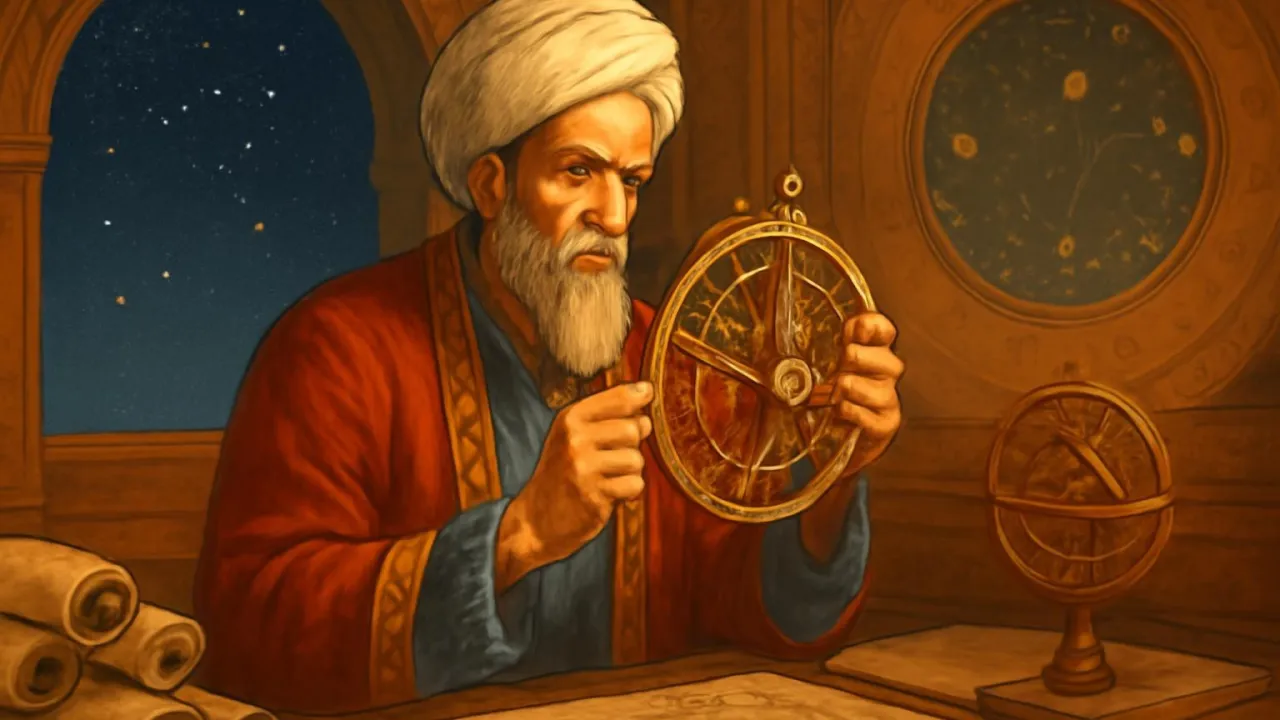
Nasir’s observatory had a giant 13-foot wall quadrant for measuring stars!
1 Curiosity Under the Persian Sky
As a young boy in Persia, Nasir al-Din al-Tusi would spend countless nights marveling at the stars. His fascination with the night sky inspired him to ask questions about how the universe worked and why the planets moved the way they did. This curiosity led him to study mathematics, astronomy, and philosophy with great enthusiasm. Even as a child, Nasir dreamed of building a place where people could explore the mysteries of space together.
2 Learning, Teaching, and Inventing
Nasir became a renowned scholar, reading ancient texts and learning from wise teachers across Persia. He mastered the use of the astrolabe, a complex instrument for measuring star positions, and taught others how to draw accurate maps. His dedication to learning helped him become a teacher himself, guiding many students in science and math. Nasir’s inventive mind led him to create new mathematical ideas to solve difficult astronomy problems.
3 The Maragha Observatory: A Center of Discovery
With support from a Mongol ruler, Nasir founded the Maragha Observatory, which became a hub for scientists from many lands. The observatory was filled with advanced tools for observing the sky, and teams of scholars worked together to record and explain what they saw. Nasir invented the Tusi-couple, a mathematical model that made it possible to describe complex planetary motions. His observatory’s discoveries set new standards for scientific research in astronomy.
4 A Lasting Legacy in Science
Nasir al-Din al-Tusi’s books and inventions traveled far beyond Persia, influencing scientists in Europe and Asia. His mathematical ideas helped later thinkers, such as Copernicus, develop new models of the solar system. Nasir’s work in philosophy also encouraged people to ask deep questions about the universe. Today, he is remembered as one of the greatest scientists of the , whose curiosity and inventions changed the world.
1. Why was the Maragha Observatory important?
2. Who did Nasir’s work help in the future?