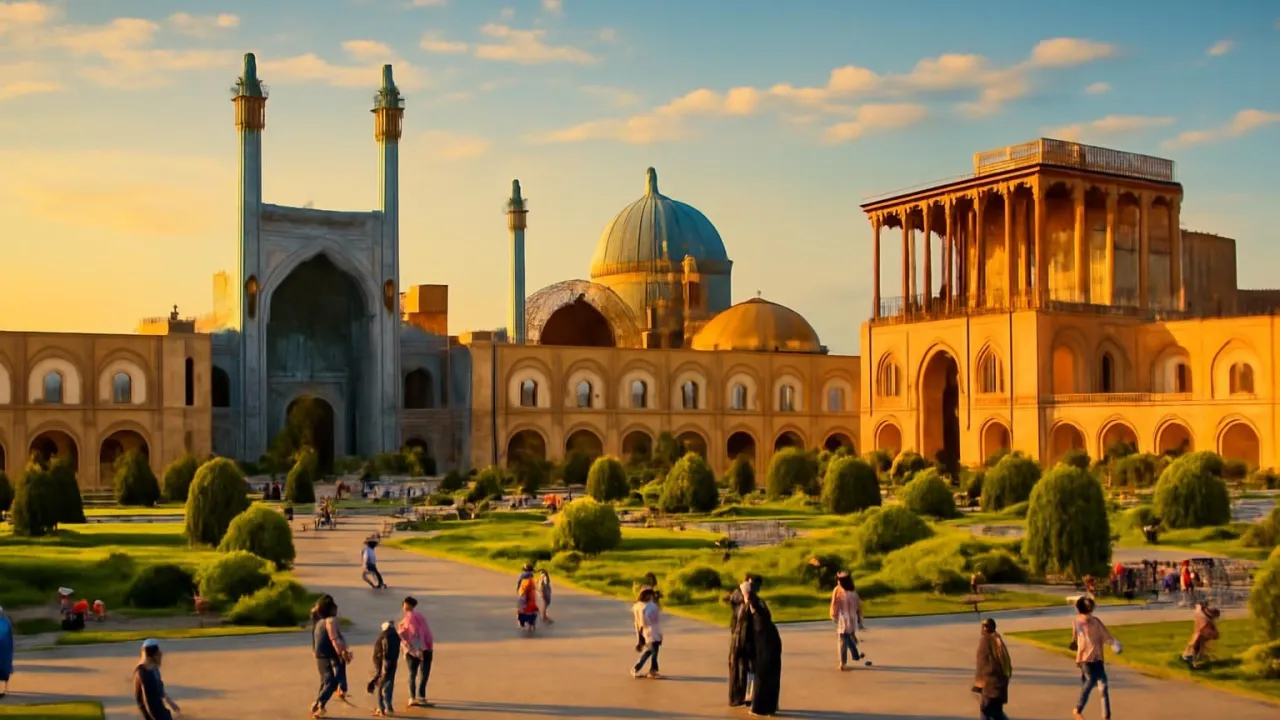
The square is so big that over 10,000 people can stand there at once!
✨ Word Sparks (Grade 2 Glossary)
Tap 🔊 to hear
bazaar
A busy market with many shops
pattern
A repeated design or shape
sunset
When the sun goes down at night
🪝
What if you could run across a giant square full of colors?
1
A Giant Place in Iran
Naqsh-e Jahan Square is in Isfahan, Iran, and it is huge. People come here to walk, play, and see friends. The square is surrounded by tall buildings and shiny blue tiles.
2
Sounds and Sights
You can hear birds singing and horses trotting on the stone. The walls are covered with colorful and beautiful shapes. At , the square glows with golden light.
3
A Place for Everyone
Families picnic and children play games in the open space. Sometimes, people shop in the or watch music shows. Visitors come from all over the world to see this amazing square.
The square’s echo effect lets a single clap bounce across the whole plaza!
✨ Word Sparks (Grade 3 Glossary)
Tap 🔊 to hear
arch
A curved shape that holds up buildings
vibrate
To move quickly back and forth
dynasty
A family that rules for many years
🪝
What echoes would you hear standing in a square bigger than a castle?
1
A Square of Surprises
Naqsh-e Jahan Square stretches across the heart of Isfahan, Iran. Its name means 'Image of the World,' and it truly feels magical. The square is surrounded by grand , blue-tiled mosques, and a royal palace. People gather here to enjoy festivals, music, and lively markets.
2
Amazing Architecture
The square was built during the Safavid over 400 years ago. Engineers designed strong stone foundations and graceful to hold up the tall buildings. Blue and turquoise tiles create patterns that shimmer in the sunlight. The square’s open space lets sound and echo, making music and laughter travel far.
3
A Place Full of Life
Vendors sell colorful carpets and sweet treats in the bazaar along the edges. Children play games while families picnic on the grass. On special days, you might see parades or hear the call to prayer from the mosques. Visitors from all over the world come to admire the beauty and history.
4
Why It Matters
Naqsh-e Jahan Square is a UNESCO World Heritage site because of its cultural and architectural importance. The square shows how people can design spaces for both fun and tradition. Its , domes, and patterns inspire artists and builders everywhere. The square reminds us how cities can bring people together.
The square once hosted royal polo games, with the king himself watching from the palace balcony!
✨ Word Sparks (Grade 4 Glossary)
Tap 🔊 to hear
acoustic
Related to how sound moves and echoes
calligraphy
Fancy handwriting used as art
geometric
Made of shapes like circles and squares
🪝
Imagine your footsteps echoing across a plaza where kings once watched polo games—what would you see and hear?
1
A Persian Masterpiece
Naqsh-e Jahan Square, also called Imam Square, was constructed in Isfahan during the Safavid dynasty between 1598 and 1629. Its name means 'Image of the World,' reflecting its role as a gathering place for people from many backgrounds. The square is bordered by the Shah Mosque, Sheikh Lotfollah Mosque, Ali Qapu Palace, and the bustling Grand Bazaar. Its enormous size and stunning blue tilework make it a symbol of Persian art and architecture.
2
Ingenious Engineering
Architects and engineers designed the square with precise measurements and strong stone foundations to support the grand buildings. The use of arches and domes allows the structures to remain stable and resist earthquakes. The open plaza creates unique effects, letting sounds vibrate and echo across the space. Decorative tiles, patterns, and cover the walls, showing both mathematical skill and artistic beauty.
3
A Center of Life and Culture
For centuries, Naqsh-e Jahan Square has been a center for celebrations, markets, and royal ceremonies. In the past, kings watched polo matches and parades from the palace balcony. Today, families gather for picnics, children play, and vendors sell crafts and sweets in the bazaar. The square’s design encourages people to meet, share stories, and enjoy music and festivals together.
4
A Global Treasure
Recognized as a UNESCO World Heritage site, the square is admired around the world for its cultural and architectural significance. Its influence can be seen in city squares and public spaces far beyond Iran. Naqsh-e Jahan Square stands as a reminder of how thoughtful design can unite communities and celebrate both tradition and creativity.
The square’s precise proportions allow a person’s voice to be heard from one end to the other thanks to its acoustic design!
✨ Word Sparks (Grade 5 Glossary)
Tap 🔊 to hear
resonance
When sound vibrates and travels clearly
tessellation
A pattern made of repeated shapes with no gaps
proportion
The balanced size and shape of parts in a design
🪝
What secrets of art, math, and sound would you discover if you spent a day in Isfahan’s Naqsh-e Jahan Square?
1
A Vision of the World in Stone and Tile
Naqsh-e Jahan Square, constructed between 1598 and 1629 during the Safavid dynasty, remains one of the world’s largest and most influential public plazas. Its Persian name, meaning 'Image of the World,' reflects the ambition of Shah Abbas I to create a space that represented the unity and diversity of his empire. Measuring 525 feet wide and 1,640 feet long, the square is framed by four architectural masterpieces: the Shah Mosque, Sheikh Lotfollah Mosque, Ali Qapu Palace, and the Qeysarie Gate leading to the Grand Bazaar.
2
Architectural and Engineering Marvels
The square’s design incorporates advanced engineering principles, including precisely calculated stone foundations and the strategic use of arches and domes to distribute weight and resist seismic forces. The Shah Mosque’s main dome rises 177 feet (54 meters) high, demonstrating mastery of both structural mechanics and acoustic . The open plaza’s geometry creates a unique soundscape, allowing voices and music to echo clearly across its vast expanse.
3
Mathematics and Artistic Innovation
The square and its surrounding buildings are adorned with intricate geometric patterns, calligraphy, and glazed tiles in shades of blue, turquoise, and gold. Safavid artisans used mathematical concepts like symmetry, , and to create visually harmonious designs that also serve structural purposes. The placement of each building was carefully planned to align with the cardinal directions, emphasizing both aesthetic beauty and urban organization.
4
A Hub of Culture, Commerce, and Ceremony
Throughout history, Naqsh-e Jahan Square has served as a stage for royal ceremonies, polo matches, public gatherings, and bustling markets. The Ali Qapu Palace’s balcony provided the Safavid kings with a panoramic view of festivities below. Today, the square remains a vibrant center where families picnic, children play, and artisans sell traditional crafts, while visitors from around the world marvel at its enduring grandeur.
5
Legacy and Global Significance
Designated a UNESCO World Heritage site in 1979, Naqsh-e Jahan Square has influenced urban planning and architectural design across continents. Its harmonious blend of function, beauty, and community engagement stands as a testament to the ingenuity of Persian civilization. The square’s enduring popularity demonstrates how thoughtful design can foster social connection, celebrate cultural identity, and inspire future generations of artists and engineers.